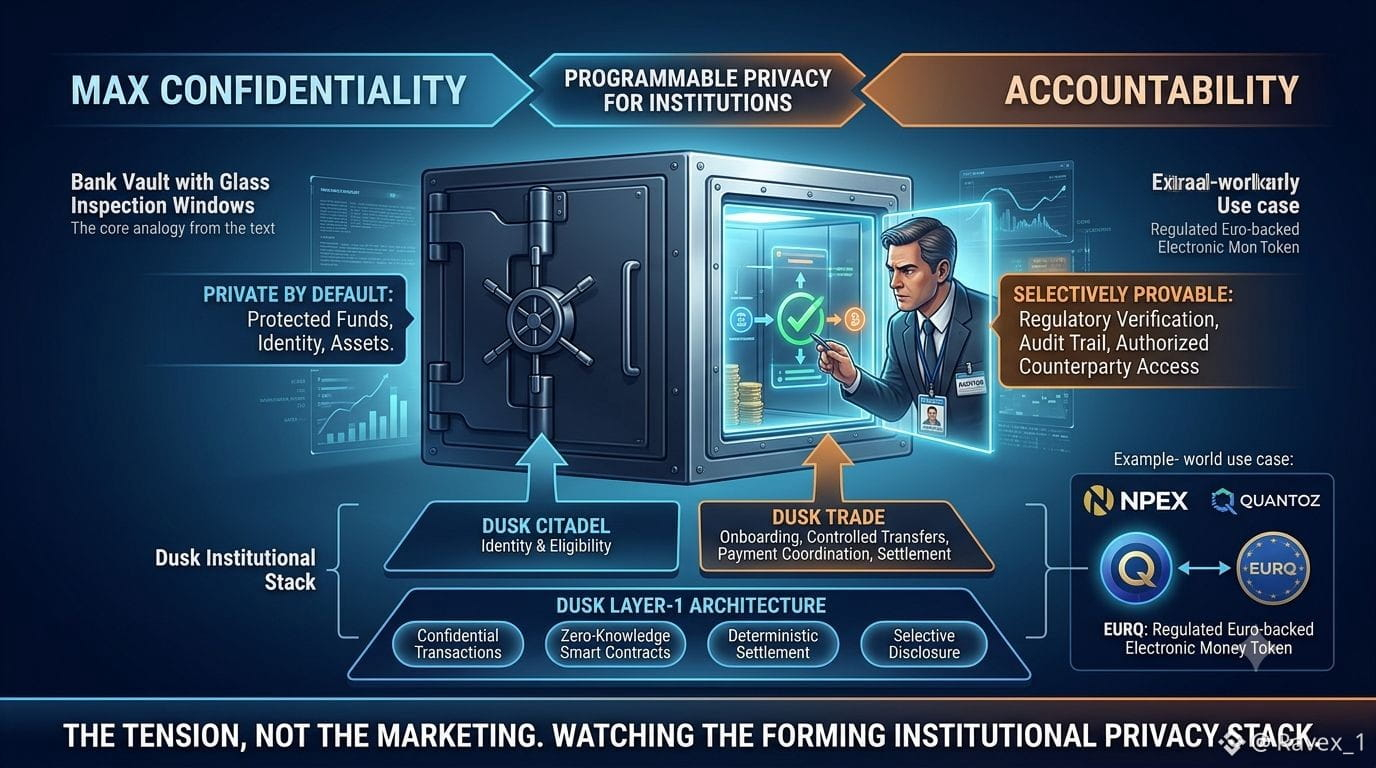
I’ve started looking at Dusk differently lately. At first, “privacy blockchain for finance” sounds like another familiar crypto pitch. But the deeper I look, the more I think the important distinction is not privacy versus transparency. It is private by default, but selectively provable when required.
I think of it like a bank vault with glass inspection windows. The money and sensitive details stay protected, but a regulator, auditor, or authorized counterparty can still verify exactly what they are entitled to see.
That is where Dusk’s architecture gets interesting. Its Layer-1 combines confidential transactions, zero-knowledge smart contracts, deterministic settlement, and selective disclosure. Then layers such as Citadel handle identity and eligibility, while Dusk Trade is being built around actual market workflows like onboarding, controlled transfers, payment coordination, and settlement.
The real signal for me is the institutional stack forming around it. Dusk, NPEX and Quantoz worked on EURQ, a regulated euro-backed electronic money token, connecting a regulated exchange, payment infrastructure and blockchain.
That matters because institutions don’t simply need “private transactions.” They need privacy without losing accountability.
But that creates the harder question: can Dusk make confidentiality programmable enough for regulators while keeping it genuinely useful for institutions?
That tension, not the marketing, is what I’m watching.
@Dusk #dusk $DUSK
I think of it like a bank vault with glass inspection windows. The money and sensitive details stay protected, but a regulator, auditor, or authorized counterparty can still verify exactly what they are entitled to see.
That is where Dusk’s architecture gets interesting. Its Layer-1 combines confidential transactions, zero-knowledge smart contracts, deterministic settlement, and selective disclosure. Then layers such as Citadel handle identity and eligibility, while Dusk Trade is being built around actual market workflows like onboarding, controlled transfers, payment coordination, and settlement.
The real signal for me is the institutional stack forming around it. Dusk, NPEX and Quantoz worked on EURQ, a regulated euro-backed electronic money token, connecting a regulated exchange, payment infrastructure and blockchain.
That matters because institutions don’t simply need “private transactions.” They need privacy without losing accountability.
But that creates the harder question: can Dusk make confidentiality programmable enough for regulators while keeping it genuinely useful for institutions?
That tension, not the marketing, is what I’m watching.
@Dusk #dusk $DUSK