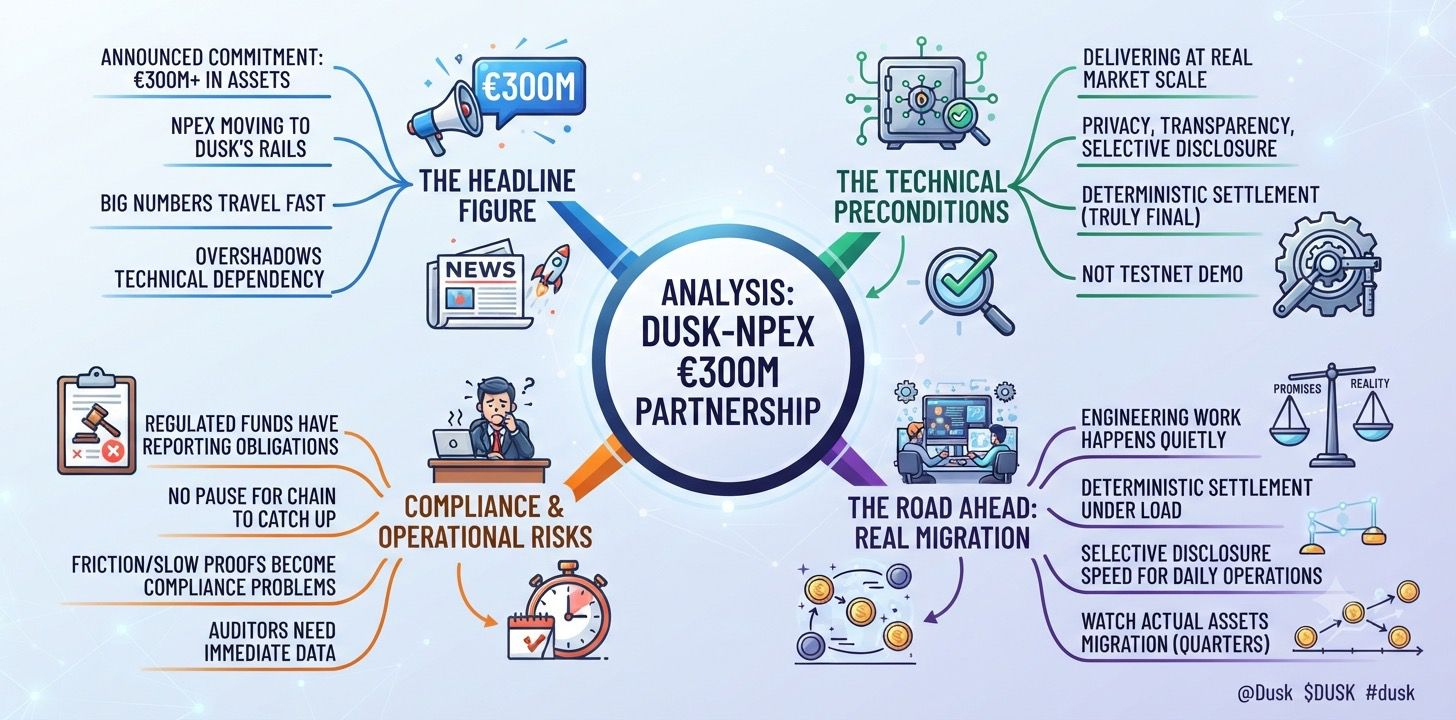
Big numbers travel faster than the infrastructure behind them, and €300M is exactly the kind of figure that gets repeated across headlines long before anyone checks what has to be true for it to become real. Dusk Network's NPEX partnership carries that number, and separating the number from the technical dependency underneath it is worth doing slowly instead of just once.
NPEX has committed to moving more than €300M in assets onto Dusk's rails. That commitment depends entirely on the base layer actually delivering privacy, transparency, selective disclosure, and deterministic settlement at the scale a real securities market requires, not a testnet demonstration with a handful of transactions. Regulated funds and bonds carry reporting obligations that do not pause for a chain to catch up technically, and any friction, slow disclosure proofs, settlement that is not truly final, becomes a compliance problem for NPEX, not just a technical inconvenience for Dusk. A fund administrator cannot tell an auditor that the blockchain was still finishing its proof generation when the reporting deadline passed.
This is the part most coverage skips. The announcement gets the headline. The engineering work of proving deterministic settlement holds under real load, or that selective disclosure can generate proofs fast enough for daily fund operations, happens quietly afterward and rarely gets its own headline at all, even though it is the part that actually determines whether €300M shows up onchain or quietly becomes €30M over a longer timeline than announced.
I am not betting against Dusk here, just refusing to treat the number as already real. A properly built settlement and disclosure layer is a precondition, not a guarantee, and the honest way to track this story is by watching actual assets migrate over the next several quarters, not by re-quoting the same figure every time it comes up.
#dusk $DUSK @Dusk