
been reading the creator pad campaign @Dusk and end up to went into Dusk’s reward docs expecting the APY to be the interesting part.
Instead, I kept coming back to who gets paid, how much, and when.
That became more interesting because of what happened on August 16.
Dusk flagged suspicious activity involving a team-managed wallet connected to bridge operations. The response was quick: affected bridge addresses were disabled/recycled, the bridge was paused, and a Web Wallet recipient blocklist was pushed live the same day.
Good incident response. But it also made me look more closely at the other side of security: how consensus participants are actually rewarded.
Here’s what stood out:
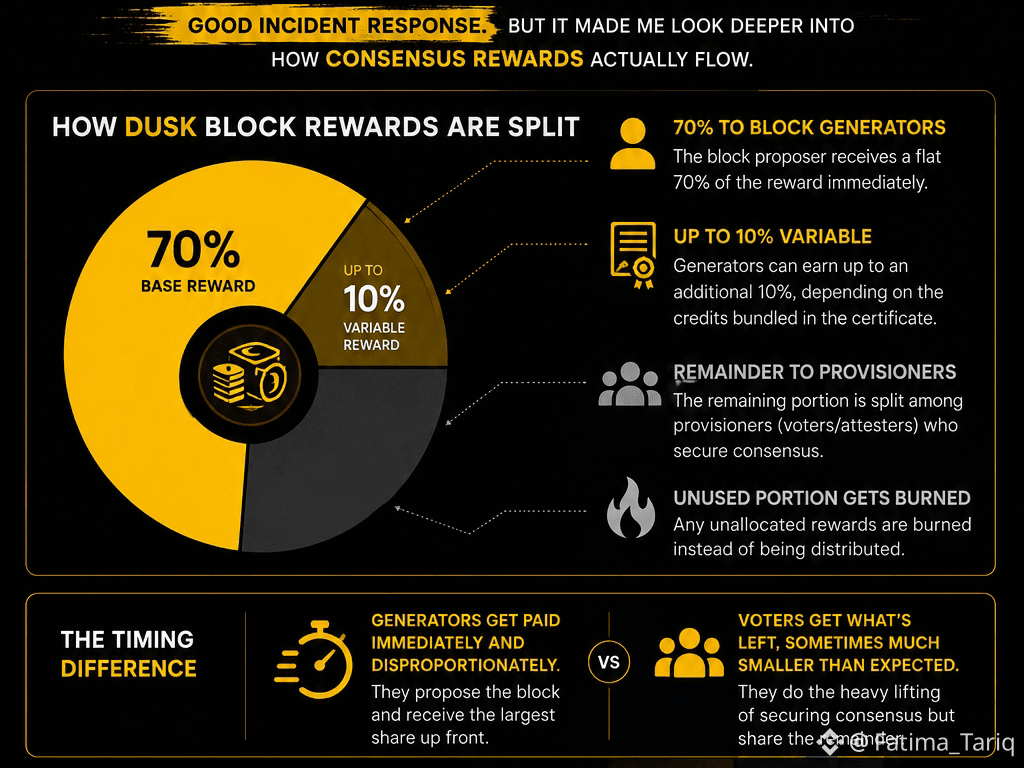
• Block generators receive 70% of the reward as the base share.
• They can receive up to another 10%, depending on the credits bundled into the certificate.
• Provisioners , the participants voting and attesting to blocks , divide the remaining reward.
• If part of the reward isn't allocated, it can be burned rather than distributed.
That creates a reward structure where the person generating the block can receive a significantly larger portion upfront, while the participants helping finalize consensus compete for the remainder.
And that's the part I think is easy to miss when you simply read “consensus participants share rewards.”
The design itself isn't necessarily a problem. Different PoS networks use different incentives to balance block production, voting, and network security.
But after looking at the numbers, one question feels more important than the headline APY:
How often does that additional 10% actually get paid to generators, and how often does it end up being burned?
Because the theoretical split and the real-world reward flow could look very different.
And after a bridge incident, understanding where incentives actually move feels just as important as understanding how quickly the team can react.
#dusk $DUSK @Dusk
Instead, I kept coming back to who gets paid, how much, and when.
That became more interesting because of what happened on August 16.
Dusk flagged suspicious activity involving a team-managed wallet connected to bridge operations. The response was quick: affected bridge addresses were disabled/recycled, the bridge was paused, and a Web Wallet recipient blocklist was pushed live the same day.
Good incident response. But it also made me look more closely at the other side of security: how consensus participants are actually rewarded.
Here’s what stood out:
• Block generators receive 70% of the reward as the base share.
• They can receive up to another 10%, depending on the credits bundled into the certificate.
• Provisioners , the participants voting and attesting to blocks , divide the remaining reward.
• If part of the reward isn't allocated, it can be burned rather than distributed.
That creates a reward structure where the person generating the block can receive a significantly larger portion upfront, while the participants helping finalize consensus compete for the remainder.
And that's the part I think is easy to miss when you simply read “consensus participants share rewards.”
The design itself isn't necessarily a problem. Different PoS networks use different incentives to balance block production, voting, and network security.
But after looking at the numbers, one question feels more important than the headline APY:
How often does that additional 10% actually get paid to generators, and how often does it end up being burned?
Because the theoretical split and the real-world reward flow could look very different.
And after a bridge incident, understanding where incentives actually move feels just as important as understanding how quickly the team can react.
#dusk $DUSK @Dusk