You know, a buddy of mine asked me the other day:
“Why can’t Wall Street just use regular public blockchains for everything and get it over with?”
Fair question. It also exposes one of the biggest problems with putting regulated finance on fully transparent rails.
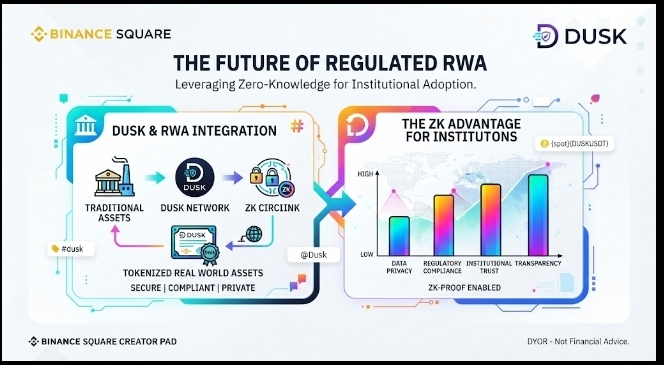
If a large institution moves trades, positions or sensitive ownership data onto a public chain, transparency can become a liability. Competitors can potentially observe flows, while regulators still need a way to verify that transactions follow the rules.
For a long time, I assumed privacy and compliance were basically opposites.
Then I started digging deeper into what @Dusk is actually building.
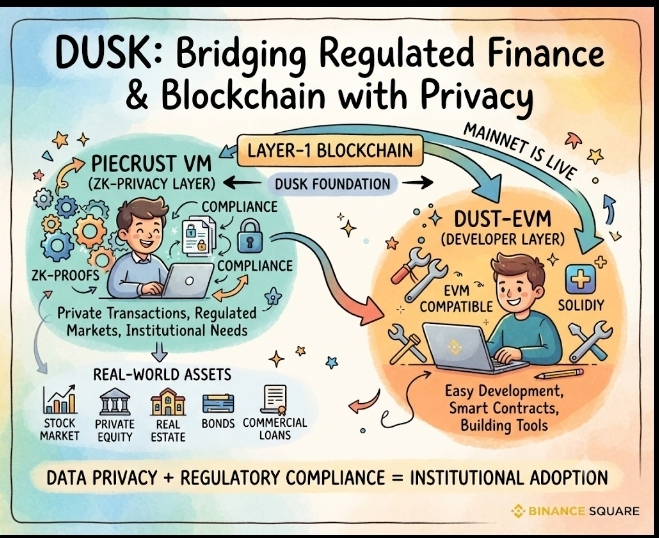
Dusk’s architecture combines two execution environments: the Piecrust VM and DuskEVM.
Piecrust is designed around Dusk’s privacy-oriented execution model, while DuskEVM provides compatibility with the EVM ecosystem and Solidity tooling. That matters because institutional adoption doesn’t only depend on cryptography; developers also need infrastructure they already understand.
The bigger idea clicked for me when I mapped this against tokenized securities.
Imagine a regulated bond market on-chain.
The network needs to establish that a transfer is valid and compliant. But the entire market shouldn’t necessarily get a real-time view of every investor’s position, transaction details or portfolio activity.
It’s to make sensitive information private by default while preserving a mechanism for authorized parties to verify what they’re entitled to verify.
That’s a much more realistic design target for institutional finance.
And honestly, this is the part of Dusk I’m watching most closely.
Whether regulated assets actually generate repeat on-chain activity, liquidity and real economic settlement $DUSK
Because if that happens, the boring side of crypto might turn out to be the most important one.
Would you rather bet on infrastructure built for regulated capital markets, or does crypto still have more appetite for speculation than settlement?
#dusk
“Why can’t Wall Street just use regular public blockchains for everything and get it over with?”
Fair question. It also exposes one of the biggest problems with putting regulated finance on fully transparent rails.
If a large institution moves trades, positions or sensitive ownership data onto a public chain, transparency can become a liability. Competitors can potentially observe flows, while regulators still need a way to verify that transactions follow the rules.
For a long time, I assumed privacy and compliance were basically opposites.
Then I started digging deeper into what @Dusk is actually building.
Dusk’s architecture combines two execution environments: the Piecrust VM and DuskEVM.
Piecrust is designed around Dusk’s privacy-oriented execution model, while DuskEVM provides compatibility with the EVM ecosystem and Solidity tooling. That matters because institutional adoption doesn’t only depend on cryptography; developers also need infrastructure they already understand.
The bigger idea clicked for me when I mapped this against tokenized securities.
Imagine a regulated bond market on-chain.
The network needs to establish that a transfer is valid and compliant. But the entire market shouldn’t necessarily get a real-time view of every investor’s position, transaction details or portfolio activity.
It’s to make sensitive information private by default while preserving a mechanism for authorized parties to verify what they’re entitled to verify.
That’s a much more realistic design target for institutional finance.
And honestly, this is the part of Dusk I’m watching most closely.
Whether regulated assets actually generate repeat on-chain activity, liquidity and real economic settlement $DUSK
Because if that happens, the boring side of crypto might turn out to be the most important one.
Would you rather bet on infrastructure built for regulated capital markets, or does crypto still have more appetite for speculation than settlement?
#dusk