My friend looked at my dashboard the other day, squinted at the screen and asked:
“So both wallets say staked, right? What’s the big deal?”
That question stuck with me because a staking UI can make two very different setups look almost identical.
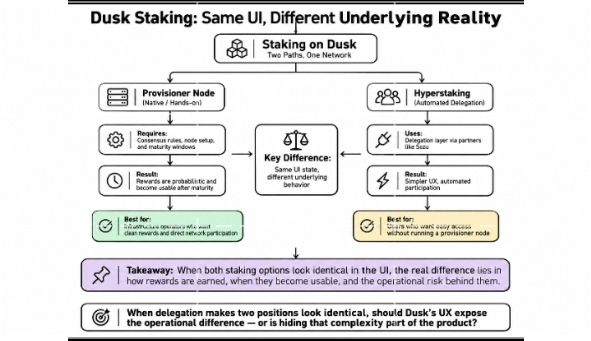
If I provision directly on @Dusk , I’m not simply locking $DUSK and collecting a number on a screen. I’m running the infrastructure that participates in consensus. Rusk explicitly separates a provisioner node from archive and prover roles, and the provisioner setup involves consensus keys, network configuration and an actual running node.
Then there’s stake abstraction.
Dusk’s own documentation describes Hyperstaking as allowing smart contracts to participate in staking, enabling things like staking pools and staking-as-a-service. Sozu is given as an example of an automated staking pool where users can stake without operating their own node.
That changes how I think about “convenience.”
The complexity hasn’t disappeared. The user simply stops touching some of it directly.
Rusk updates recent releases include changes around stake-event handling, wallet staking flows and provisioner-related functionality. The engineering surface underneath that simple “staked” label is considerably more complicated than the dashboard suggests.
It reminds me of driving an automatic car down an icy hill.
You appreciate the automation—until you suddenly need to understand what the transmission is doing.
That’s my bigger takeaway:
Abstraction doesn’t delete risk. It relocates responsibility.
So when I evaluate a staking product now, I’m not only asking:
“What's my yield?”
I’m asking:
Who actually controls the stake, who operates the infrastructure, what does the smart-contract layer control, and what happens when something breaks?
Because a clean interface is great.
But knowing what sits underneath it is even better.
How do you balance convenience with actually understanding the machinery behind your portfolio?
#dusk
“So both wallets say staked, right? What’s the big deal?”
That question stuck with me because a staking UI can make two very different setups look almost identical.
If I provision directly on @Dusk , I’m not simply locking $DUSK and collecting a number on a screen. I’m running the infrastructure that participates in consensus. Rusk explicitly separates a provisioner node from archive and prover roles, and the provisioner setup involves consensus keys, network configuration and an actual running node.
Then there’s stake abstraction.
Dusk’s own documentation describes Hyperstaking as allowing smart contracts to participate in staking, enabling things like staking pools and staking-as-a-service. Sozu is given as an example of an automated staking pool where users can stake without operating their own node.
That changes how I think about “convenience.”
The complexity hasn’t disappeared. The user simply stops touching some of it directly.
Rusk updates recent releases include changes around stake-event handling, wallet staking flows and provisioner-related functionality. The engineering surface underneath that simple “staked” label is considerably more complicated than the dashboard suggests.
It reminds me of driving an automatic car down an icy hill.
You appreciate the automation—until you suddenly need to understand what the transmission is doing.
That’s my bigger takeaway:
Abstraction doesn’t delete risk. It relocates responsibility.
So when I evaluate a staking product now, I’m not only asking:
“What's my yield?”
I’m asking:
Who actually controls the stake, who operates the infrastructure, what does the smart-contract layer control, and what happens when something breaks?
Because a clean interface is great.
But knowing what sits underneath it is even better.
How do you balance convenience with actually understanding the machinery behind your portfolio?
#dusk