#dusk $DUSK @Dusk
Dusk and the quiet problem of who actually licenses a market
I've noticed most RWA threads talk about tokenization like it's a technical unlock. The logic seems clean enough: write the contract, mint the asset, ownership is settled onchain, done. For a while I accepted that framing too it fits how most of crypto already thinks about ownership. But reading through Dusk's NPEX material this week, that framing started to fall apart.
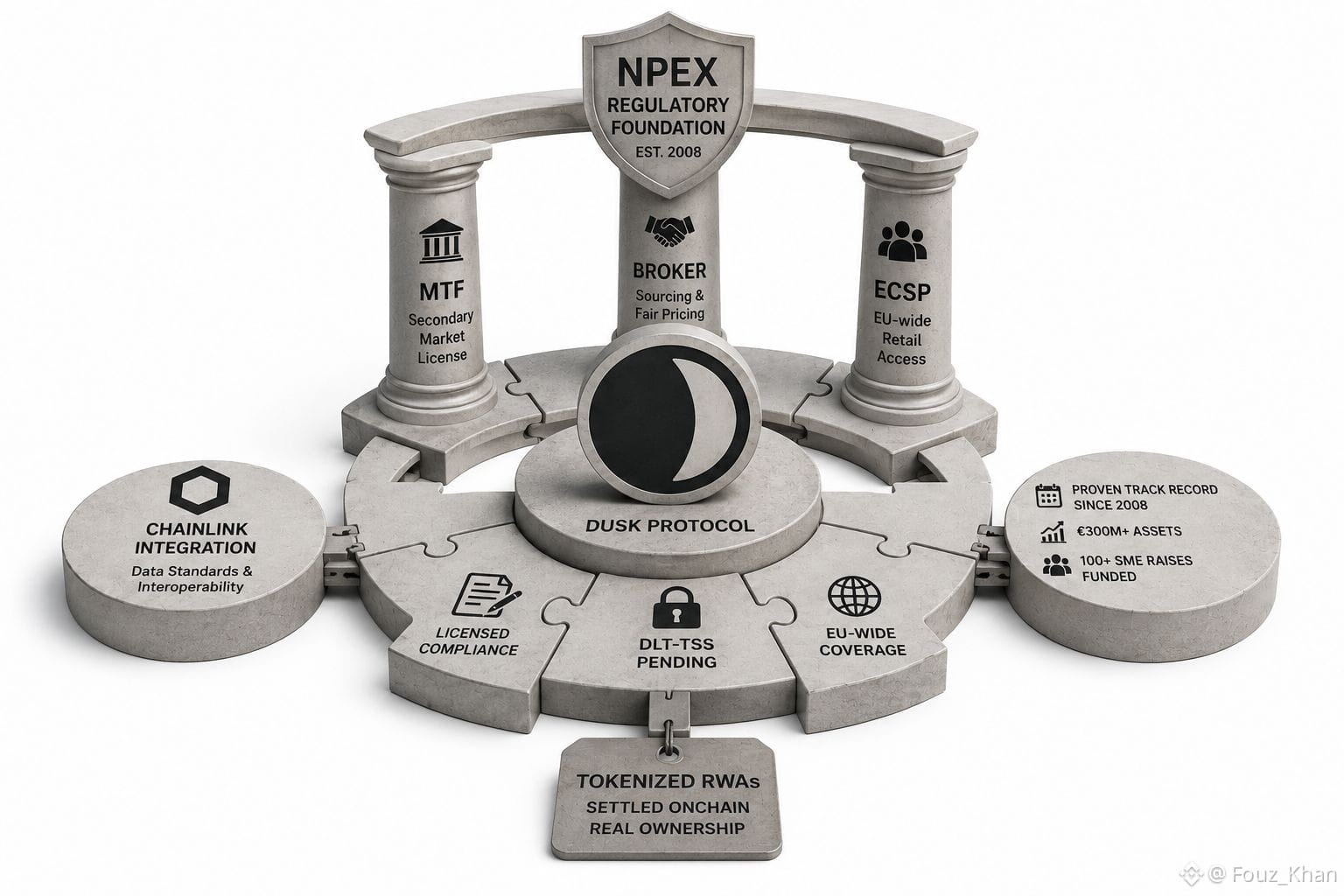
NPEX isn't a startup exchange Dusk is bootstrapping from zero. It's been operating since 2008, AFM regulated, pushing over €300M in assets through its own rails, and along the way, funded well over a hundred SME raises. That's not infrastructure Dusk is inventing it's infrastructure Dusk is inheriting, license and all. MTF, Broker, and now ECSP, with a fourth DLT TSS still pending.
What sits with me is what that stacking actually buys. MTF lets you run a secondary market. Broker lets you source instruments like bonds and money market funds. ECSP lets you offer retail funded investment products across the entire EU. Each one closes a gap a purely technical chain can't close on its own, no matter how good its zero knowledge stack is.
Then there's the Chainlink layer underneath, handling interoperability and data standards. Nobody's really asking what happens the day one of those regulated assets needs to settle somewhere Chainlink isn't watching.
The part I keep turning over: a license is only as good as the entity holding it. Dusk gets protocol level compliance because NPEX already earned it the slow, boring, pre blockchain way years of audits, real capital raised for real SMEs. Not something you replicate by writing better code.
So if regulatory coverage is the real moat here, not the cryptography what happens to every other privacy chain chasing RWA that doesn't have an NPEX to inherit from?
@Dusk $DUSK #dusk
$LINK
Dusk and the quiet problem of who actually licenses a market
I've noticed most RWA threads talk about tokenization like it's a technical unlock. The logic seems clean enough: write the contract, mint the asset, ownership is settled onchain, done. For a while I accepted that framing too it fits how most of crypto already thinks about ownership. But reading through Dusk's NPEX material this week, that framing started to fall apart.
NPEX isn't a startup exchange Dusk is bootstrapping from zero. It's been operating since 2008, AFM regulated, pushing over €300M in assets through its own rails, and along the way, funded well over a hundred SME raises. That's not infrastructure Dusk is inventing it's infrastructure Dusk is inheriting, license and all. MTF, Broker, and now ECSP, with a fourth DLT TSS still pending.
What sits with me is what that stacking actually buys. MTF lets you run a secondary market. Broker lets you source instruments like bonds and money market funds. ECSP lets you offer retail funded investment products across the entire EU. Each one closes a gap a purely technical chain can't close on its own, no matter how good its zero knowledge stack is.
Then there's the Chainlink layer underneath, handling interoperability and data standards. Nobody's really asking what happens the day one of those regulated assets needs to settle somewhere Chainlink isn't watching.
The part I keep turning over: a license is only as good as the entity holding it. Dusk gets protocol level compliance because NPEX already earned it the slow, boring, pre blockchain way years of audits, real capital raised for real SMEs. Not something you replicate by writing better code.
So if regulatory coverage is the real moat here, not the cryptography what happens to every other privacy chain chasing RWA that doesn't have an NPEX to inherit from?
@Dusk $DUSK #dusk
$LINK