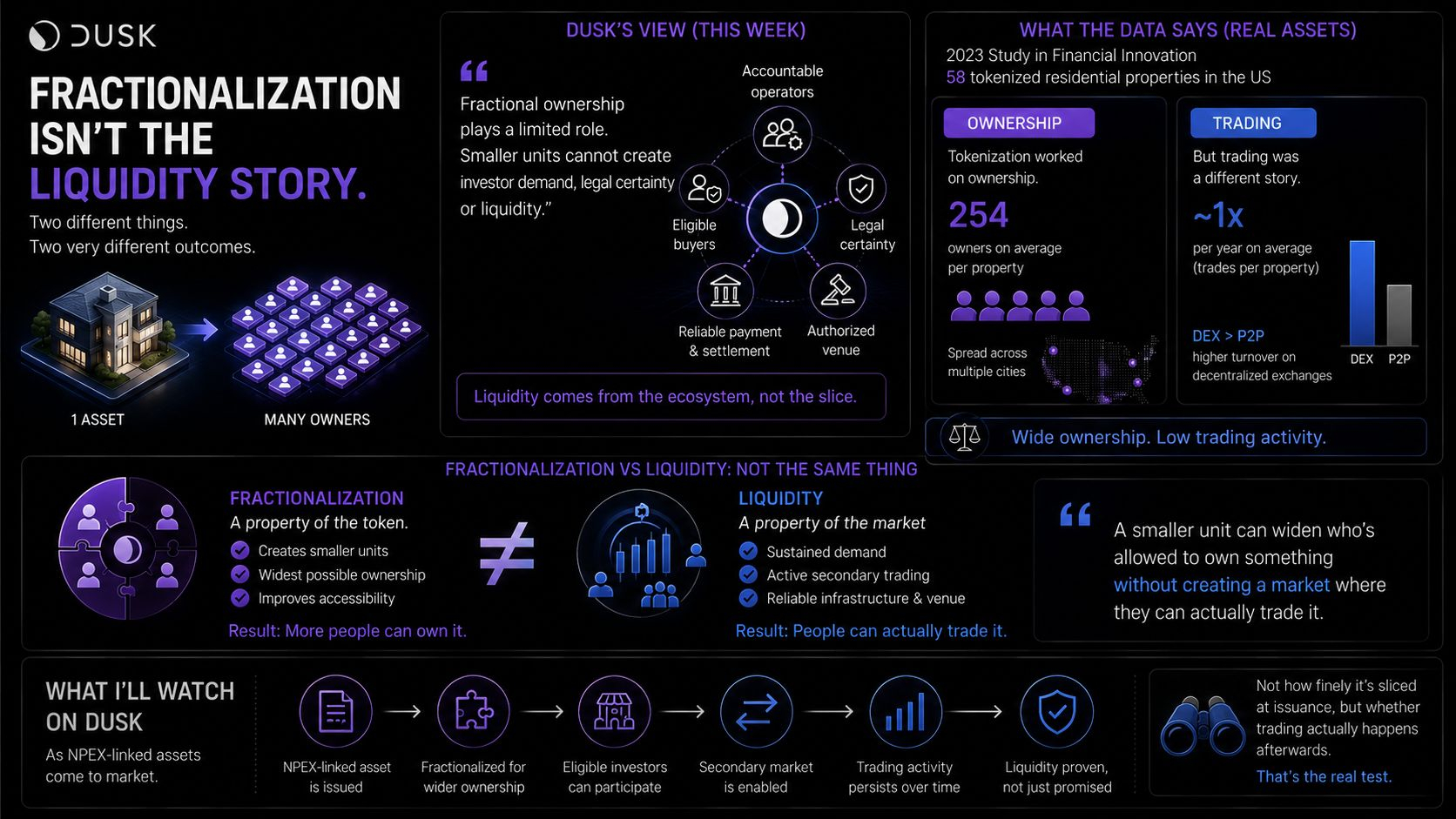
I assumed fractionalization was most of the liquidity story: split an asset into smaller pieces, and the pool of potential owners gets wider. Dusk's own writing on tokenization for SMEs, published this week, says that's a limited part of the picture, and an independent academic study of real tokenized assets shows why the gap matters.
Dusk says it plainly: "fractional ownership plays a limited role. Smaller units cannot create investor demand, legal certainty or liquidity." The value, they argue, comes from connecting the security to accountable operators, eligible buyers, reliable payment and settlement, and an authorized venue, not from how finely it's sliced.
A 2023 study published in Financial Innovation tested something close to this against real 58 tokenized residential properties in the US. On ownership, the results were clear: the average property had 254 separate owners. But on trading, the picture was different. Ownership changed hands about once a year on average, with properties on decentralized exchanges turning over more often than those traded peer-to-peer, though the yearly baseline stayed low either way.
Which means the two claims people conflate, "this asset is fractionalized" and "this asset is liquid," are actually describing two different things. Fractionalization is a property of the token. Liquidity is a property of the market around it.
"A smaller unit can widen who's allowed to own something without creating a market where they can actually trade it."
What I'd watch as NPEX-linked assets come onto Dusk: not how finely they're fractionalized at issuance, but whether secondary trading actually persists after that, the same gap the 58-property study found between wide ownership and active trading.
#dusk $DUSK @Dusk
Dusk says it plainly: "fractional ownership plays a limited role. Smaller units cannot create investor demand, legal certainty or liquidity." The value, they argue, comes from connecting the security to accountable operators, eligible buyers, reliable payment and settlement, and an authorized venue, not from how finely it's sliced.
A 2023 study published in Financial Innovation tested something close to this against real 58 tokenized residential properties in the US. On ownership, the results were clear: the average property had 254 separate owners. But on trading, the picture was different. Ownership changed hands about once a year on average, with properties on decentralized exchanges turning over more often than those traded peer-to-peer, though the yearly baseline stayed low either way.
Which means the two claims people conflate, "this asset is fractionalized" and "this asset is liquid," are actually describing two different things. Fractionalization is a property of the token. Liquidity is a property of the market around it.
"A smaller unit can widen who's allowed to own something without creating a market where they can actually trade it."
What I'd watch as NPEX-linked assets come onto Dusk: not how finely they're fractionalized at issuance, but whether secondary trading actually persists after that, the same gap the 58-property study found between wide ownership and active trading.
#dusk $DUSK @Dusk