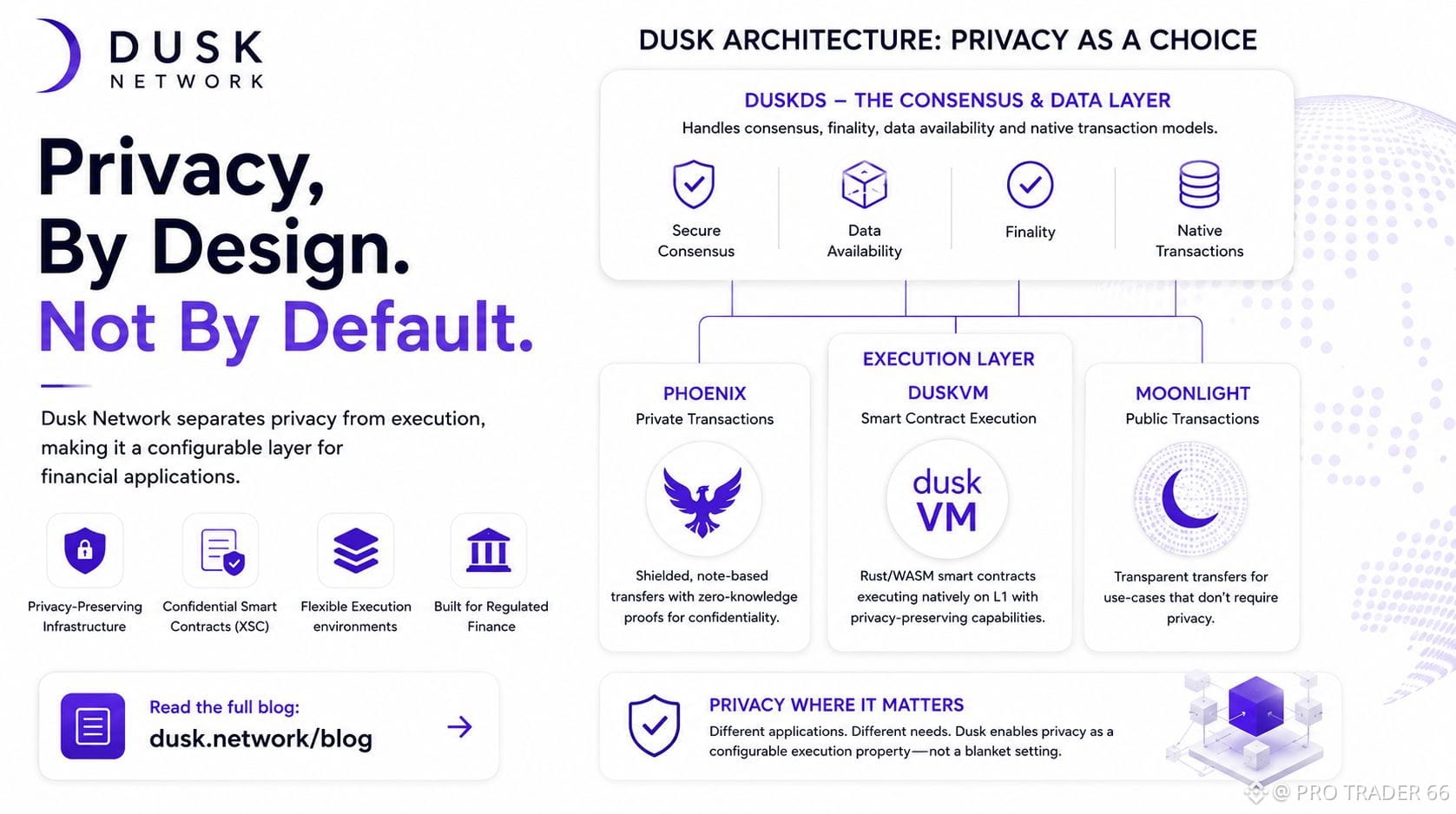
i went back through Dusk Network’s architecture and noticed something i had initially overlooked: privacy isn’t treated as a single switch across the entire blockchain.
Dusk separates its base layer, DuskDS, from execution environments such as DuskVM, where Rust/WASM contracts can run directly on the L1. Its transaction model also distinguishes between public and privacy-preserving transfers.
What caught my attention is how this connects privacy with the broader blockchain design. Instead of making the whole network opaque, Dusk appears to be building different execution and transaction paths so applications can decide what information needs to remain private.
That matters especially for financial applications, where privacy and auditability often pull in opposite directions.
But there is a real trade-off: privacy-preserving computation introduces additional cryptographic and operational complexity. The architecture may be technically capable, but production-scale performance and sustained adoption still need to prove the model.
So i don’t see Dusk simply as a privacy blockchain. I see it as an attempt to make privacy part of blockchain infrastructure itself.
The question i’m watching is simple: can Dusk balance privacy, transparency, performance, and regulatory requirements without making the user experience too complex?
@Dusk #dusk $DUSK
Dusk separates its base layer, DuskDS, from execution environments such as DuskVM, where Rust/WASM contracts can run directly on the L1. Its transaction model also distinguishes between public and privacy-preserving transfers.
What caught my attention is how this connects privacy with the broader blockchain design. Instead of making the whole network opaque, Dusk appears to be building different execution and transaction paths so applications can decide what information needs to remain private.
That matters especially for financial applications, where privacy and auditability often pull in opposite directions.
But there is a real trade-off: privacy-preserving computation introduces additional cryptographic and operational complexity. The architecture may be technically capable, but production-scale performance and sustained adoption still need to prove the model.
So i don’t see Dusk simply as a privacy blockchain. I see it as an attempt to make privacy part of blockchain infrastructure itself.
The question i’m watching is simple: can Dusk balance privacy, transparency, performance, and regulatory requirements without making the user experience too complex?
@Dusk #dusk $DUSK