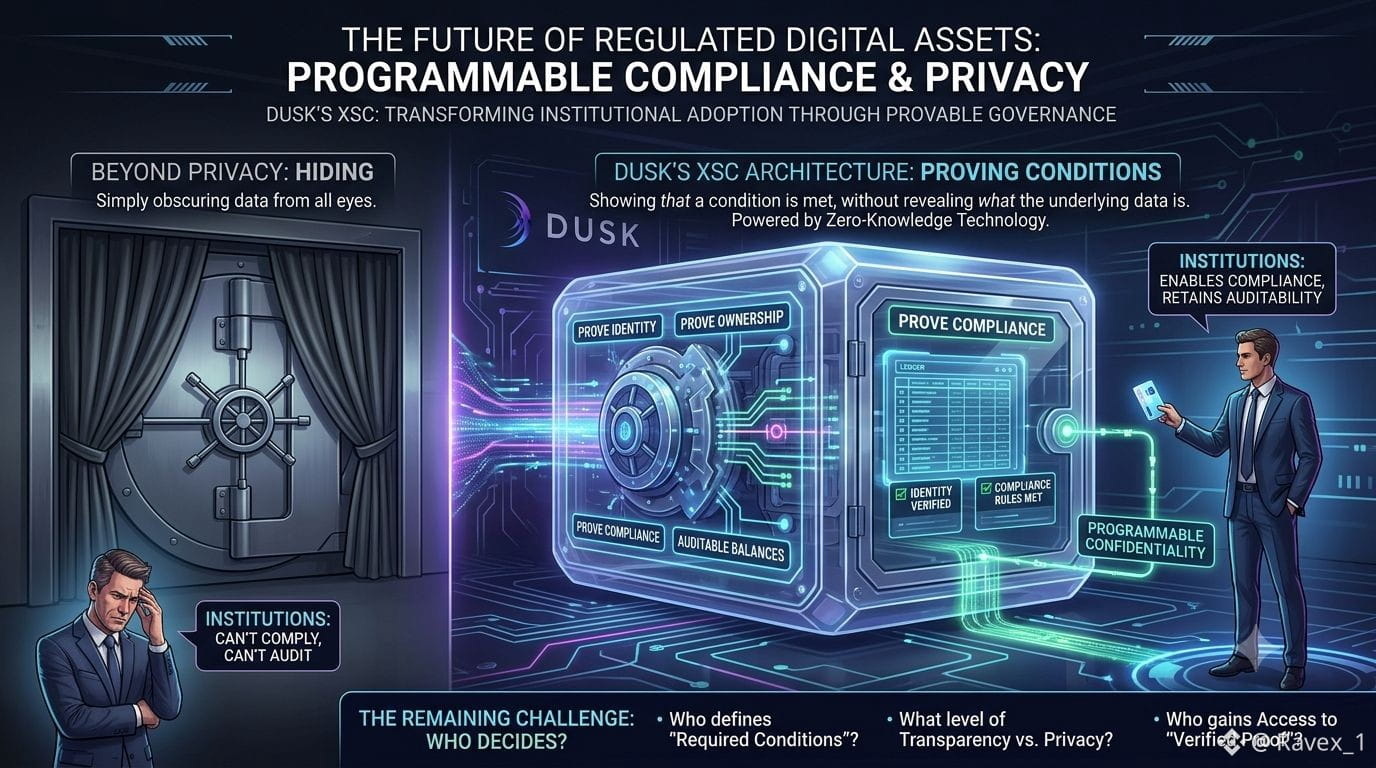
I don’t think the interesting part of Dusk is simply “privacy.” The overlooked distinction is between hiding information and controlling what information can be proven. Dusk’s Confidential Security Contract (XSC) architecture is built around that second idea.
I think of it like a bank vault with a transparent verification window. You don’t show everyone what is inside, but you can still prove that the required conditions are satisfied. Zero-knowledge technology makes that model possible: a party can prove something is true without revealing the underlying sensitive data.
That matters enormously for regulated assets. Institutions need auditability, identity controls, ownership rules, and compliance, but they also cannot realistically put every investor balance or transaction detail into public view.
Dusk’s confidential smart contracts and XSC framework attempt to make those requirements programmable at the blockchain layer rather than bolted on afterward.
But this creates the harder question I keep coming back to: if financial privacy becomes programmable, who decides exactly what must remain private, what must be provable, and who gets access to that proof?
For institutional adoption, that governance question may matter just as much as the
@Dusk #dusk $DUSK
I think of it like a bank vault with a transparent verification window. You don’t show everyone what is inside, but you can still prove that the required conditions are satisfied. Zero-knowledge technology makes that model possible: a party can prove something is true without revealing the underlying sensitive data.
That matters enormously for regulated assets. Institutions need auditability, identity controls, ownership rules, and compliance, but they also cannot realistically put every investor balance or transaction detail into public view.
Dusk’s confidential smart contracts and XSC framework attempt to make those requirements programmable at the blockchain layer rather than bolted on afterward.
But this creates the harder question I keep coming back to: if financial privacy becomes programmable, who decides exactly what must remain private, what must be provable, and who gets access to that proof?
For institutional adoption, that governance question may matter just as much as the
@Dusk #dusk $DUSK