



Central Bank Digital Currencies (CBDCs) and stablecoins are changing how digital money works by offering both state-backed and privately issued forms of digital cash.
The main differences between CBDCs and stablecoins are:
Issuer: CBDCs are central-bank issued; stablecoins are privately issued.
Backing: CBDCs use state reserves; stablecoins use collateral or algorithms.
Purpose: CBDCs support policy; stablecoins enable private payments.
In this guide, you’ll learn everything about CBDCs and stablecoins, and by the end, you’ll be able to differentiate between the two and understand their role in the future of digital money.
Key Takeaways:
CBDCs are digital money from governments; stablecoins are digital money from private companies.
CBDCs are backed by central banks and are legal tender; stablecoins are backed by reserves or code and can carry more risk.
CBDCs aim to support faster payments and financial inclusion; stablecoins focus on flexibility, global use, and low-cost transfers.
Risks differ: CBDCs raise privacy concerns, while stablecoins can lose value (depeg) or face uncertain rules.
Both show how the future of money may mix government control with private innovation.
What are CBDCs and how do they work?
CBDCs are digital forms of money issued by a central bank. They are a direct liability of the state, not a commercial bank. They are denominated 1:1 with the national currency, and recognized as legal tender (can be used to pay off debt).
Permissioned blockchains or centralized ledgers can be used by CBDCs. Users access them via digital wallets, with rules enforced by the central bank and regulated intermediaries.
CBDCs can support instant settlement, programmability, and fine-grained limits. They may integrate with fast payment systems, or new rails for wholesale settlement.
The difference between retail and wholesale CBDCs
Retail CBDCs are designed for the public for daily payments (buying groceries, receiving salaries etc.). They mirror cash but in a digital format, with wallet thresholds and privacy tiers.
Wholesale CBDCs are for financial institutions, streamlining settlement and liquidity. They aim to modernize payment systems like RTGs (Real-Time Gross Settlement) and DvPs (Delivery-versus-Payment) and improve how trades are settled.
Some jurisdictions prefer wholesale CBDCs, as private fast payment systems already work well for consumers. Others explore retail CBDCs for inclusion and resilience.
Why governments are pursuing digital currencies
Governments view CBDCs as tools for faster payments, financial inclusion, and policy control.
Some see CBDCs as an answer to the rise of private digital assets, improving competition, setting privacy standards, and gaining public trust to counter global stablecoins.
CBDCs can support cross-border pilots (testing), connecting central banks worldwide for instant foreign exchanges and settlement (as seen in mBridge and other CBDC projects).
Current CBDC implementations worldwide
As of July 2025, 137 countries, covering 98% of global GDP, are exploring CBDCs. 49 are currently in pilot, whilst a few have already launched.
Launched CBDCs like Bahamas’ Sand Dollar, Jamaica’s JAM-DEX, and Nigeria’s eNaira focus on domestic reach and access for the native population.
Piloting CBDCs like China’s e-CNY, the EU’s Digital Euro, and the UAE’s Digital Dirham are currently being designed and working towards a launch.
Forward look: CBDCs could make payments faster, and give governments new ways to manage the economy, helping more people access banking, while also changing how money moves around the world.
Understanding Stablecoins
What stablecoins are and their core mechanisms
Stablecoins are digital tokens pegged to a stable value via fiat, commodities, or crypto. They seek low volatility for payments, trading, and savings, delivered on public blockchains.
They are maintained via collateral reserves, over-collateralized crypto and algorithms that manage supply. Transparency varies depending on the issuer and model.
Types of stablecoins
Fiat-Backed
Fiat-backed stablecoins are pegged 1:1 to traditional currencies such as the US Dollar, which are held in reserve by an issuer or trust. Examples include USD₮ and EURC.
Commodity-Backed
Commodity-backed stablecoins derive their value from physical assets like gold or other commodities. While they can be useful for commodity settlement, they carry key risks related to storage and auditing. Examples include PAXG and XAUT.
Crypto-Backed
Crypto-backed stablecoins are secured by over-collateralization with volatile cryptocurrencies through smart contracts. Their stability is maintained by requiring excess collateral and implementing liquidation mechanisms. Examples include USDS and LUSD.
Algorithmic
Algorithmic stablecoins rely on code to automatically expand or contract supply in order to maintain their peg. However, the fragility of these designs was exposed by the Terra collapse in 2022 (UST).
Hybrid
Hybrid stablecoins combine offchain reserves with onchain mechanisms in order to balance capital efficiency with a robust peg. An example is FRAX.
Yield-Bearing
Yield-bearing stablecoins are backed by reserves that generate returns. Depending on the model, the yield may accrue to the issuer or be distributed to holders. An example is Ondo USDY.
Major stablecoins in the market
The global stablecoin market cap sits at over $287b (as of 11 September 2025). Leading stablecoins include USD₮, USDC, and USDS (previously DAI). Each has different backing models and market shares.
USD₮ alone holds ~59% of market share and remains the largest stablecoin with strong share in trading pairs and emerging market use. USDC has institutional traction as a regulated and transparent digital dollar. USDS leads crypto-backed designs by market cap.
Real-world use cases and adoption patterns
Annual stablecoin transfer volumes hit $27.6T in 2024, surpassing Visa and Mastercard combined volumes and signaling growing global use beyond crypto trading.
Real-world use cases include cross-border payments, merchant settlements, B2B invoices, treasury operations, and remittances with near-instant settlement.
Institutions are piloting onchain settlement with tokenized deposits and stablecoins, while still linking to the traditional banking system to accelerate transfers.
Forward look: Stablecoins are making it easier to send, spend, and save money online by enabling fast global payments, business transactions, and connecting traditional banks with the blockchain, showing that digital money could become a regular part of everyday finance.
Head-to-Head Comparison: CBDCs vs. Stablecoins
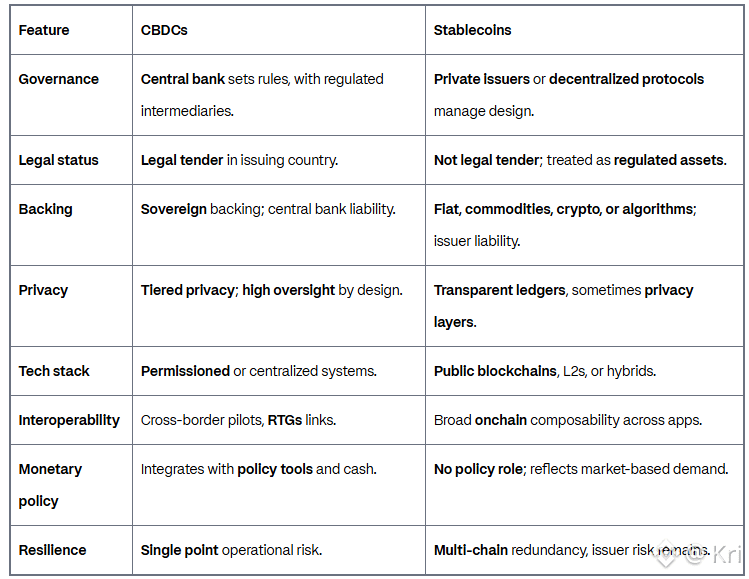
Governance and control: centralized authority vs. private issuance
CBDCs are controlled by the government, supporting oversight, anti-money laundering (AML) rules, and financial safety nets.
Stablecoins are controlled by private companies or protocols, with market rules like transparency, audits, and arbitrage helping keep them in check.
Backing and stability mechanisms
CBDCs are backed by the central bank. Holders can always redeem them because they are legal tender (can be used to pay off debt).
Stablecoins are backed by reserves like cash, government bonds, crypto, or algorithms. For example, USD₮ holds mostly T-bills (US Treasury bills), and USDC provides monthly reserve reports.
Privacy and surveillance implications
CBDCs can have some privacy features, but the government can see transactions. People trade convenience for privacy when they choose CBDCs over stablecoins.
Stablecoins operate on public blockchains, so transactions are visible for all to see, though some try to add privacy tech.
Technology infrastructure: blockchains vs. permissioned systems
CBDCs usually use private networks or central databases, enabling fast transactions and controlled access.
Stablecoins run on public blockchains like Ethereum, Solana, or Layer 2 networks, using open standards and Proof of Stake security.
Regulatory status and legal tender recognition
CBDCs are state-backed digital currency.
Stablecoins are getting clearer rules in the EU (MiCA) and U.S. (GENIUS Act 2025), covering reserves, disclosures, and anti-money laundering.
Forward look: While CBDCs and stablecoins have their own pros and cons, both show how the future of money could combine official control with private innovation, giving people and businesses more ways to pay, save, and move money worldwide.
