Haan, tumhari original style ko maintain karte hue—personal incident + Dusk governance insight + natural analytical ending—post aise better flow karegi:
#dusk $DUSK @Dusk almost turned my entire portfolio into dust 😭
I was doing a Dusk trading task and accidentally opened a much larger position than I intended. Luckily, I noticed it in time and closed it before liquidation.
That experience actually made me think about something else: when a proposed change to @Dusk actually becomes part of the protocol, what is the exact process?
Apparently, writing a convincing DIP is only the beginning.
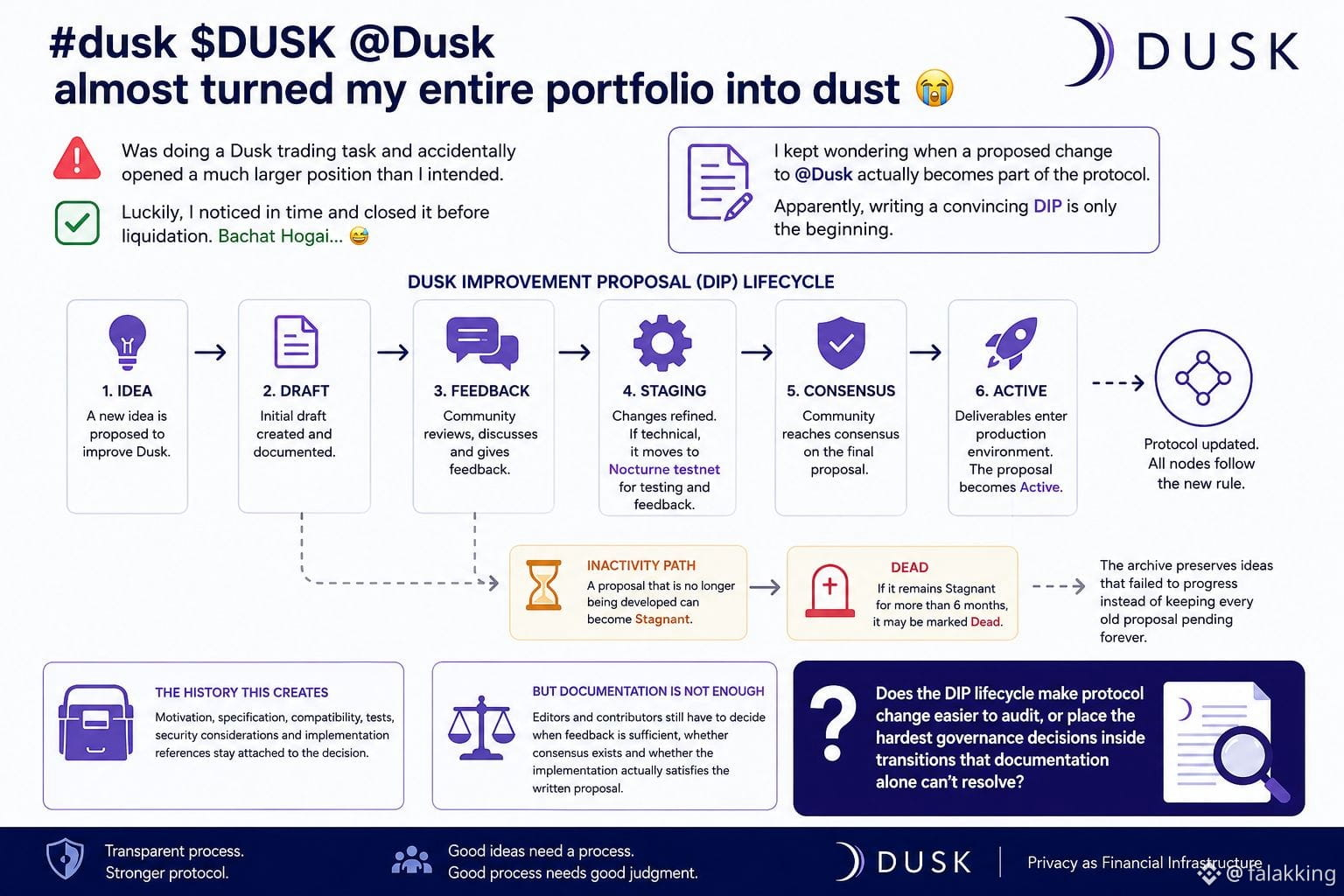
A Dusk Improvement Proposal moves through Idea, Draft and Feedback before reaching Staging. If it requires technical implementation, the staging phase puts it on the Nocturne testnet for another round of testing and feedback.
Only after consensus is reached and the deliverables enter the production environment does the proposal become Active.
That separation is important.
A merged document can preserve the specification, reasoning and discussion behind a change, but that doesn't automatically mean every node is already following the new rule on mainnet.
Proposal maturity and production activation are two different things.
There is also an inactivity path. A proposal that is no longer being developed can become Stagnant, and if it stays there for more than six months, it can eventually be marked Dead.
I actually like the history this creates. Motivation, specifications, compatibility, testing, security considerations and implementation references remain connected to the decision instead of disappearing into scattered discussions.
But documentation alone doesn't remove the hardest governance questions.
Someone still has to decide when feedback is sufficient, whether consensus really exists, and whether the final implementation actually matches what was proposed.
Does the DIP lifecycle make Dusk protocol changes easier to audit, or does it simply move the hardest governance decisions into transitions that documentation cannot
#dusk $DUSK @Dusk almost turned my entire portfolio into dust 😭
I was doing a Dusk trading task and accidentally opened a much larger position than I intended. Luckily, I noticed it in time and closed it before liquidation.
That experience actually made me think about something else: when a proposed change to @Dusk actually becomes part of the protocol, what is the exact process?
Apparently, writing a convincing DIP is only the beginning.
A Dusk Improvement Proposal moves through Idea, Draft and Feedback before reaching Staging. If it requires technical implementation, the staging phase puts it on the Nocturne testnet for another round of testing and feedback.
Only after consensus is reached and the deliverables enter the production environment does the proposal become Active.
That separation is important.
A merged document can preserve the specification, reasoning and discussion behind a change, but that doesn't automatically mean every node is already following the new rule on mainnet.
Proposal maturity and production activation are two different things.
There is also an inactivity path. A proposal that is no longer being developed can become Stagnant, and if it stays there for more than six months, it can eventually be marked Dead.
I actually like the history this creates. Motivation, specifications, compatibility, testing, security considerations and implementation references remain connected to the decision instead of disappearing into scattered discussions.
But documentation alone doesn't remove the hardest governance questions.
Someone still has to decide when feedback is sufficient, whether consensus really exists, and whether the final implementation actually matches what was proposed.
Does the DIP lifecycle make Dusk protocol changes easier to audit, or does it simply move the hardest governance decisions into transitions that documentation cannot