
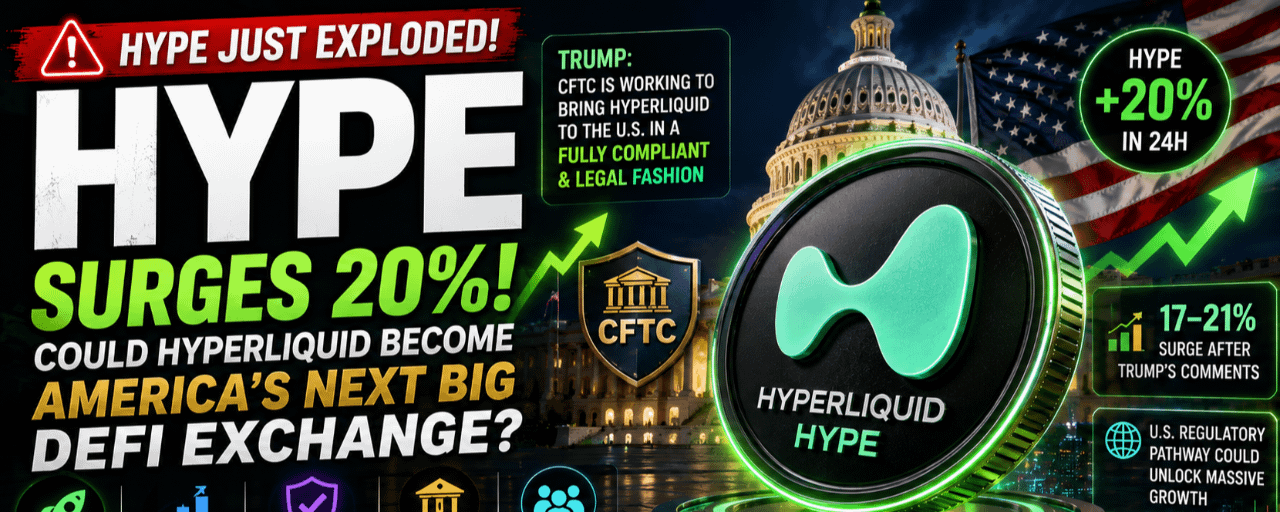

Hyperliquid is suddenly at the center of one of crypto’s biggest regulatory stories.
HYPE has surged sharply after U.S. President Donald Trump said that CFTC Chair Michael Selig is working on a path to bring Hyperliquid into the United States in a fully compliant and legal fashion.
The market reacted immediately.
HYPE climbed more than 17% in 24 hours, while other Hyperliquid-linked assets also rallied strongly.
But here's the question that matters:
Is HYPE's rally just another crypto pump—or could Hyperliquid actually become a major regulated U.S. derivatives platform?
🇺🇸 Why Trump's Comments Matter
Hyperliquid has built its reputation around on-chain perpetual futures trading, allowing users to trade derivatives around the clock.
Perpetual futures have become one of crypto's most important markets because traders can gain leveraged exposure without actually holding the underlying asset.
Hyperliquid has become a major player in that market.
And now the possibility of bringing that infrastructure into the U.S. is attracting serious attention.
Trump's comments specifically referenced the CFTC working toward a compliant route for Hyperliquid.
That doesn't mean Hyperliquid has already received approval.
It means the regulatory conversation has moved into a much more interesting phase.
🔥 HYPE's Reaction Was Immediate
HYPE jumped after Trump's remarks, with reports putting the move around 17%–21% depending on the measurement window.
The token moved toward the $70+ area, bringing it close to its previous record levels. One market report placed the recent peak around $76.87.
This is important because traders aren't only betting on today's price.
They're increasingly pricing in a potential future where:
Hyperliquid + U.S. regulation + institutional derivatives = much larger market opportunity.
🏦 Why the U.S. Market Could Be a Game Changer
The U.S. is one of the world's largest financial markets.
If Hyperliquid can eventually offer its on-chain derivatives infrastructure to U.S. traders through a compliant structure, the addressable market could expand dramatically.
And this is happening at a time when regulators are becoming more open to crypto derivatives.
The CFTC has already allowed regulated venues to move forward with bitcoin perpetual-style products, creating an important precedent for the broader derivatives market.
That makes Hyperliquid's situation particularly interesting.
The question is no longer simply:
“Can DeFi compete with centralized exchanges?”
It is becoming:
“Can on-chain markets become part of regulated American financial infrastructure?”
⚡ Hyperliquid Already Has a Major Advantage
Hyperliquid isn't an unknown project suddenly trying to enter the derivatives market.
The platform has already built significant activity around on-chain perpetuals.
Recent reporting estimated around $172.6 billion in 30-day volume, placing Hyperliquid among the dominant venues for on-chain perpetual trading.
That scale matters.
A regulatory pathway would therefore not be creating the business from zero.
It could potentially bring an already-established on-chain trading ecosystem closer to the U.S. financial system.
🧠 The Bigger Story Isn't HYPE's Price
This is where I think traders should look beyond the chart.
HYPE's rally is exciting.
But the more important development is the potential change in market structure.
For years, crypto derivatives were largely divided into:
Traditional centralized exchanges
versus
Offshore/on-chain DeFi platforms.
Hyperliquid represents a third possibility:
High-performance on-chain derivatives infrastructure that could potentially operate within a regulated framework.
If that model succeeds, it could influence how future financial markets are built.
🏦 Could Wall Street Actually Use Hyperliquid?
This is one of the most interesting questions.
Traditional institutions care about several things:
Regulation
Liquidity
Execution speed
Risk controls
Custody
Compliance
Market transparency
Hyperliquid already has a strong argument around liquidity and on-chain execution.
The remaining challenge is the regulatory framework.
If U.S. regulators find a workable structure, institutional participation could become much easier.
And that's potentially far more important than a short-term HYPE price rally.
⚠️ But Don't Confuse “Regulatory Path” With “Approval”
This is probably the most important warning for HYPE traders right now.
Trump's comments do not mean Hyperliquid has already received a U.S. license.
There is currently no confirmed formal approval or launch timetable for a U.S. retail venue.
That distinction matters.
The market may be pricing in a very optimistic future.
But between:
“Regulators are working on a path”
and
“Hyperliquid is approved and operating in the U.S.”
there is potentially a long regulatory process.
⚔️ The Regulatory Debate Could Get Complicated
Hyperliquid's model is fundamentally different from a traditional centralized derivatives exchange.
That creates difficult questions.
Who is responsible for compliance?
How would KYC work?
Who controls access?
How should decentralized infrastructure be registered?
Which entity would actually operate the regulated venue?
These aren't minor technical details.
They could determine whether Hyperliquid can successfully enter the U.S. market.
Recent reporting has highlighted exactly these challenges around KYC, licensing and the legal structure required for a U.S. pathway.
📈 What Could Make the HYPE Bull Case Stronger?
I would watch several developments.
🟢 1. A concrete CFTC framework
If regulators provide a specific pathway rather than general comments, that would be a major development.
🟢 2. Institutional participation
If more traditional financial firms begin using Hyperliquid infrastructure, the thesis becomes stronger.
🟢 3. Sustained trading volume
The platform needs to maintain strong activity after the current excitement fades.
🟢 4. HYPE holds its breakout
If HYPE can consolidate instead of immediately giving back its gains, traders may interpret the move as more than a news-driven spike.
🟢 5. U.S. access becomes realistic
This would be the biggest potential catalyst of all.
🔴 What Could Go Wrong?
The bearish case is just as important.
1. Regulatory delays
The U.S. approval process could take much longer than the market expects.
2. No final approval
A regulatory discussion doesn't guarantee a successful launch.
3. Profit-taking
HYPE has already experienced a very sharp move, so traders could take profits.
4. Competition
CME, Coinbase, Kalshi and other regulated venues are also moving deeper into crypto derivatives.
5. Valuation risk
The market could price in a successful U.S. expansion before the actual business opportunity is proven.
👀 HYPE vs Traditional Exchanges
This is where the story gets especially interesting.
Traditional exchanges have decades of regulatory experience, institutional relationships and established infrastructure.
Hyperliquid has something different:
On-chain settlement + 24/7 markets + crypto-native infrastructure.
If regulators allow the two models to coexist, we could see an entirely new category of financial markets emerge.
Instead of DeFi replacing Wall Street...
DeFi infrastructure could become part of Wall Street.
That's a much bigger narrative.
🚀 Could HYPE Challenge the Major Crypto Exchanges?
It's too early to say.
But Hyperliquid has already demonstrated that traders are willing to use an on-chain platform for serious derivatives activity.
The next challenge is scaling that model into a regulatory environment.
If Hyperliquid succeeds, it could potentially become one of the strongest examples of DeFi moving from an alternative financial system toward mainstream financial infrastructure.
And that would make HYPE's current rally much more meaningful.
🧩 The Real HYPE Investment Thesis
The HYPE story can now be divided into three stages:
Stage 1 — Proven product
Hyperliquid already has significant on-chain derivatives activity.
Stage 2 — Regulatory bridge
U.S. regulators are exploring how on-chain derivatives platforms could operate legally.
Stage 3 — Institutional expansion
If a workable structure emerges, institutional and U.S. market access could potentially expand.
We're somewhere between Stage 1 and Stage 2.
The market, however, may already be thinking about Stage 3.
And that's where both the opportunity and the risk are.
💡 My Take
The most interesting thing about HYPE right now isn't that it jumped 20%.
It's why it jumped.
The market is reacting to the possibility that one of crypto's largest on-chain derivatives platforms could eventually find a legitimate route into the world's biggest financial market.
Trump's comments have opened the door to that possibility, while CFTC officials have already expressed interest in creating a regulatory path for on-chain markets.
But the door being open doesn't mean Hyperliquid has walked through it yet.
There are still major questions around licensing, KYC, market structure and institutional access.
So I wouldn't look at HYPE and simply ask:
“Can it pump again?”
I'd ask something much bigger:
Can Hyperliquid turn its on-chain trading success into regulated U.S. financial infrastructure?
If the answer eventually becomes yes, HYPE could have a much bigger story ahead than today's rally suggests.
If regulatory hurdles prove too difficult, however, the market could quickly reconsider the premium currently being placed on the token.
The price move is exciting.
The regulatory experiment is the real story. 👀
💬 What Do YOU Think?
Could Hyperliquid become a major regulated U.S. derivatives platform?
🟢 Yes — HYPE could become a major winner 🚀
🔵 Regulation will take much longer
🔴 The rally is already overextended
🟡 Too early to tell
👇 Vote and tell me your reason.
#Hyperliquid #HYPE #DeFi #Crypto #CryptoRegulation #CFTC #Bitcoin #Altcoins #Derivatives #CryptoMarket #BinanceSquare