Crypto just crossed a line that matters.
For years, Bitcoin was treated mainly as a private-sector experiment.
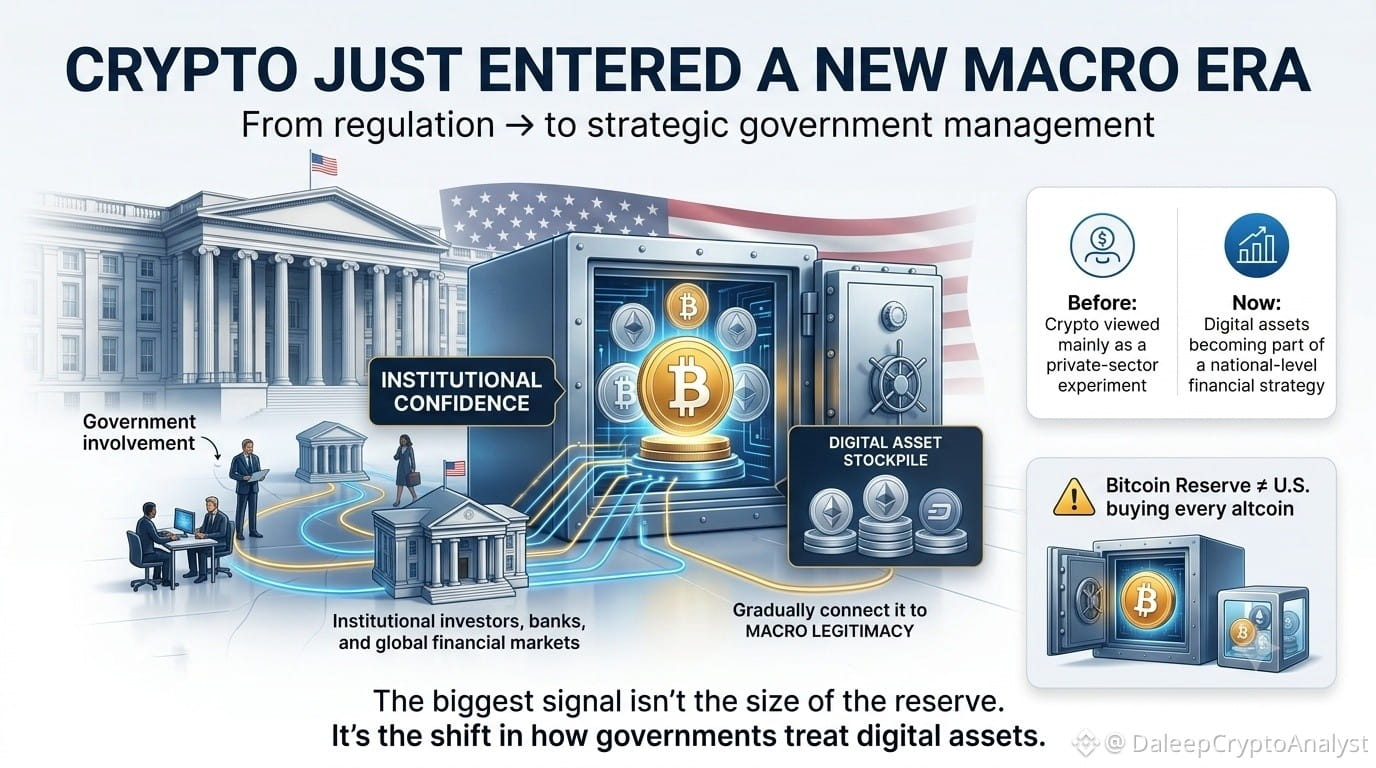
Now the U.S. government has formally established a Strategic Bitcoin Reserve and a separate U.S. Digital Asset Stockpile. The March 2025 executive order directs the reserve to hold government-owned BTC obtained through forfeiture and says those Bitcoin reserve assets are not to be sold; it also allows Treasury and Commerce to develop budget-neutral strategies for acquiring additional BTC.
That changes the conversation.
The important signal isn't simply “the government owns crypto.”
It’s that digital assets are being incorporated into a national-level financial strategy.
That can influence how institutions, corporations and other governments think about crypto's legitimacy, custody, infrastructure and long-term role in the financial system.
But there’s an important distinction:
Bitcoin has the clearest reserve status.
The broader Digital Asset Stockpile is designed to manage other government-held digital assets, primarily those obtained through forfeiture, and the order does not authorize unrestricted purchases of additional non-BTC assets without further executive or legislative action.
So I wouldn’t frame this as “the U.S. is buying every altcoin.”
The bigger story is simpler:
Crypto has moved from being something governments regulate to something the U.S. government is strategically managing.
That shift could have consequences far beyond the initial reserve itself.
#bitcoin #Crypto #BTC #CryptoRegulationUpdate
For years, Bitcoin was treated mainly as a private-sector experiment.
Now the U.S. government has formally established a Strategic Bitcoin Reserve and a separate U.S. Digital Asset Stockpile. The March 2025 executive order directs the reserve to hold government-owned BTC obtained through forfeiture and says those Bitcoin reserve assets are not to be sold; it also allows Treasury and Commerce to develop budget-neutral strategies for acquiring additional BTC.
That changes the conversation.
The important signal isn't simply “the government owns crypto.”
It’s that digital assets are being incorporated into a national-level financial strategy.
That can influence how institutions, corporations and other governments think about crypto's legitimacy, custody, infrastructure and long-term role in the financial system.
But there’s an important distinction:
Bitcoin has the clearest reserve status.
The broader Digital Asset Stockpile is designed to manage other government-held digital assets, primarily those obtained through forfeiture, and the order does not authorize unrestricted purchases of additional non-BTC assets without further executive or legislative action.
So I wouldn’t frame this as “the U.S. is buying every altcoin.”
The bigger story is simpler:
Crypto has moved from being something governments regulate to something the U.S. government is strategically managing.
That shift could have consequences far beyond the initial reserve itself.
#bitcoin #Crypto #BTC #CryptoRegulationUpdate