
I was revisiting TermMax’s fee page while the market was quiet, and one line kept catching my eye: a 2% lending fee. My first reaction was simple 2% of principal sounds expensive.
So I actually sat with the formula. That isn’t what TermMax charges.
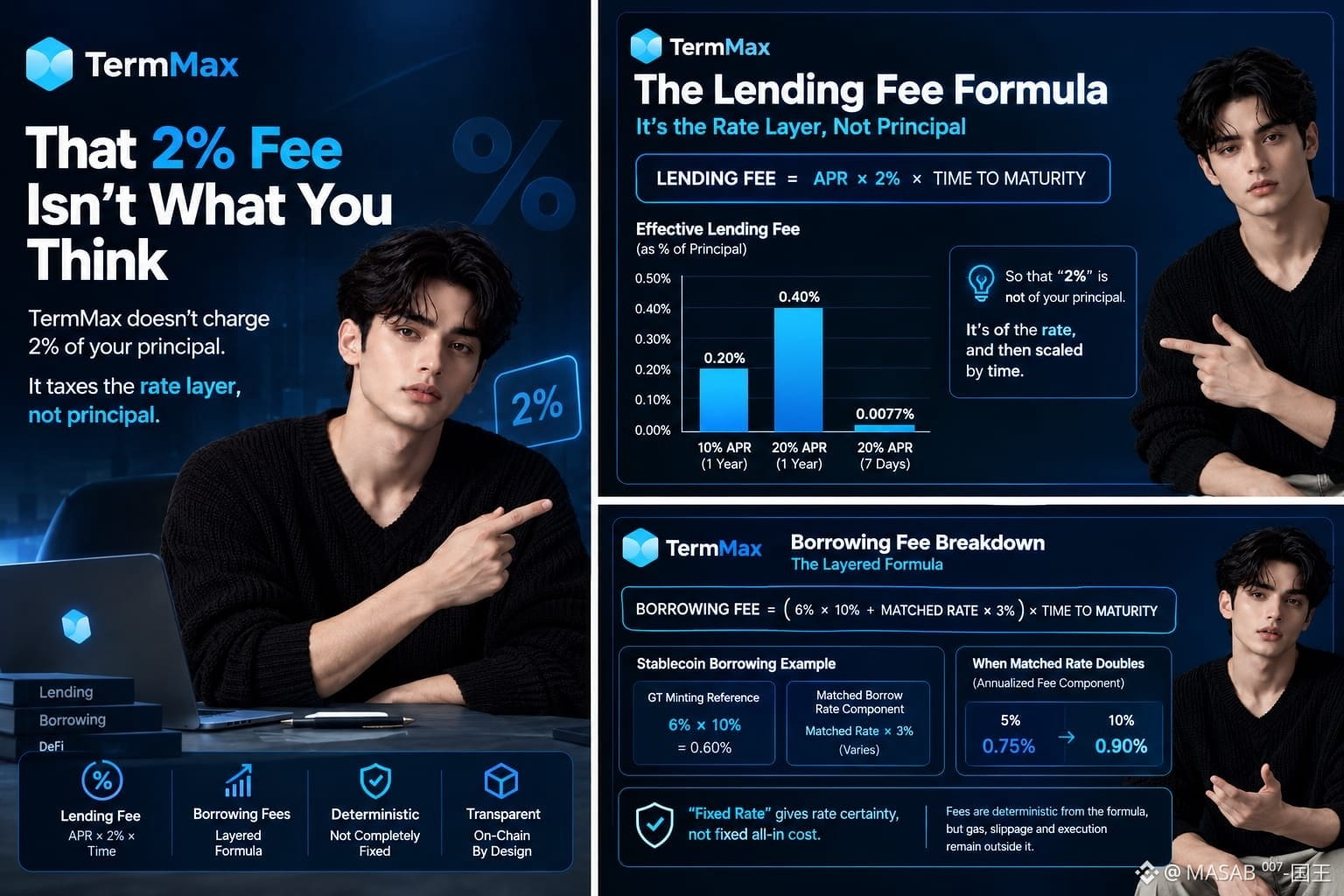
The lending fee rate is APR × 2% × time to maturity. At 10% APR for one year, the effective fee is 0.20% of the lend amount. At 20% APR, it becomes 0.40%. For a seven-day loan at 20% APR, it is only about 0.0077% of principal.
That distinction matters.
TermMax taxes the rate layer, not principal at the headline percentage.
Borrowing is more layered. For stablecoins, the documented formula combines a 6% GT minting reference rate × 10% with the matched borrow rate × 3%, then scales both by maturity. If the matched rate doubles from 5% to 10%, the annualized fee component rises from 0.75% to 0.90% before time scaling.
So “fixed rate” gives rate certainty, not fixed all-in cost. Fees are deterministic from the formula, but gas, slippage and execution remain outside it.
The tab is still open. That 2% now looks very different.
#termmax @TermMax
So I actually sat with the formula. That isn’t what TermMax charges.
The lending fee rate is APR × 2% × time to maturity. At 10% APR for one year, the effective fee is 0.20% of the lend amount. At 20% APR, it becomes 0.40%. For a seven-day loan at 20% APR, it is only about 0.0077% of principal.
That distinction matters.
TermMax taxes the rate layer, not principal at the headline percentage.
Borrowing is more layered. For stablecoins, the documented formula combines a 6% GT minting reference rate × 10% with the matched borrow rate × 3%, then scales both by maturity. If the matched rate doubles from 5% to 10%, the annualized fee component rises from 0.75% to 0.90% before time scaling.
So “fixed rate” gives rate certainty, not fixed all-in cost. Fees are deterministic from the formula, but gas, slippage and execution remain outside it.
The tab is still open. That 2% now looks very different.
#termmax @TermMax