#dusk $DUSK @Dusk
I finally forced myself to actually read through Dusk's documentation from start to finish—no more cheating with other people's notes. And weirdly, the thing that stuck with me wasn't even the technical stuff.
It was realizing how careless everyone is with the term "on-chain securities."
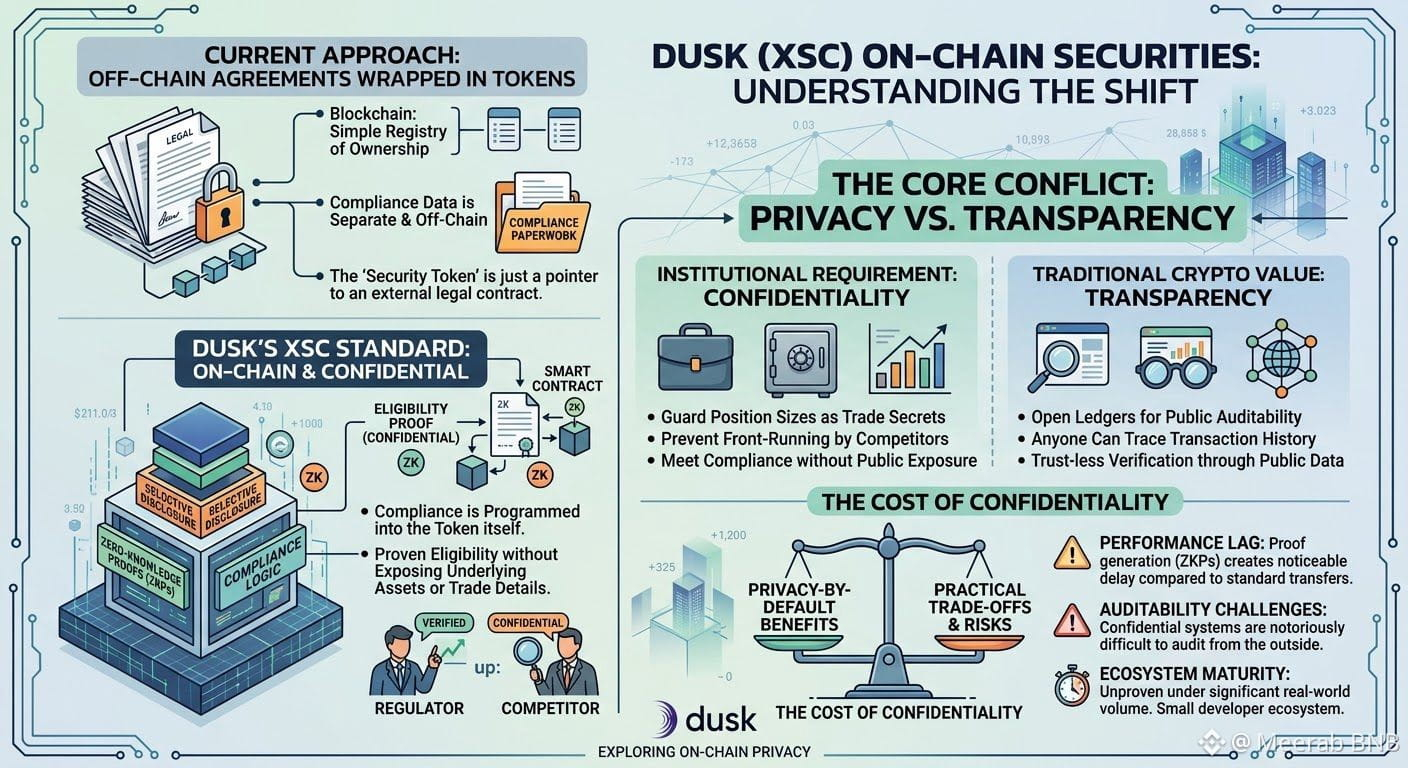
Half the projects out there claiming they're doing security tokens? They're literally just taking an off-chain legal agreement, wrapping a token around it, and calling it a day. The compliance paperwork is still sitting in some folder somewhere. The blockchain's only job is logging who owns what—nothing actually lives on chain in any meaningful sense.
What Dusk's XSC is attempting is different. They're building selective disclosure right into the token standard itself. So a company can prove eligibility or compliance to a regulator without exposing every single trade to the entire internet—competitors included, or anyone with an Etherscan link and too much time.
I tested the testnet flow to see how a confidential contract actually works in practice. Not gonna lie—it's slower than the marketing makes it seem. Proof generation adds noticeable lag compared to a standard transfer. That's the real cost nobody puts in the glossy slides.
But here's what actually got me thinking: privacy-by-default flips the whole crypto assumption on its head. We've been sold transparency as the killer feature forever. For institutions though, the ones used to guarding position sizes like state secrets, that privacy might be worth way more than speed or cheap fees.
Risks are real too—tiny ecosystem, completely unproven under serious volume, and confidential systems are a nightmare to audit from the outside. You just have to trust it works.
So I keep coming back to: would institutions actually choose privacy over transparency? Or is that still asking too much from a space that built its whole identity on open ledgers?
$DUSK @Dusk
I finally forced myself to actually read through Dusk's documentation from start to finish—no more cheating with other people's notes. And weirdly, the thing that stuck with me wasn't even the technical stuff.
It was realizing how careless everyone is with the term "on-chain securities."
Half the projects out there claiming they're doing security tokens? They're literally just taking an off-chain legal agreement, wrapping a token around it, and calling it a day. The compliance paperwork is still sitting in some folder somewhere. The blockchain's only job is logging who owns what—nothing actually lives on chain in any meaningful sense.
What Dusk's XSC is attempting is different. They're building selective disclosure right into the token standard itself. So a company can prove eligibility or compliance to a regulator without exposing every single trade to the entire internet—competitors included, or anyone with an Etherscan link and too much time.
I tested the testnet flow to see how a confidential contract actually works in practice. Not gonna lie—it's slower than the marketing makes it seem. Proof generation adds noticeable lag compared to a standard transfer. That's the real cost nobody puts in the glossy slides.
But here's what actually got me thinking: privacy-by-default flips the whole crypto assumption on its head. We've been sold transparency as the killer feature forever. For institutions though, the ones used to guarding position sizes like state secrets, that privacy might be worth way more than speed or cheap fees.
Risks are real too—tiny ecosystem, completely unproven under serious volume, and confidential systems are a nightmare to audit from the outside. You just have to trust it works.
So I keep coming back to: would institutions actually choose privacy over transparency? Or is that still asking too much from a space that built its whole identity on open ledgers?
$DUSK @Dusk