#dusk $DUSK
There are two ways to build on Dusk and i kept seeing them mentioned as if they were interchangeable. Reading the actual developer docs, theyre not. Theyre different enough that choosing wrong probably costs you a rewrite.
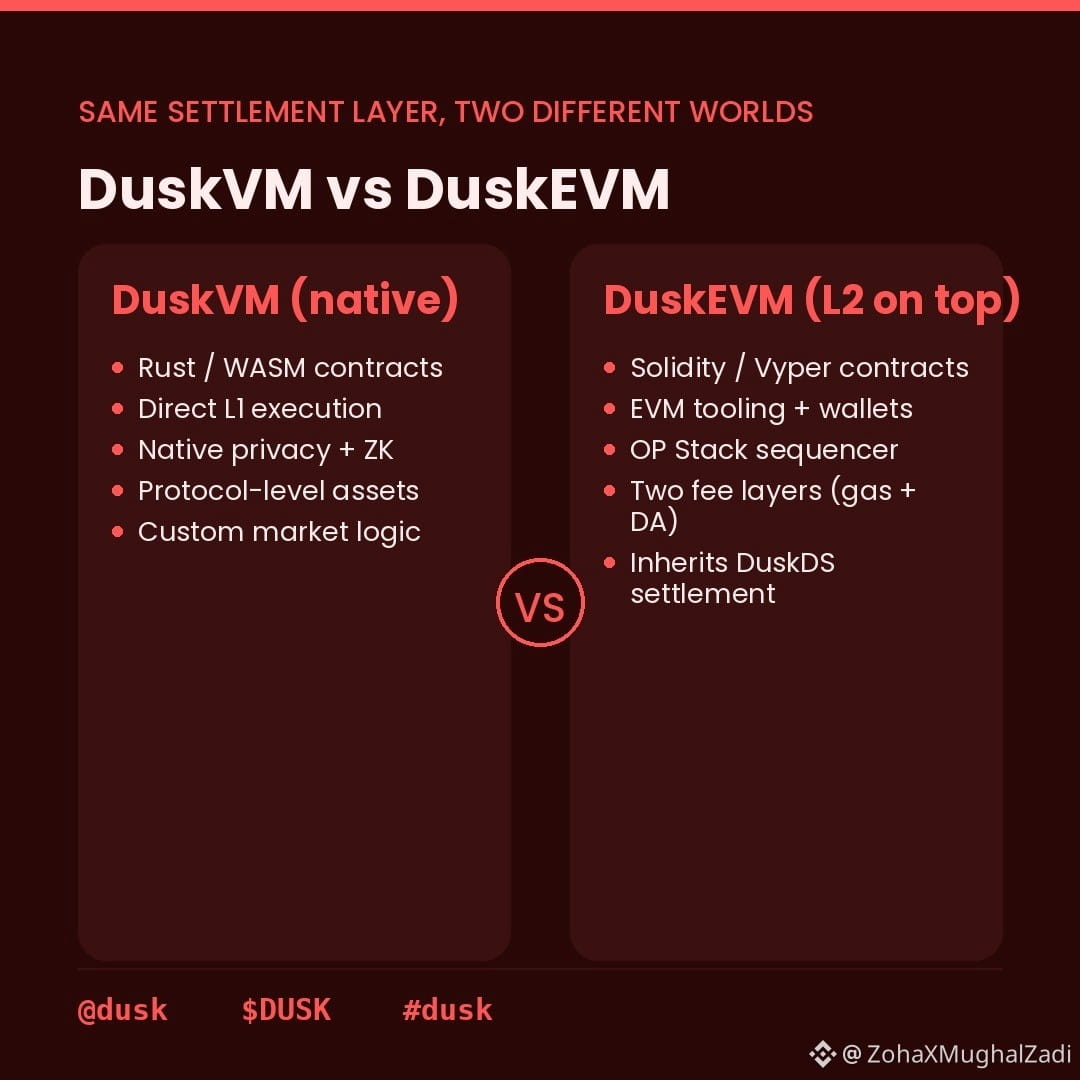
DuskEVM is an EVM-compatible layer running on top of DuskDS using OP Stack. You write Solidity or Vyper, use familiar EVM tooling, deploy the way you would on Ethereum or Arbitrum. Your contract inherits DuskDS as a settlement and data-availability layer. The cost is two fee layers: the normal EVM gas fee plus a data-availability fee for posting batch data to the underlying chain.
DuskVM is native Dusk. You write in Rust, compile to WASM, deploy directly on the L1. You get access to the native transaction models (Moonlight and Phoenix), protocol-level privacy and ZK capabilities, and the full custom market logic that lives close to the chain. No extra fee layer, no OP Stack abstraction in between.
The docs are direct about when to pick each. DuskEVM if your app benefits from Solidity, EVM wallets, and existing Ethereum tooling. DuskVM if your app needs native privacy, ZK, protocol-level assets, or direct control over the execution model.
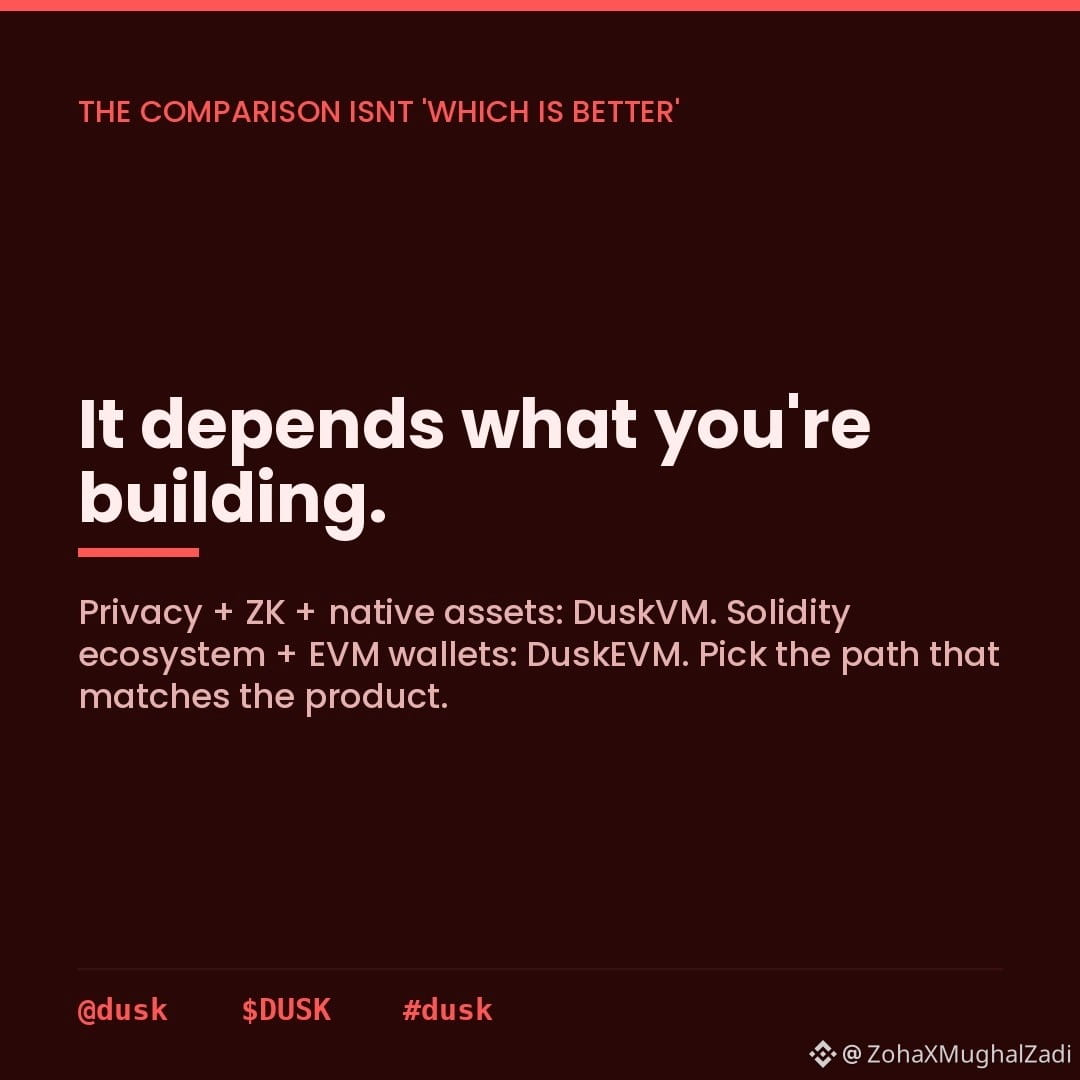
Whats honest about that framing is it doesnt pretend one is better. The choice depends entirely on what the application needs. A financial application that wants custom privacy logic probably belongs on DuskVM. A Solidity team that wants DuskDS settlement under an existing app probably belongs on DuskEVM.
The tradeoff i keep thinking about: DuskEVM gives you the EVM ecosystem but puts an abstraction between your code and the privacy features that make Dusk interesting. DuskVM gives you the full stack but requires Rust and a different mental model.
if you were building something finance-specific on Dusk, which path would you actually take, the familiar EVM tooling, or the native stack with direct access to the privacy layer? @Dusk
$BTW
$MAGMA #dusk
There are two ways to build on Dusk and i kept seeing them mentioned as if they were interchangeable. Reading the actual developer docs, theyre not. Theyre different enough that choosing wrong probably costs you a rewrite.
DuskEVM is an EVM-compatible layer running on top of DuskDS using OP Stack. You write Solidity or Vyper, use familiar EVM tooling, deploy the way you would on Ethereum or Arbitrum. Your contract inherits DuskDS as a settlement and data-availability layer. The cost is two fee layers: the normal EVM gas fee plus a data-availability fee for posting batch data to the underlying chain.
DuskVM is native Dusk. You write in Rust, compile to WASM, deploy directly on the L1. You get access to the native transaction models (Moonlight and Phoenix), protocol-level privacy and ZK capabilities, and the full custom market logic that lives close to the chain. No extra fee layer, no OP Stack abstraction in between.
The docs are direct about when to pick each. DuskEVM if your app benefits from Solidity, EVM wallets, and existing Ethereum tooling. DuskVM if your app needs native privacy, ZK, protocol-level assets, or direct control over the execution model.
Whats honest about that framing is it doesnt pretend one is better. The choice depends entirely on what the application needs. A financial application that wants custom privacy logic probably belongs on DuskVM. A Solidity team that wants DuskDS settlement under an existing app probably belongs on DuskEVM.
The tradeoff i keep thinking about: DuskEVM gives you the EVM ecosystem but puts an abstraction between your code and the privacy features that make Dusk interesting. DuskVM gives you the full stack but requires Rust and a different mental model.
if you were building something finance-specific on Dusk, which path would you actually take, the familiar EVM tooling, or the native stack with direct access to the privacy layer? @Dusk
$BTW
$MAGMA #dusk