I used to think privacy in financial markets was mainly about hiding transaction details. The more I read about @DuskFoundation, the more incomplete that idea started to feel.
In regulated finance, privacy cannot simply mean that nobody sees anything. Different participants may need different levels of information for legitimate reasons.
That is why Dusk’s approach to selective disclosure caught my attention.
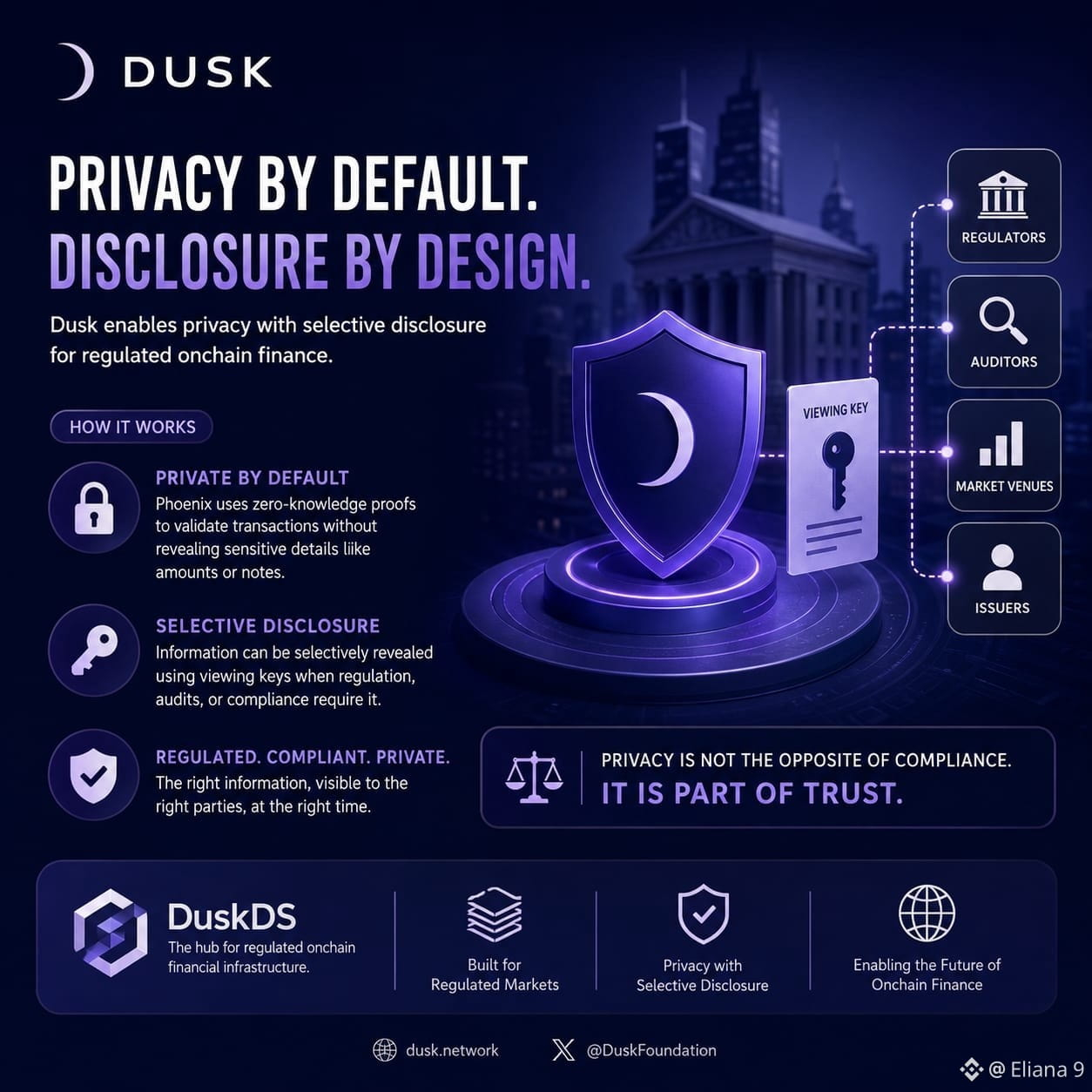
On DuskDS, Phoenix is the shielded, note-based transaction model. It uses zero-knowledge proofs so transaction correctness can be proven without publicly revealing details such as the amount being transferred or the specific notes involved. Dusk’s documentation also says users can selectively reveal information through viewing keys when regulation or auditing requires it.
For me, that distinction matters.
A fully transparent blockchain can expose information that financial participants may not want to reveal publicly. But regulated markets can also require controlled access to specific information for issuers, venues, auditors or supervisors. Dusk describes this balance as privacy with selective disclosure.
So the more useful question may not be whether finance should be public or private.
It is whether information can remain confidential by default while still becoming visible to authorized parties when a workflow requires it.
That balance is what I find most interesting about Dusk’s approach to regulated onchain finance.
#dusk $DUSK @Dusk
In regulated finance, privacy cannot simply mean that nobody sees anything. Different participants may need different levels of information for legitimate reasons.
That is why Dusk’s approach to selective disclosure caught my attention.
On DuskDS, Phoenix is the shielded, note-based transaction model. It uses zero-knowledge proofs so transaction correctness can be proven without publicly revealing details such as the amount being transferred or the specific notes involved. Dusk’s documentation also says users can selectively reveal information through viewing keys when regulation or auditing requires it.
For me, that distinction matters.
A fully transparent blockchain can expose information that financial participants may not want to reveal publicly. But regulated markets can also require controlled access to specific information for issuers, venues, auditors or supervisors. Dusk describes this balance as privacy with selective disclosure.
So the more useful question may not be whether finance should be public or private.
It is whether information can remain confidential by default while still becoming visible to authorized parties when a workflow requires it.
That balance is what I find most interesting about Dusk’s approach to regulated onchain finance.
#dusk $DUSK @Dusk