Argued with someone in a group chat yesterday about $DUSK . He kept saying "2.8 milliseconds on-chain verification, nothing else comes close." I kept asking him where the proof generation time goes in that calculation.
He did not have an answer.
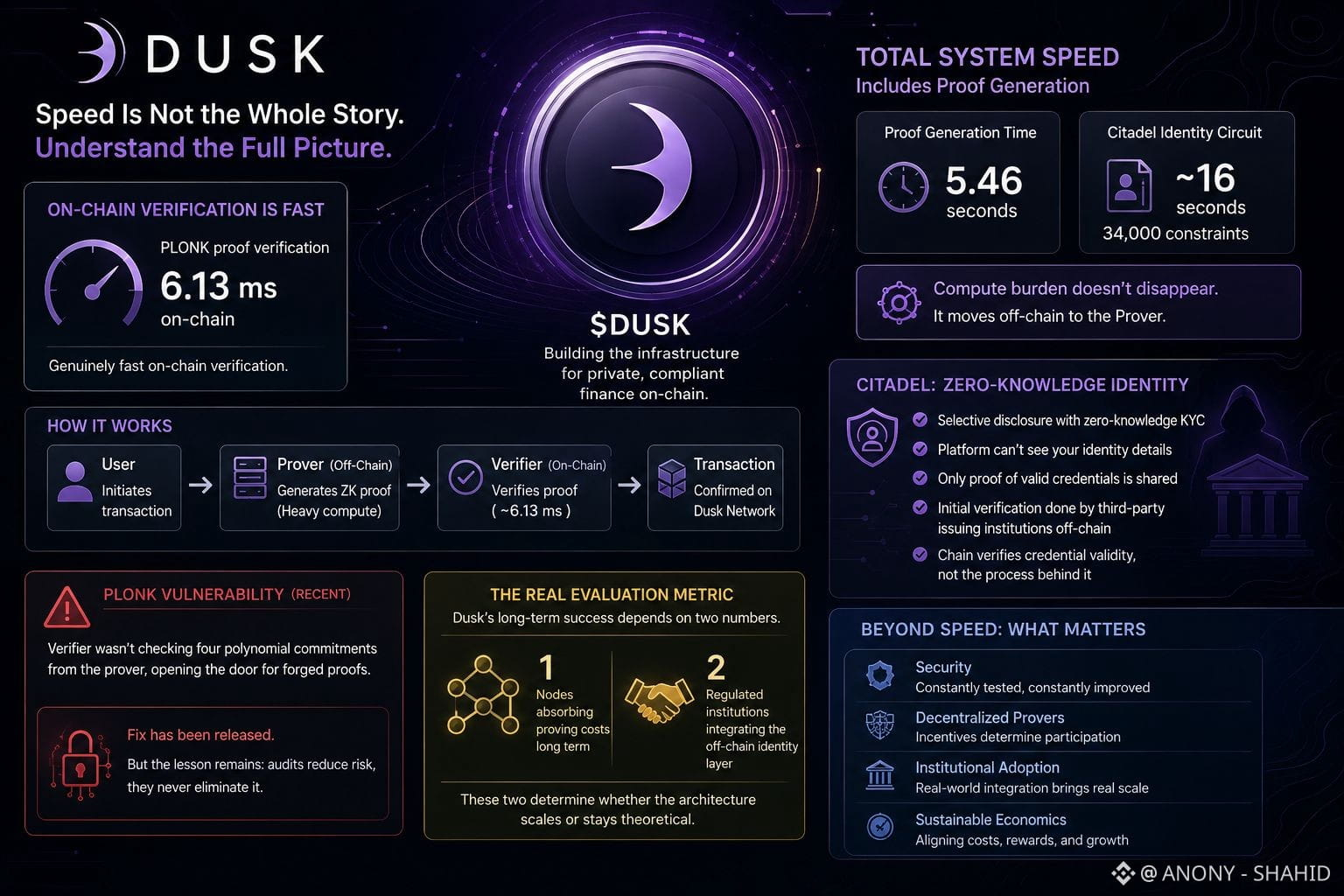
On-chain verification speed and total system speed are different numbers. PLONK proof verification on Dusk runs around 6.13 milliseconds. That part is genuinely fast. But generating that proof takes 5.46 seconds. The Citadel identity circuit specifically takes roughly 16 seconds to prove, involving 34,000 constraints.
The compute burden does not disappear. It moves off-chain onto whoever runs the Prover. On-chain looks light because someone else absorbed the heavy work upstream. The real question is who runs those Prover nodes and what incentivizes them to keep doing it at scale.
Citadel's selective disclosure design is impressive on paper. Zero-knowledge KYC means the platform cannot see your identity details, only confirmation that you passed a credential check. But the initial verification still runs through a third-party issuing institution outside the chain. The chain confirms the credential is valid. It cannot confirm the issuing institution behaved correctly during the verification process.
The PLONK vulnerability that surfaced recently is worth understanding. The verifier was not checking four polynomial commitments from the prover, which meant a malicious actor could potentially forge proofs. The fix has been released. But the incident illustrates something consistent across every ZK system: audits reduce risk, they do not eliminate it.
Dusk's real evaluation metric is not on-chain verification speed. It is how many nodes absorb proving costs long term and how many regulated institutions integrate the off-chain identity layer.
Those two numbers determine whether the architecture scales or stays theoretical.
#dusk @Dusk #Binance
He did not have an answer.
On-chain verification speed and total system speed are different numbers. PLONK proof verification on Dusk runs around 6.13 milliseconds. That part is genuinely fast. But generating that proof takes 5.46 seconds. The Citadel identity circuit specifically takes roughly 16 seconds to prove, involving 34,000 constraints.
The compute burden does not disappear. It moves off-chain onto whoever runs the Prover. On-chain looks light because someone else absorbed the heavy work upstream. The real question is who runs those Prover nodes and what incentivizes them to keep doing it at scale.
Citadel's selective disclosure design is impressive on paper. Zero-knowledge KYC means the platform cannot see your identity details, only confirmation that you passed a credential check. But the initial verification still runs through a third-party issuing institution outside the chain. The chain confirms the credential is valid. It cannot confirm the issuing institution behaved correctly during the verification process.
The PLONK vulnerability that surfaced recently is worth understanding. The verifier was not checking four polynomial commitments from the prover, which meant a malicious actor could potentially forge proofs. The fix has been released. But the incident illustrates something consistent across every ZK system: audits reduce risk, they do not eliminate it.
Dusk's real evaluation metric is not on-chain verification speed. It is how many nodes absorb proving costs long term and how many regulated institutions integrate the off-chain identity layer.
Those two numbers determine whether the architecture scales or stays theoretical.
#dusk @Dusk #Binance