I've been watching the ZK narrative heat up again this cycle. Everyone chases the projects flashing the fastest numbers, but I keep asking myself the same thing: who actually pays for the heavy lifting?
Most of these systems look clean on-chain. Verification feels almost free. What doesn't get talked about enough is the off-chain side. Generating the proofs still eats serious compute. Someone has to run those provers, keep them online, and absorb the cost. If the incentives aren't clear, nodes won't do it for free for long.
That question is what pulled me into looking at DUSK more carefully lately. The on-chain verification times are solid, no argument there. But the real friction sits in the proving layer and the identity setup. The compliance angle is interesting for regulated environments, yet it still leans on off-chain issuers. That creates a trust point the chain itself can't fully remove.
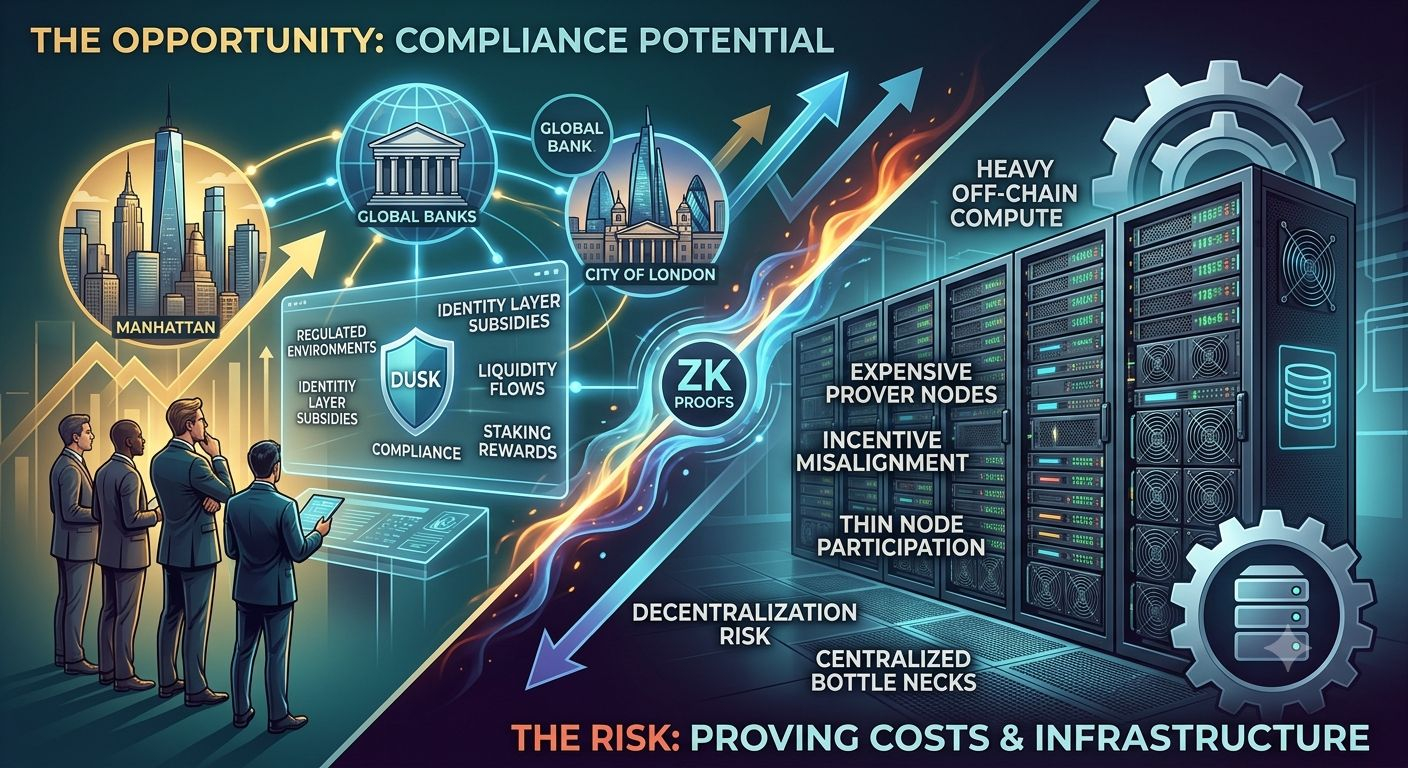
For capital, the opportunity I see is if enough infrastructure players decide the identity layer is worth subsidizing. Liquidity and staking rewards could follow if that happens. The risk is simpler: if proving stays expensive and node participation stays thin, the whole system stays more centralized than the marketing suggests. A recent verifier issue didn't help confidence either, even after the fix.
Lesson I keep relearning: headline speed numbers rarely tell you where the capital actually has to sit.
Curious what others are weighting more right now, the compliance potential or the proving cost?
$DUSK #dusk @Dusk
Most of these systems look clean on-chain. Verification feels almost free. What doesn't get talked about enough is the off-chain side. Generating the proofs still eats serious compute. Someone has to run those provers, keep them online, and absorb the cost. If the incentives aren't clear, nodes won't do it for free for long.
That question is what pulled me into looking at DUSK more carefully lately. The on-chain verification times are solid, no argument there. But the real friction sits in the proving layer and the identity setup. The compliance angle is interesting for regulated environments, yet it still leans on off-chain issuers. That creates a trust point the chain itself can't fully remove.
For capital, the opportunity I see is if enough infrastructure players decide the identity layer is worth subsidizing. Liquidity and staking rewards could follow if that happens. The risk is simpler: if proving stays expensive and node participation stays thin, the whole system stays more centralized than the marketing suggests. A recent verifier issue didn't help confidence either, even after the fix.
Lesson I keep relearning: headline speed numbers rarely tell you where the capital actually has to sit.
Curious what others are weighting more right now, the compliance potential or the proving cost?
$DUSK #dusk @Dusk