#termmax @TermMax I was reading the TermMax documentation today, and one thing really caught my attention
It was Range Orders.
At first the name sounded complicated. But the idea is actually quite simple:
What if I don't want to accept the lending rate the protocol gives me? What if I want to set my own conditions?
That's basically what TermMax is trying to enable.
Their documentation gives a very clear example:
Imagine I want to lend USDC.
I could set:
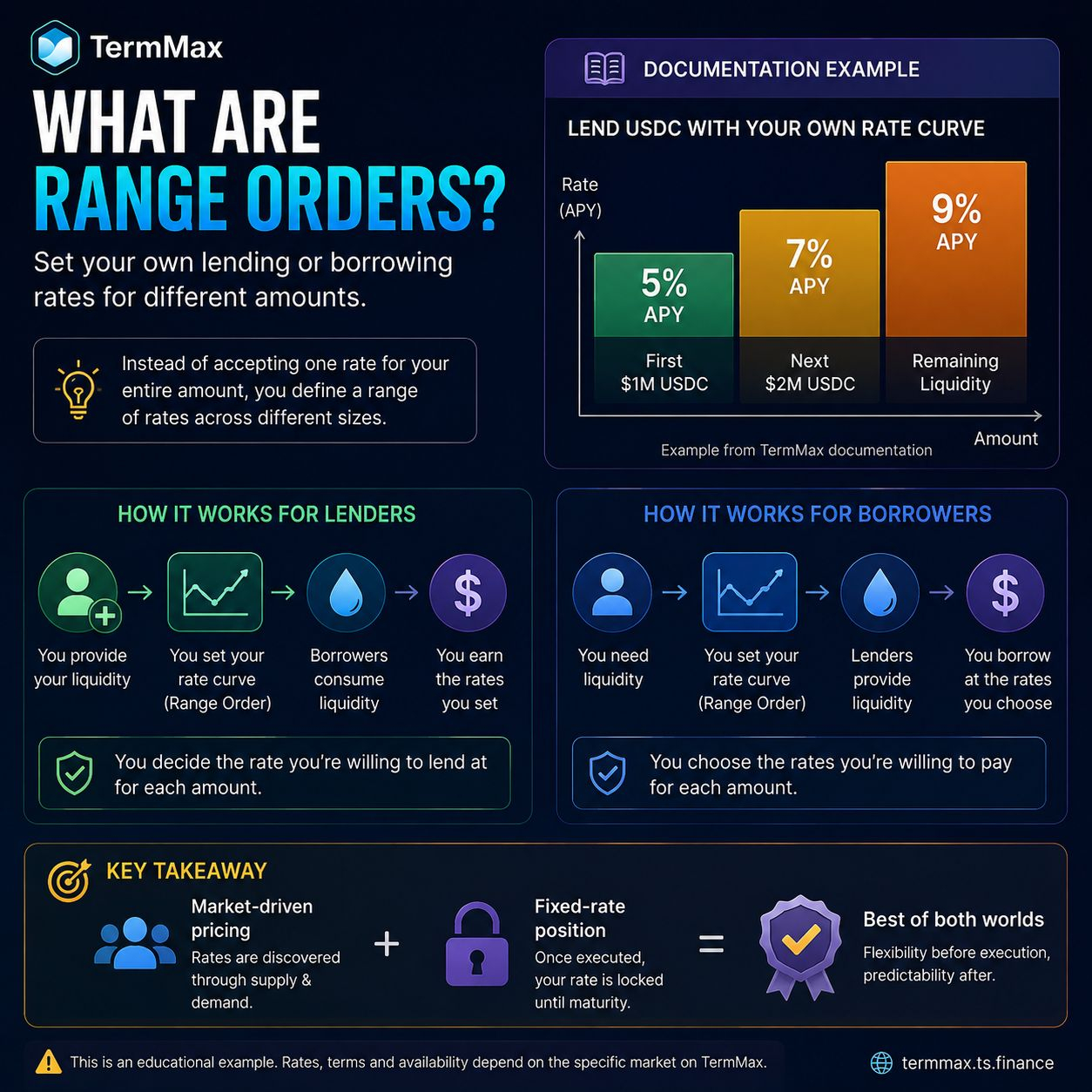
🔹 First $1M → 5%
🔹 Next $2M → 7%
🔹 Remaining liquidity → 9%
So I'm not simply pressing “Lend” and accepting whatever APY appears on my screen.
I'm saying:
“At this amount, I'm willing to lend at this rate. If you want more of my liquidity, I want a higher rate.”
And borrowers can create their own rate curves too.
This was the moment Range Orders finally made sense to me.
A fixed-rate position doesn't mean the entire market has one fixed rate.
The market can still discover a price through lenders and borrowers setting the conditions they're willing to accept.
Then, once the position is executed, you get the predictability of a fixed rate.
That's actually a pretty interesting combination:
Market-driven pricing → fixed-rate position.
I found this much easier to understand after seeing the example in their documentation.
#TermMax #DeFi #RangeOrders #FixedRate
It was Range Orders.
At first the name sounded complicated. But the idea is actually quite simple:
What if I don't want to accept the lending rate the protocol gives me? What if I want to set my own conditions?
That's basically what TermMax is trying to enable.
Their documentation gives a very clear example:
Imagine I want to lend USDC.
I could set:
🔹 First $1M → 5%
🔹 Next $2M → 7%
🔹 Remaining liquidity → 9%
So I'm not simply pressing “Lend” and accepting whatever APY appears on my screen.
I'm saying:
“At this amount, I'm willing to lend at this rate. If you want more of my liquidity, I want a higher rate.”
And borrowers can create their own rate curves too.
This was the moment Range Orders finally made sense to me.
A fixed-rate position doesn't mean the entire market has one fixed rate.
The market can still discover a price through lenders and borrowers setting the conditions they're willing to accept.
Then, once the position is executed, you get the predictability of a fixed rate.
That's actually a pretty interesting combination:
Market-driven pricing → fixed-rate position.
I found this much easier to understand after seeing the example in their documentation.
#TermMax #DeFi #RangeOrders #FixedRate