Most crypto projects treat regulation as an obstacle to route around. Dusk Network has spent years treating it as the actual design specification, and its relationship with MiCA, the EU's Markets in Crypto Assets regulation, shows exactly what that looks like in practice.
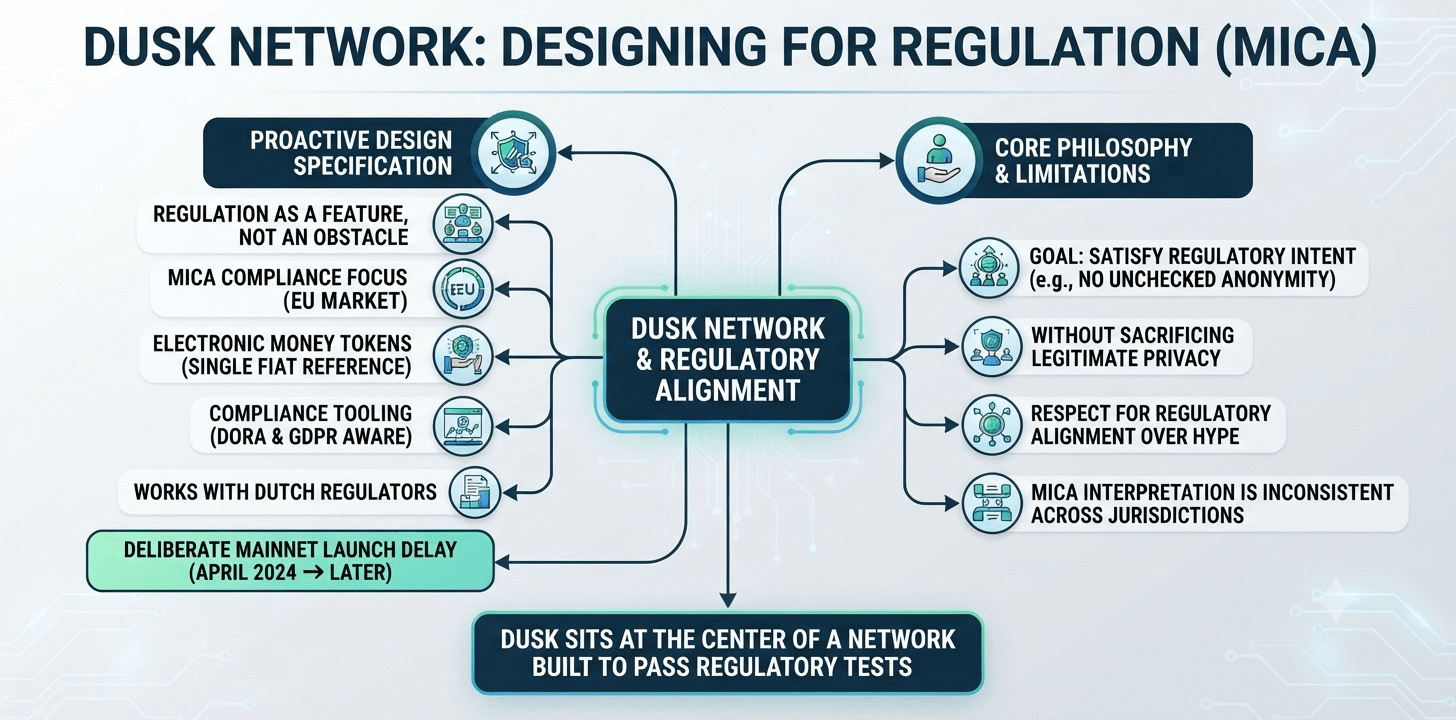
MiCA sorts crypto assets into defined categories, including electronic money tokens, which reference a single fiat currency the way a digital euro would, and asset referenced tokens, which reference multiple currencies, commodities, or other assets at once. Dusk's payment infrastructure was built specifically around the electronic money token category rather than treating stablecoin style assets as a regulatory afterthought, and its broader compliance tooling was designed to reconcile with adjacent frameworks like DORA and GDPR at the same time, not MiCA in isolation, an approach that also shapes how Dusk works with Dutch regulators overseeing its home market. When MiCA's requirements were still evolving ahead of full implementation, Dusk's leadership made the deliberate choice to delay its own mainnet launch, originally planned for April 2024, rather than ship a network that might not hold up once the rules fully landed. Emanuele Francioni, Dusk's founder, has described the goal plainly: build a model that satisfies what these regulations actually target, namely unchecked anonymity, without sacrificing legitimate privacy.
I respect that decision more the longer I sit with it. Delaying a mainnet launch for regulatory alignment is not a move that generates hype, and it cost Dusk months of momentum at a time when attention in this industry moves to whatever launches next.
The honest limitation is that MiCA itself is still being interpreted inconsistently across exchanges and jurisdictions within Europe, let alone globally.
DUSK sits at the center of a network built to keep passing that test.
@Dusk $DUSK #dusk
MiCA sorts crypto assets into defined categories, including electronic money tokens, which reference a single fiat currency the way a digital euro would, and asset referenced tokens, which reference multiple currencies, commodities, or other assets at once. Dusk's payment infrastructure was built specifically around the electronic money token category rather than treating stablecoin style assets as a regulatory afterthought, and its broader compliance tooling was designed to reconcile with adjacent frameworks like DORA and GDPR at the same time, not MiCA in isolation, an approach that also shapes how Dusk works with Dutch regulators overseeing its home market. When MiCA's requirements were still evolving ahead of full implementation, Dusk's leadership made the deliberate choice to delay its own mainnet launch, originally planned for April 2024, rather than ship a network that might not hold up once the rules fully landed. Emanuele Francioni, Dusk's founder, has described the goal plainly: build a model that satisfies what these regulations actually target, namely unchecked anonymity, without sacrificing legitimate privacy.
I respect that decision more the longer I sit with it. Delaying a mainnet launch for regulatory alignment is not a move that generates hype, and it cost Dusk months of momentum at a time when attention in this industry moves to whatever launches next.
The honest limitation is that MiCA itself is still being interpreted inconsistently across exchanges and jurisdictions within Europe, let alone globally.
DUSK sits at the center of a network built to keep passing that test.
@Dusk $DUSK #dusk