#dusk $DUSK @Dusk
I initially approached Dusk’s documentation with a simple understanding: tokenizing a bond or fund mainly involves recording ownership in a smart contract. What shifted my perspective was realizing that the real complexity lies in the ecosystem surrounding the token—rules around eligibility, transfers, private data handling, payments, settlement, and ongoing servicing all needed to align.
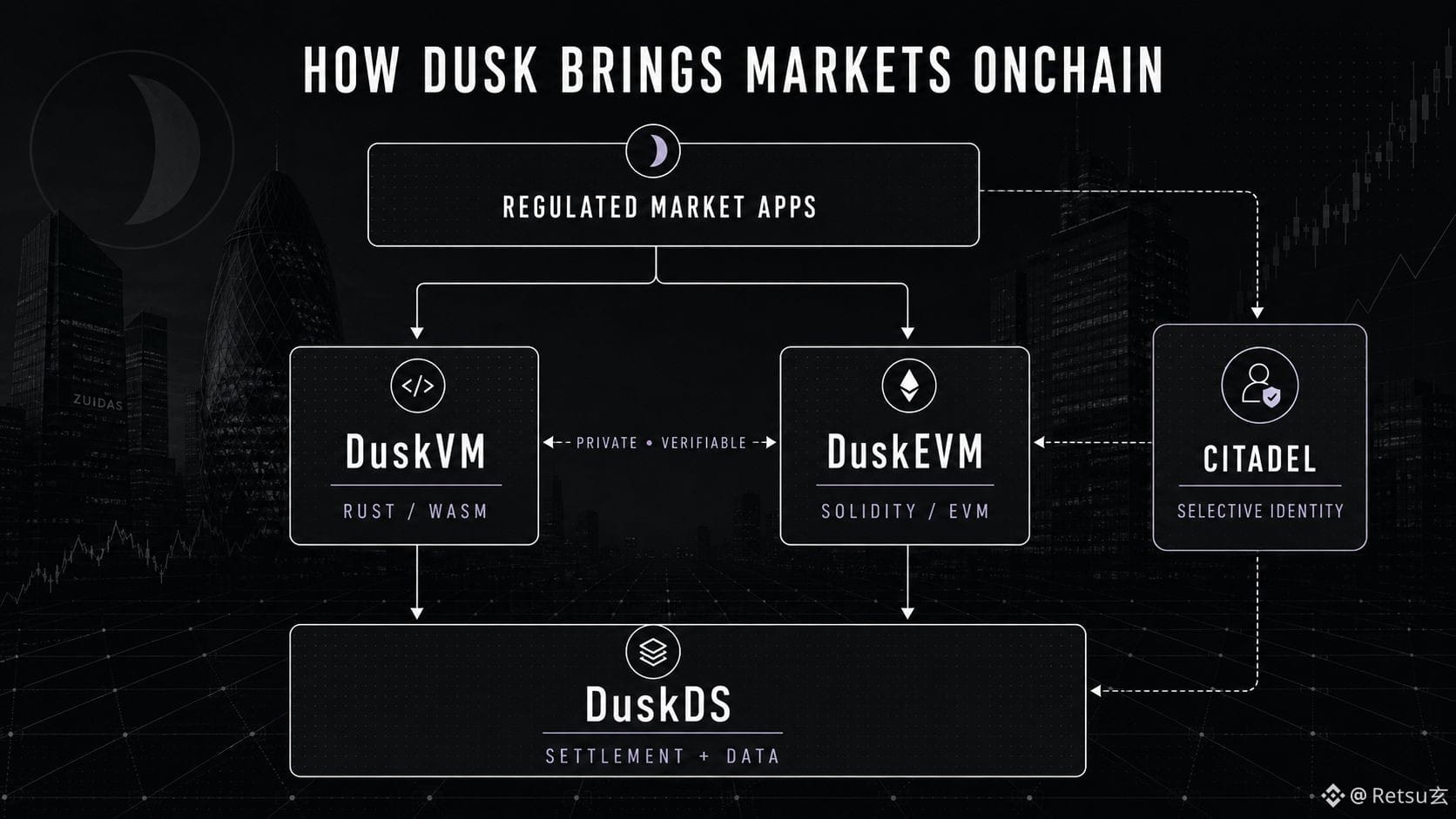
Dusk addresses this by distributing responsibilities across its architecture. DuskVM executes Rust and WebAssembly contracts directly on Layer 1. DuskEVM allows Solidity-based apps to leverage familiar EVM tools, while batches, transaction metadata, and state commitments progress toward final settlement via DuskDS. Citadel employs credentials and zero-knowledge proofs so users can demonstrate they hold an approved license without revealing personal information or the full license details on-chain; service providers still retain control over which issuers and attributes they recognize.
This changed how I viewed the system.
My takeaway: privacy here isn’t about complete invisibility. It’s about enabling verification without requiring broad disclosure. The challenge, though, is determining where control lies when these boundaries matter. If a credential is revoked mid-trade, whose state governs eligibility at settlement? And when policies from issuers, trading venues, auditors, and regulators clash, who ultimately decides when and how much information must be disclosed?
I’m keen to see how this plays out in real-world use.
I initially approached Dusk’s documentation with a simple understanding: tokenizing a bond or fund mainly involves recording ownership in a smart contract. What shifted my perspective was realizing that the real complexity lies in the ecosystem surrounding the token—rules around eligibility, transfers, private data handling, payments, settlement, and ongoing servicing all needed to align.
Dusk addresses this by distributing responsibilities across its architecture. DuskVM executes Rust and WebAssembly contracts directly on Layer 1. DuskEVM allows Solidity-based apps to leverage familiar EVM tools, while batches, transaction metadata, and state commitments progress toward final settlement via DuskDS. Citadel employs credentials and zero-knowledge proofs so users can demonstrate they hold an approved license without revealing personal information or the full license details on-chain; service providers still retain control over which issuers and attributes they recognize.
This changed how I viewed the system.
My takeaway: privacy here isn’t about complete invisibility. It’s about enabling verification without requiring broad disclosure. The challenge, though, is determining where control lies when these boundaries matter. If a credential is revoked mid-trade, whose state governs eligibility at settlement? And when policies from issuers, trading venues, auditors, and regulators clash, who ultimately decides when and how much information must be disclosed?
I’m keen to see how this plays out in real-world use.