Ask most people evaluating a privacy chain whether it's private, and they'll check a box: yes or no. For Dusk, that's the wrong question, and Dusk's own writeup on Hedger shows why.
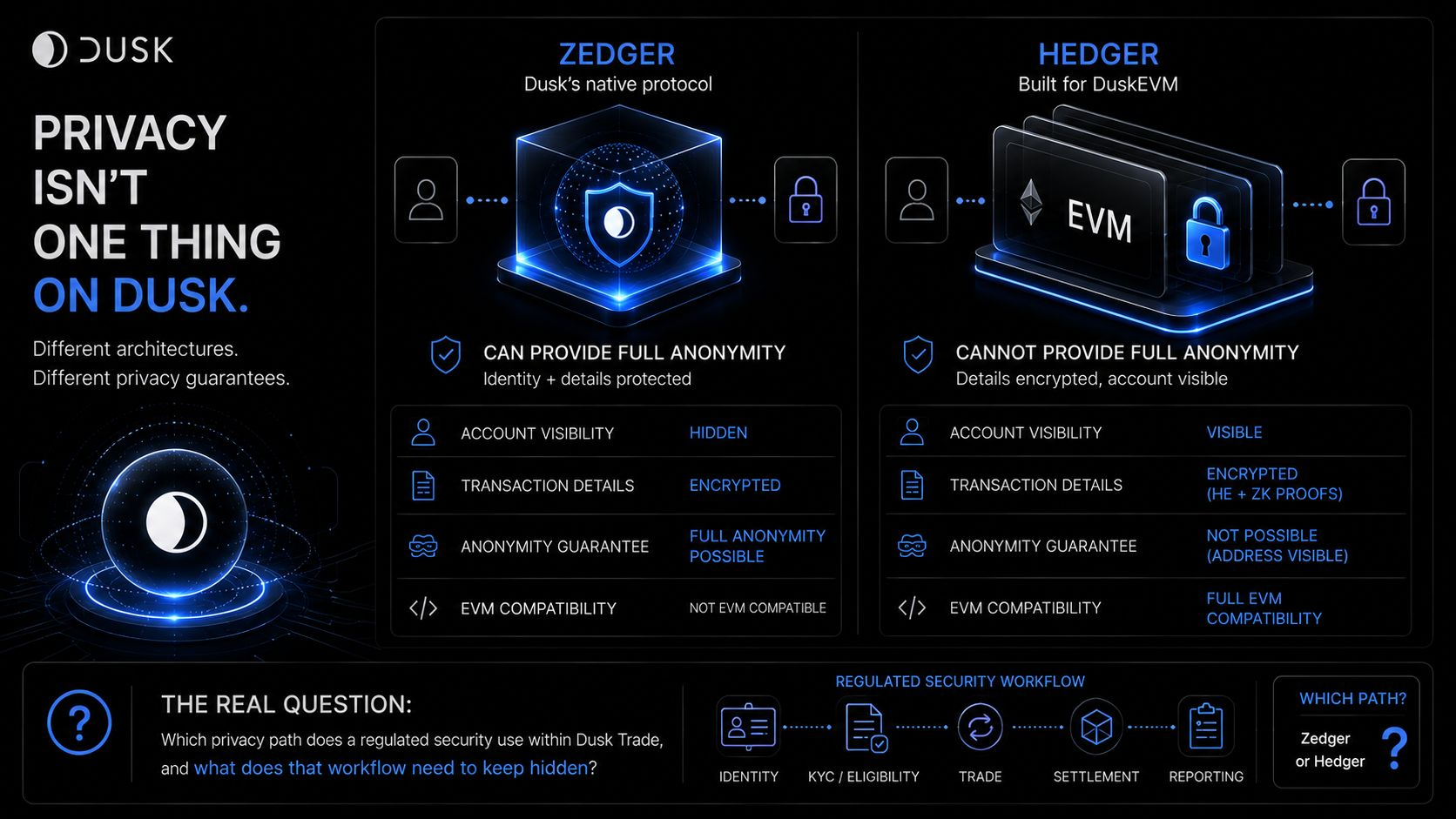
Zedger, Dusk's native privacy-preserving protocol, can provide full anonymity. Hedger, built for DuskEVM, can't. Dusk says it plainly: the EVM's account-based model prevents full anonymity, while Hedger keeps transaction details encrypted using homomorphic encryption and zero-knowledge proofs without offering that same full-anonymity guarantee.
That's not a bug Dusk is hiding. It's the trade-off the architecture makes explicit: EVM compatibility comes with a different privacy guarantee than Zedger's full anonymity.
Here's what actually changes when that trade-off gets made. The important difference isn't simply whether transaction details are encrypted. It's the anonymity guarantee. Use the Zedger path and full anonymity is available. Use the EVM-compatible Hedger path and the same guarantee isn't. Same brand, same word "confidential," different guarantee underneath.
That changes what the actual question should be for anyone evaluating this. Not "does Dusk support confidential transactions." Both paths support private transaction flows, but they don't provide the same anonymity guarantee. The real question is whether the guarantee a regulated asset gets actually matches what its workflow needs in the first place.
"Privacy that keeps transaction details confidential and privacy that provides full anonymity are two different guarantees, even when a project ships both under the same word."
What I'd actually want to see: which privacy path a regulated security actually uses within Dusk Trade, and what that workflow requires the path to keep hidden.
#dusk $DUSK @Dusk
Zedger, Dusk's native privacy-preserving protocol, can provide full anonymity. Hedger, built for DuskEVM, can't. Dusk says it plainly: the EVM's account-based model prevents full anonymity, while Hedger keeps transaction details encrypted using homomorphic encryption and zero-knowledge proofs without offering that same full-anonymity guarantee.
That's not a bug Dusk is hiding. It's the trade-off the architecture makes explicit: EVM compatibility comes with a different privacy guarantee than Zedger's full anonymity.
Here's what actually changes when that trade-off gets made. The important difference isn't simply whether transaction details are encrypted. It's the anonymity guarantee. Use the Zedger path and full anonymity is available. Use the EVM-compatible Hedger path and the same guarantee isn't. Same brand, same word "confidential," different guarantee underneath.
That changes what the actual question should be for anyone evaluating this. Not "does Dusk support confidential transactions." Both paths support private transaction flows, but they don't provide the same anonymity guarantee. The real question is whether the guarantee a regulated asset gets actually matches what its workflow needs in the first place.
"Privacy that keeps transaction details confidential and privacy that provides full anonymity are two different guarantees, even when a project ships both under the same word."
What I'd actually want to see: which privacy path a regulated security actually uses within Dusk Trade, and what that workflow requires the path to keep hidden.
#dusk $DUSK @Dusk