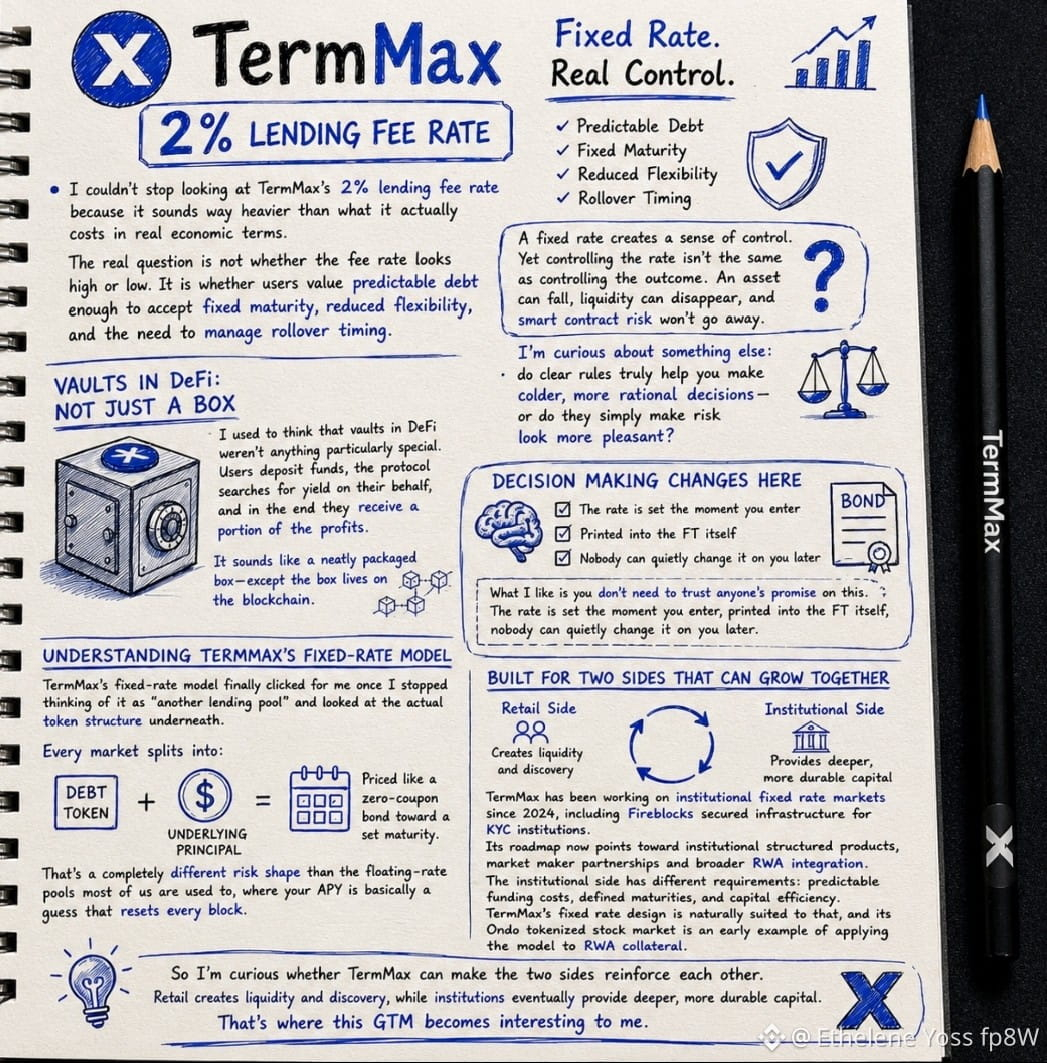
#termmax @TermMax I couldn’t stop looking at TermMax’s 2% lending fee rate because it sounds way heavier than what it actually costs in real economic terms.That changes how I judge TermMax. The real question is not whether the fee rate looks high or low. It is whether users value predictable debt enough to accept fixed maturity reduced flexibility and the need to manage rollover timing.I used to think that vaults in DeFi weren’t anything particularly special. Users deposit funds, the protocol searches for yield on their behalf, and in the end they receive a portion of the profits. It sounds like a neatly packaged box—except the box lives on the blockchain.I still want to observe how TermMax’s vaults handle periods of highly volatile markets. Because a strategy that seems very reasonable when liquidity is abundant may only truly be tested once maturities begin to diverge and users want to withdraw capital at the same time
#termmax @TermMaxI noticed TermMax not through another story about DeFi lending. Something else caught my attention here—the logic behind decision-making itself changes.what I like is you don't need to trust anyone's promise on this. the rate is set the moment you enter, printed into the FT itself, nobody can quietly change it on you later.
feels like the closest thing DeFi has gotten to an actual bond market instead of just slapping "fixed" on a variable product and hoping nobody checks.TermMax's fixed-rate model finally clicked for me once I stopped thinking of it as "another lending pool" and looked at the actual token structure underneath. Every market splits into a debt token and the underlying principal, priced like a zero-coupon bond toward a set maturity. That's a completely different risk shape than the floating-rate pools most of us are used to, where your APY is basically a guess that resets every block.I noticed something while going through @TermMax that I initially overlooked.
The part of TermMax you see every day is loud.
#termmex
#termmax @TermMaxI noticed TermMax not through another story about DeFi lending. Something else caught my attention here—the logic behind decision-making itself changes.what I like is you don't need to trust anyone's promise on this. the rate is set the moment you enter, printed into the FT itself, nobody can quietly change it on you later.
feels like the closest thing DeFi has gotten to an actual bond market instead of just slapping "fixed" on a variable product and hoping nobody checks.TermMax's fixed-rate model finally clicked for me once I stopped thinking of it as "another lending pool" and looked at the actual token structure underneath. Every market splits into a debt token and the underlying principal, priced like a zero-coupon bond toward a set maturity. That's a completely different risk shape than the floating-rate pools most of us are used to, where your APY is basically a guess that resets every block.I noticed something while going through @TermMax that I initially overlooked.
The part of TermMax you see every day is loud.
#termmex