Was checking a USDC market at 3 AM and thinking 🧐, why does it take so long just to figure out where the best rate is?
Then I tried #TermMax ’s Order Aggregator and finally understood what it’s actually doing.
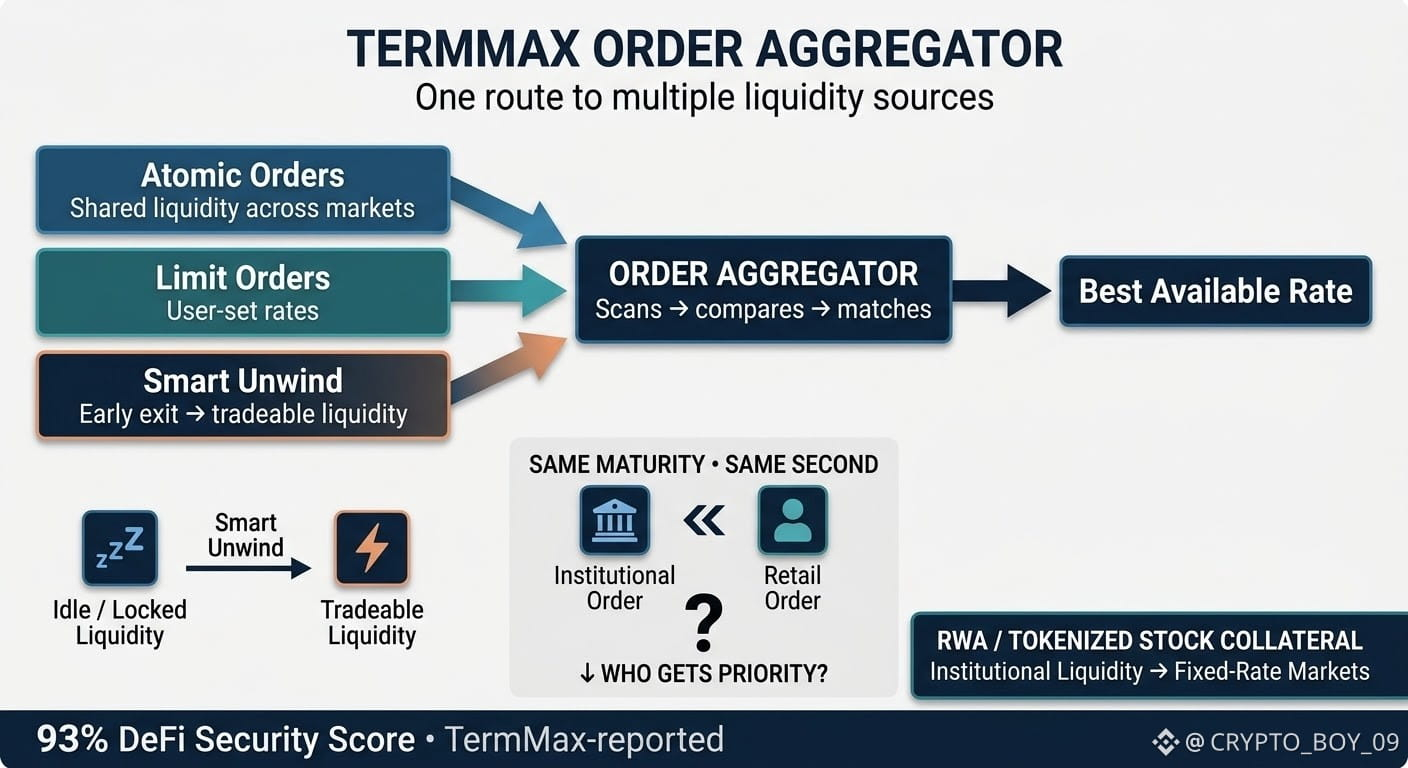
Instead of checking everything separately, it brings liquidity from three different sources into one place:
1- Atomic Orders that are ready to use
2- Limit orders placed by other users
3- Smart Unwind positions where someone is exiting before maturity
Normally, you’d have to find these separately, and sometimes deal with multiple transactions. Here, they’re all available in one shot.
The part I found most interesting is Smart Unwind.
Some liquidity would otherwise just sit there until maturity, basically “sleeping.” Aggregating that liquidity means capital that felt stuck can actually become usable again.
That said, I’m not assuming smooth automation will always stay smooth. When markets are calm, optimization is easy. The real test comes when everyone wants the same maturity and liquidity gets tight.
And now that institutional collateral like tokenized stocks is coming into the picture, with a security score comparable to Aave V3, this starts to feel like more than just a small experiment.
So the question isn’t whether combining three liquidity sources is smart. It is.
The real question is: when a large institutional order and my small order want the same liquidity at the exact same second, who gets priority?
@TermMax #TermMax
$RICE $BTW $ACE
Then I tried #TermMax ’s Order Aggregator and finally understood what it’s actually doing.
Instead of checking everything separately, it brings liquidity from three different sources into one place:
1- Atomic Orders that are ready to use
2- Limit orders placed by other users
3- Smart Unwind positions where someone is exiting before maturity
Normally, you’d have to find these separately, and sometimes deal with multiple transactions. Here, they’re all available in one shot.
The part I found most interesting is Smart Unwind.
Some liquidity would otherwise just sit there until maturity, basically “sleeping.” Aggregating that liquidity means capital that felt stuck can actually become usable again.
That said, I’m not assuming smooth automation will always stay smooth. When markets are calm, optimization is easy. The real test comes when everyone wants the same maturity and liquidity gets tight.
And now that institutional collateral like tokenized stocks is coming into the picture, with a security score comparable to Aave V3, this starts to feel like more than just a small experiment.
So the question isn’t whether combining three liquidity sources is smart. It is.
The real question is: when a large institutional order and my small order want the same liquidity at the exact same second, who gets priority?
@TermMax #TermMax
$RICE $BTW $ACE