Lately, I’ve been checking fixed-income markets across chains, and one thing keeps bothering me: ten networks can look like diversification while the actual liquidity underneath remains thin.
The common assumption is simple: more chains = more capital efficiency. I’m not convinced.
@TermMax is interesting because it attacks the plumbing rather than just adding another lending interface.
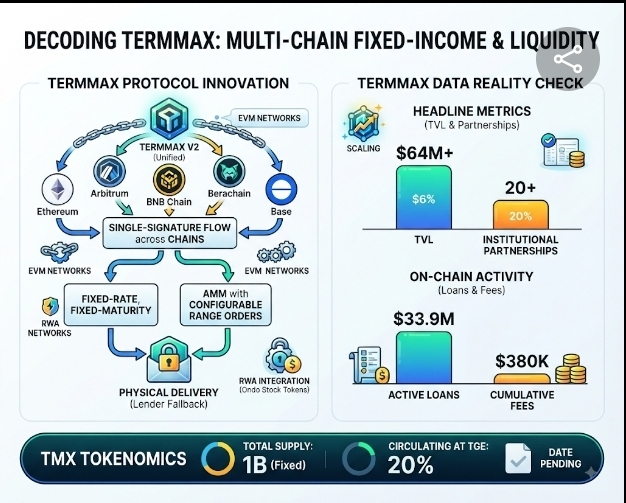
Its fixed-rate, fixed-maturity markets use an AMM with configurable range orders, while V2 brings unified orders and a single-signature flow across chains.
Physical delivery also gives lenders a fallback when volatility or liquidity makes normal liquidation impractical.
📊 The Data Reality Check
The latest rollout makes this tangible.
#TermMax now lists Ethereum, Arbitrum, BNB Chain, Berachain, Base, and other EVM networks, while its app highlights RWA markets involving Ondo stock tokens.
That creates a real-world use case: borrowing against tokenized financial assets rather than farming another volatile token.
However, a quick sanity check matters:
Headline Metrics: Cites $64M+ TVL and 20+ institutional partnerships.
On-Chain Reality: DeFiLlama shows about $33.9M in active loans and cumulative fees around $380K.
These numbers aren’t contradictory; they highlight why headline TVL is never the same as active fixed-income liquidity.
🏛️ The Institutional Angle & Tokenomics
For institutions, this matters beyond yield.
A MiCA- or securities-regulated environment needs predictable settlement, auditable rules, and controlled disclosure.
TermMax helps with rate and execution certainty, but privacy/compliance controls still have to exist around the asset and venue.
As for $TMX, the whitepaper targets a 1B fixed supply with 20% circulating at TGE August 25.
The bigger question I’m watching: Do institutions really need maximum privacy, or programmable privacy that knows when to hide and when to reveal?
Drop your thoughts below! 👇
The common assumption is simple: more chains = more capital efficiency. I’m not convinced.
@TermMax is interesting because it attacks the plumbing rather than just adding another lending interface.
Its fixed-rate, fixed-maturity markets use an AMM with configurable range orders, while V2 brings unified orders and a single-signature flow across chains.
Physical delivery also gives lenders a fallback when volatility or liquidity makes normal liquidation impractical.
📊 The Data Reality Check
The latest rollout makes this tangible.
#TermMax now lists Ethereum, Arbitrum, BNB Chain, Berachain, Base, and other EVM networks, while its app highlights RWA markets involving Ondo stock tokens.
That creates a real-world use case: borrowing against tokenized financial assets rather than farming another volatile token.
However, a quick sanity check matters:
Headline Metrics: Cites $64M+ TVL and 20+ institutional partnerships.
On-Chain Reality: DeFiLlama shows about $33.9M in active loans and cumulative fees around $380K.
These numbers aren’t contradictory; they highlight why headline TVL is never the same as active fixed-income liquidity.
🏛️ The Institutional Angle & Tokenomics
For institutions, this matters beyond yield.
A MiCA- or securities-regulated environment needs predictable settlement, auditable rules, and controlled disclosure.
TermMax helps with rate and execution certainty, but privacy/compliance controls still have to exist around the asset and venue.
As for $TMX, the whitepaper targets a 1B fixed supply with 20% circulating at TGE August 25.
The bigger question I’m watching: Do institutions really need maximum privacy, or programmable privacy that knows when to hide and when to reveal?
Drop your thoughts below! 👇