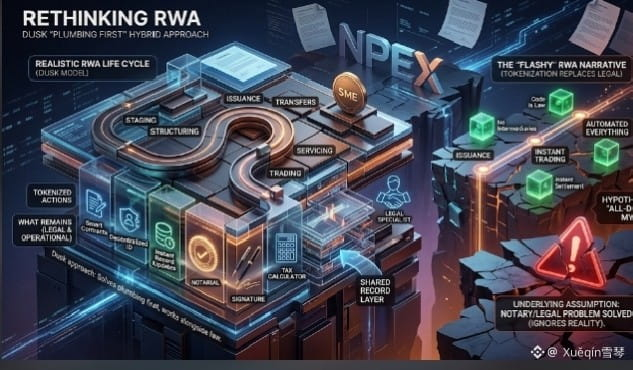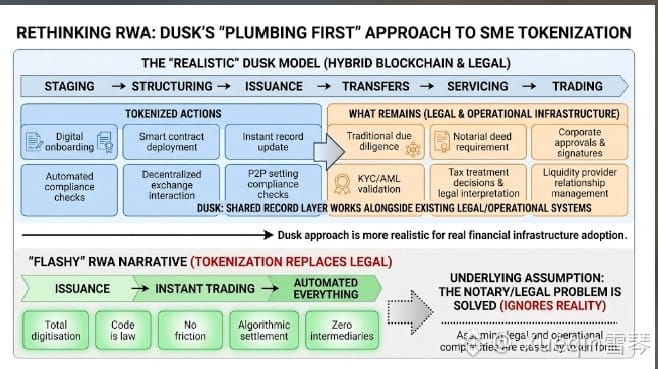
#dusk $DUSK @Dusk I was digging through Dusk’s SME tokenization work and almost skipped over one small detail: the six-stage lifecycle table.
Then I noticed the “what remains” column.
Structuring still needs corporate approvals. Transfers can still require a notary. Servicing still involves people making decisions around things like tax treatment.
That changed how I look at Dusk.
The interesting part isn’t that tokenization magically replaces the existing legal system. It doesn’t.
What Dusk seems to be building is a shared record layer that works alongside the legal and operational infrastructure already there.
The NPEX context makes this especially clear. If Dutch BV shares still require a notarial deed, putting them into token form doesn’t suddenly erase that requirement.
And honestly, I think that’s more realistic than a lot of RWA narratives.
Tokenization may remove reconciliation, fragmented records and some operational friction, while leaving laws, notaries and accountable operators exactly where they need to be.
That feels less flashy, but probably much closer to how real financial infrastructure gets adopted.
Dusk may be solving the plumbing first.
The trading experience can come later.
It made me wonder: how many RWA narratives quietly assume the notary problem has already been solved?
@Dusk
#dusk
$DUSK
Then I noticed the “what remains” column.
Structuring still needs corporate approvals. Transfers can still require a notary. Servicing still involves people making decisions around things like tax treatment.
That changed how I look at Dusk.
The interesting part isn’t that tokenization magically replaces the existing legal system. It doesn’t.
What Dusk seems to be building is a shared record layer that works alongside the legal and operational infrastructure already there.
The NPEX context makes this especially clear. If Dutch BV shares still require a notarial deed, putting them into token form doesn’t suddenly erase that requirement.
And honestly, I think that’s more realistic than a lot of RWA narratives.
Tokenization may remove reconciliation, fragmented records and some operational friction, while leaving laws, notaries and accountable operators exactly where they need to be.
That feels less flashy, but probably much closer to how real financial infrastructure gets adopted.
Dusk may be solving the plumbing first.
The trading experience can come later.
It made me wonder: how many RWA narratives quietly assume the notary problem has already been solved?
@Dusk
#dusk
$DUSK