
good


Publier

Rida Malik7
·
--
Haussier#dusk $DUSK @Dusk
The hardest part of financial innovation has never been creating another asset. It has been building a market where that asset can actually move, settle, and trade efficiently.
That distinction matters more than it first appears. Tokenizing a bond, fund, or other real-world asset is relatively easy to describe. Creating the infrastructure around it—privacy, compliance, settlement, liquidity, and reliable market access—is where the real challenge begins.
This is where I find Dusk interesting.
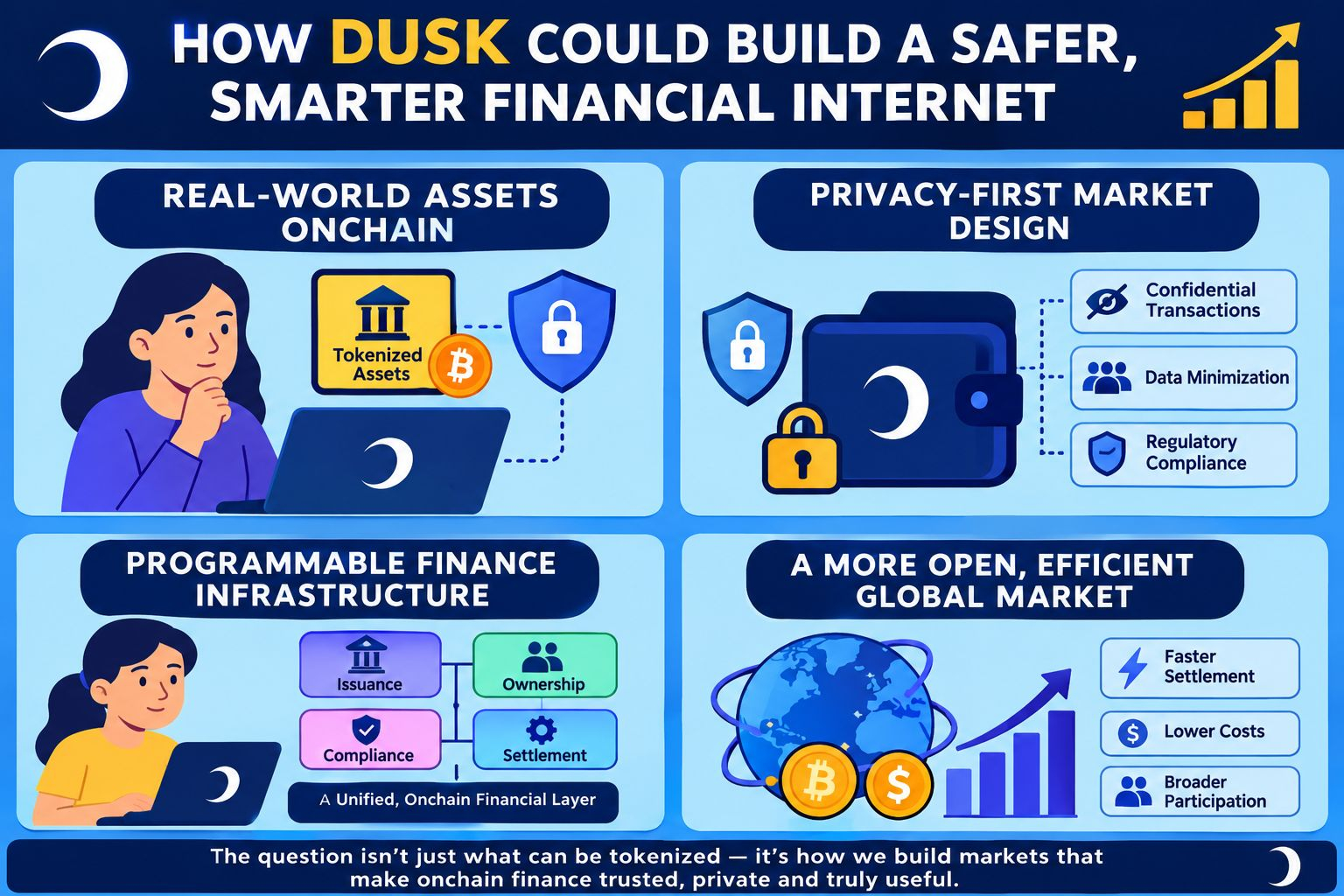
Its broader thesis seems less about putting traditional assets on a blockchain and more about making regulated financial activity native to an onchain environment. That changes the question from “Can this asset be tokenized?” to “Can this asset participate in a functioning market?”
The second-order effects could be significant. If issuance, ownership, compliance, and settlement become programmable, financial markets may become less dependent on fragmented intermediaries. But programmability also creates new dependencies: liquidity still has to exist, institutions still need incentives, and privacy cannot simply be treated as an optional feature.
Maybe the real test for Dusk is not whether assets can move onchain, but whether markets built around them can become genuinely useful.
$METAB
$PORTAL
The hardest part of financial innovation has never been creating another asset. It has been building a market where that asset can actually move, settle, and trade efficiently.
That distinction matters more than it first appears. Tokenizing a bond, fund, or other real-world asset is relatively easy to describe. Creating the infrastructure around it—privacy, compliance, settlement, liquidity, and reliable market access—is where the real challenge begins.
This is where I find Dusk interesting.
Its broader thesis seems less about putting traditional assets on a blockchain and more about making regulated financial activity native to an onchain environment. That changes the question from “Can this asset be tokenized?” to “Can this asset participate in a functioning market?”
The second-order effects could be significant. If issuance, ownership, compliance, and settlement become programmable, financial markets may become less dependent on fragmented intermediaries. But programmability also creates new dependencies: liquidity still has to exist, institutions still need incentives, and privacy cannot simply be treated as an optional feature.
Maybe the real test for Dusk is not whether assets can move onchain, but whether markets built around them can become genuinely useful.
$METAB
$PORTAL
Avertissement : ce contenu inclut des opinions de tiers. Il ne constitue pas un conseil. Binance Ai peut être utilisée, sans garantie de résultat. Consultez les CG.