#termmax @TermMax
One feature I keep coming back to in @TermMax is the two-way range order.
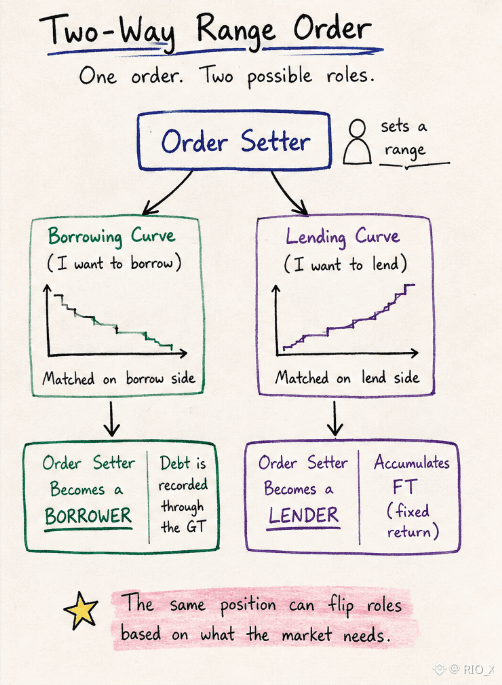
It combines a borrowing curve and a lending curve inside one order.
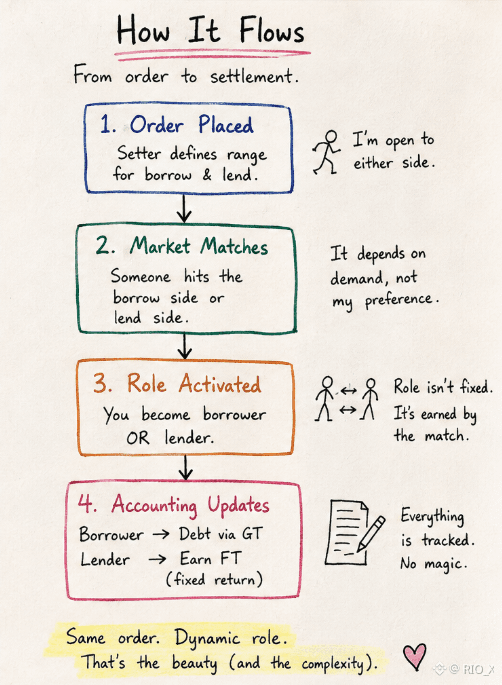
That means the same order setter can potentially participate on either side depending on what the market actually needs.
If the borrowing curve gets matched, the order setter becomes a borrower and debt gets recorded through the GT. $ACE
If the lending curve gets matched, the order setter becomes a lender and accumulates FT representing the fixed return.
That's a very different mental model from simply depositing assets into a pool.
The position can change role based on which side of the market is filled. $GPS
I like mechanisms like this because the capital isn't assigned to only one outcome from the start.
The trade-off is complexity. $TUT
Dynamic roles require more careful understanding of the accounting, pricing and eventual settlement.
Still, as a MARKET structure, it's one of the more interesting parts of TermMax.
One feature I keep coming back to in @TermMax is the two-way range order.
It combines a borrowing curve and a lending curve inside one order.
That means the same order setter can potentially participate on either side depending on what the market actually needs.
If the borrowing curve gets matched, the order setter becomes a borrower and debt gets recorded through the GT. $ACE
If the lending curve gets matched, the order setter becomes a lender and accumulates FT representing the fixed return.
That's a very different mental model from simply depositing assets into a pool.
The position can change role based on which side of the market is filled. $GPS
I like mechanisms like this because the capital isn't assigned to only one outcome from the start.
The trade-off is complexity. $TUT
Dynamic roles require more careful understanding of the accounting, pricing and eventual settlement.
Still, as a MARKET structure, it's one of the more interesting parts of TermMax.
borrowing curve
100%
lending curve
0%
fixed return
0%
4 Votes • Vote fermé