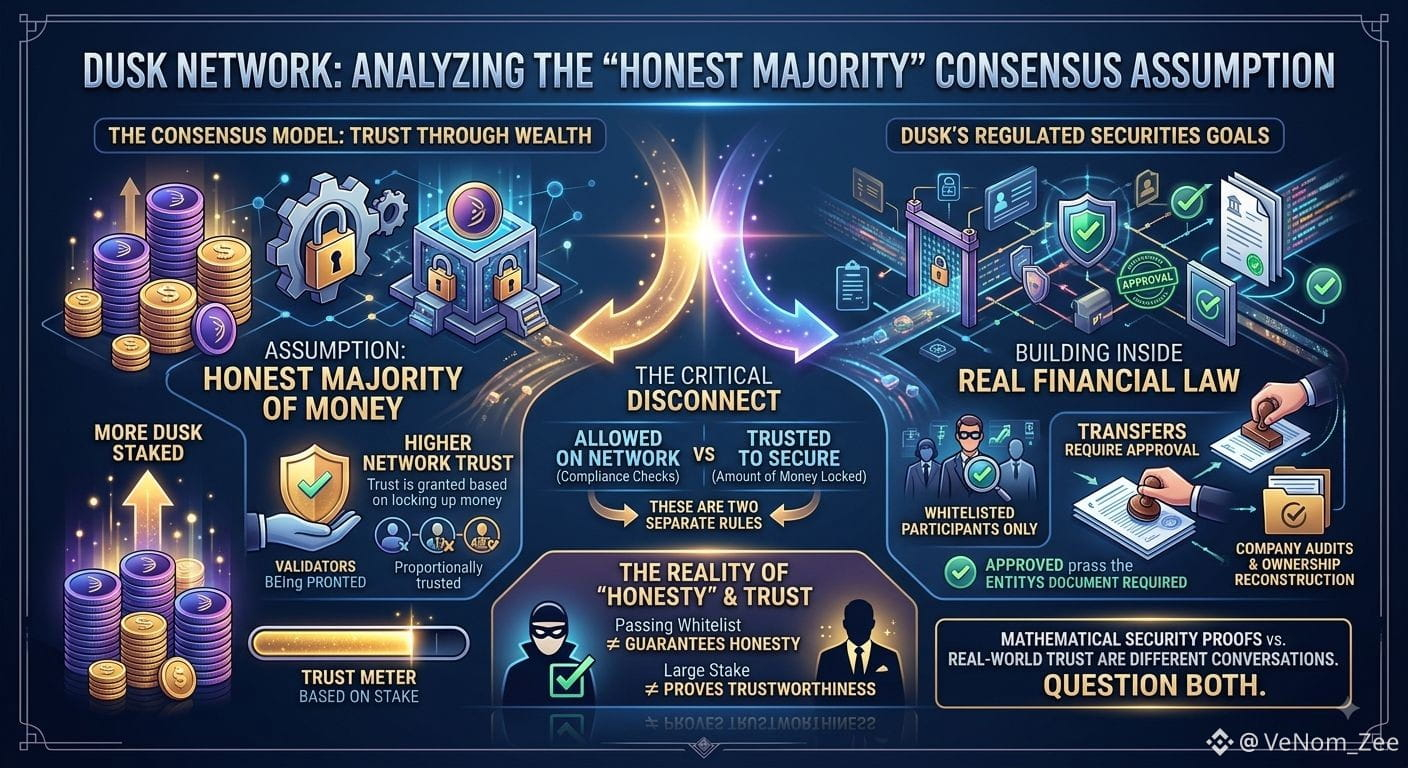
I've been sitting with a phrase from Dusk Network's whitepaper for a few days now: "honest majority of money." That's the actual assumption their consensus system runs on — the more DUSK someone has staked, the more the network trusts them to act honestly.
What pulled me in wasn't the cryptography, it was the goal behind it. Dusk isn't just trying to be a private coin. It's built around regulated securities — whitelisted participants, transfers that need approval before they settle, records built so a company can reconstruct exactly who owned what at any given moment. That's a genuine attempt to work inside real financial law instead of around it, which is rarer than it sounds in this space.
Here's where I slow down, though. Being allowed onto the network and being trusted to secure it are two separate questions, answered by two separate rules. One is decided by compliance checks. The other is decided by how much money someone is willing to lock up. Nothing in the design guarantees those two things line up. Passing a whitelist doesn't make someone honest, and neither does having a large stake — history has plenty of wealthy people who weren't trustworthy at all.
None of this makes the project bad. It just means the math proving the system is "secure" and the real-world question of who actually deserves trust are two different conversations, and it's worth questioning both instead of accepting either at face value.
Still learning as I go — and I think that's the only honest way to approach any of this.
@Dusk #dusk $DUSK
What pulled me in wasn't the cryptography, it was the goal behind it. Dusk isn't just trying to be a private coin. It's built around regulated securities — whitelisted participants, transfers that need approval before they settle, records built so a company can reconstruct exactly who owned what at any given moment. That's a genuine attempt to work inside real financial law instead of around it, which is rarer than it sounds in this space.
Here's where I slow down, though. Being allowed onto the network and being trusted to secure it are two separate questions, answered by two separate rules. One is decided by compliance checks. The other is decided by how much money someone is willing to lock up. Nothing in the design guarantees those two things line up. Passing a whitelist doesn't make someone honest, and neither does having a large stake — history has plenty of wealthy people who weren't trustworthy at all.
None of this makes the project bad. It just means the math proving the system is "secure" and the real-world question of who actually deserves trust are two different conversations, and it's worth questioning both instead of accepting either at face value.
Still learning as I go — and I think that's the only honest way to approach any of this.
@Dusk #dusk $DUSK