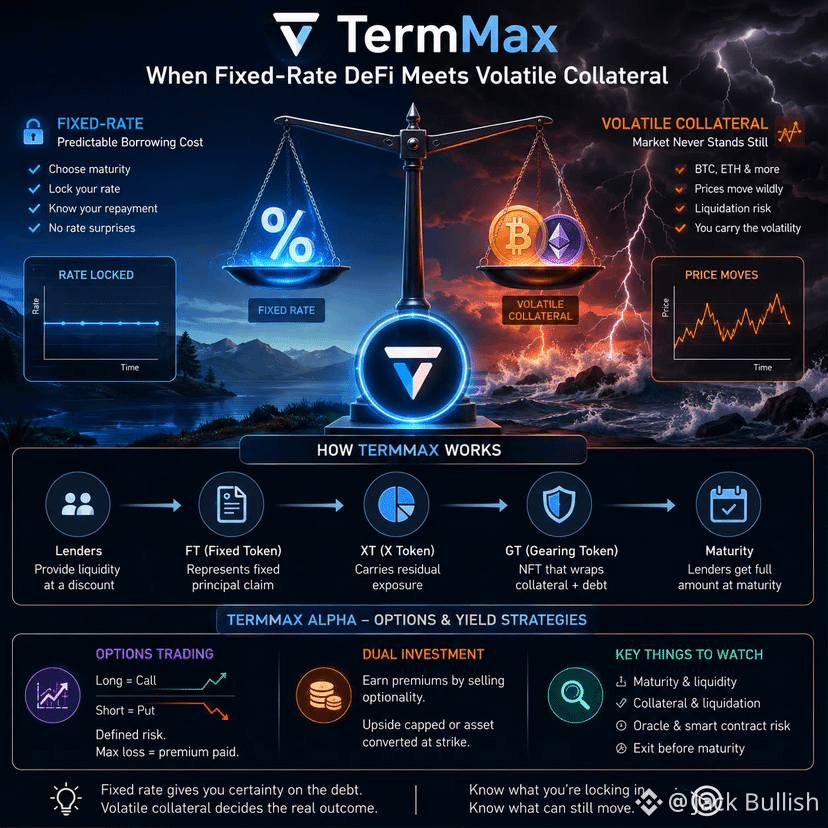

I think TermMax gets more interesting the longer you stare at it.
At first, it just looks like another fixed-rate lending protocol.
Then you realize the weird part:
your borrowing rate can stay still while the asset backing that loan moves like a maniac.
That changes how you think about the position.
With normal DeFi lending, I’m usually watching the borrow rate first.
5% now.
8% tomorrow.
12% when liquidity gets tight.
TermMax removes some of that noise.
You pick the maturity.
You lock the rate.
You know what the debt should look like when that date arrives.
Sounds comfortable.
Until BTC drops 18%.
Then you remember:
the rate was fixed.
The collateral wasn't.
That’s the part people gloss over.
TermMax isn't removing risk.
It is separating it.
Interest-rate risk becomes easier to see.
Collateral risk becomes much more important.
And suddenly maturity matters more than an APR headline.
A 30-day position and a 180-day position can look similar on a dashboard and feel completely different once you're inside one.
Because time is part of the trade.
Then there’s Alpha.
This is where TermMax starts feeling less like a lending app and more like something a trader would actually sit with.
You can express long and short option exposure with defined strikes and premiums.
Clean structure.
But defined risk isn't the same as no risk.
A premium collected today can look tiny when the market is quiet and very different after a violent move.
Same with Dual Investment.
The yield is tempting until you remember what you're giving up to earn it.
That’s usually the quiet part.
The number on the screen is the reward.
The thing you're giving away is underneath it.
And that’s what keeps me interested in TermMax.
Not the fixed-rate headline.
The fact that it makes you pay attention to things DeFi users often ignore:
maturity, exit liquidity, collateral quality, liquidation mechanics, and who carries the ugly part of the trade.
A fixed rate can make a position feel calm.
The collateral will tell you whether it really is.
#termmax @TermMax
At first, it just looks like another fixed-rate lending protocol.
Then you realize the weird part:
your borrowing rate can stay still while the asset backing that loan moves like a maniac.
That changes how you think about the position.
With normal DeFi lending, I’m usually watching the borrow rate first.
5% now.
8% tomorrow.
12% when liquidity gets tight.
TermMax removes some of that noise.
You pick the maturity.
You lock the rate.
You know what the debt should look like when that date arrives.
Sounds comfortable.
Until BTC drops 18%.
Then you remember:
the rate was fixed.
The collateral wasn't.
That’s the part people gloss over.
TermMax isn't removing risk.
It is separating it.
Interest-rate risk becomes easier to see.
Collateral risk becomes much more important.
And suddenly maturity matters more than an APR headline.
A 30-day position and a 180-day position can look similar on a dashboard and feel completely different once you're inside one.
Because time is part of the trade.
Then there’s Alpha.
This is where TermMax starts feeling less like a lending app and more like something a trader would actually sit with.
You can express long and short option exposure with defined strikes and premiums.
Clean structure.
But defined risk isn't the same as no risk.
A premium collected today can look tiny when the market is quiet and very different after a violent move.
Same with Dual Investment.
The yield is tempting until you remember what you're giving up to earn it.
That’s usually the quiet part.
The number on the screen is the reward.
The thing you're giving away is underneath it.
And that’s what keeps me interested in TermMax.
Not the fixed-rate headline.
The fact that it makes you pay attention to things DeFi users often ignore:
maturity, exit liquidity, collateral quality, liquidation mechanics, and who carries the ugly part of the trade.
A fixed rate can make a position feel calm.
The collateral will tell you whether it really is.
#termmax @TermMax