The more I dug into Dusk, one thing just wouldn't leave my head.
Everyone talks about privacy like it's a single switch you turn on. Either a chain is private, or it isn't.
But refunds broke that idea for me.
Think about it. You send funds into a contract, something fails, and the money comes back. Simple, right?
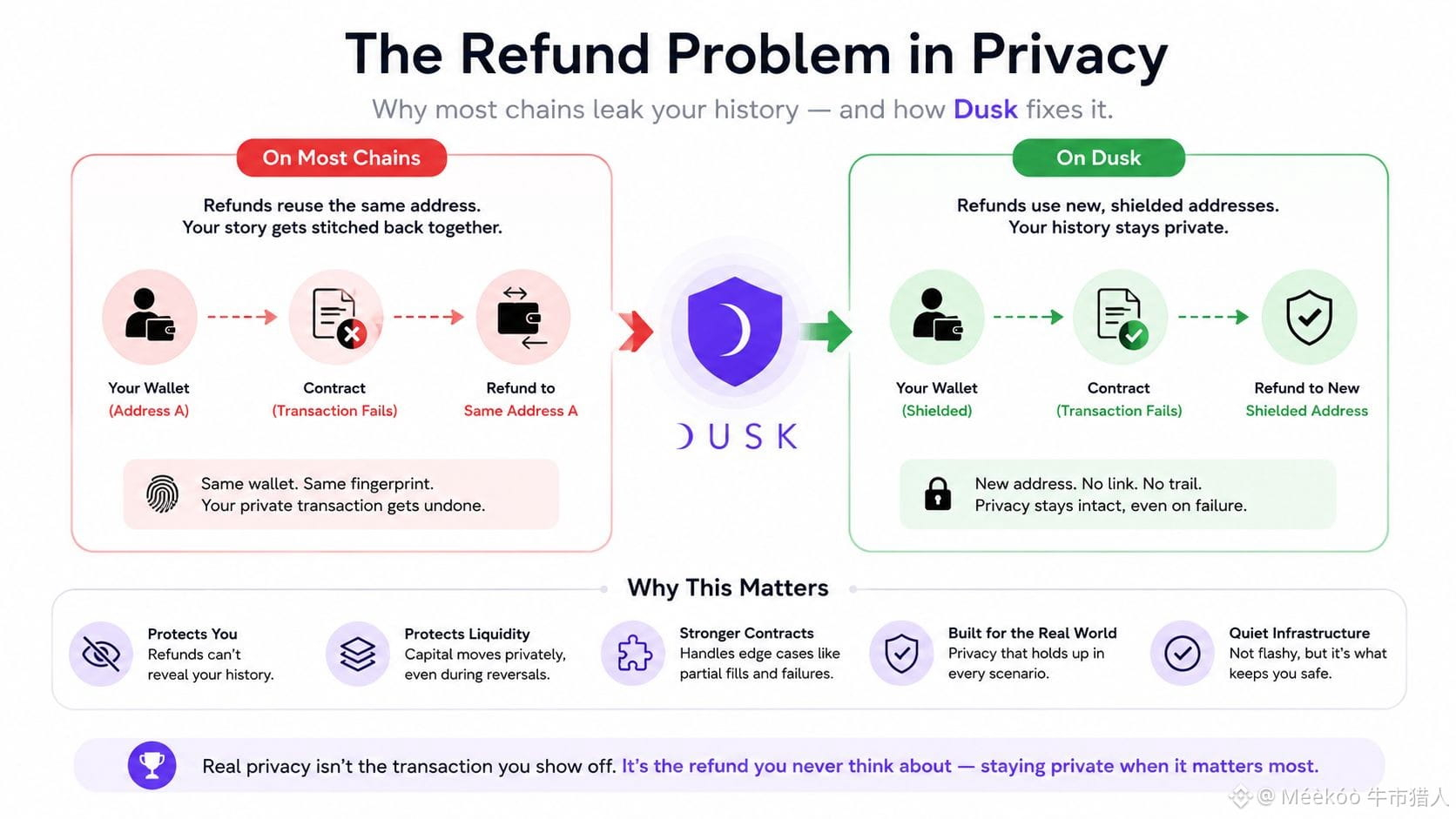
Except on most chains, that return trip uses the same address you started with. Same wallet, same fingerprint, same story stitched back together.
So the "private" transaction you just did gets quietly undone by its own refund.
That's not some rare glitch. It's a gap nobody designed around.
I think this is where the market gets Dusk wrong. People look at charts, listings, maybe TVL, and call it a day.
Nobody's asking what happens when a transaction doesn't go as planned. That's the real test of privacy, not the happy path.
Dusk actually treats that failure case as core design, not an afterthought.
Its shielded execution model doesn't reuse addresses for returns, so a refund can't reconnect you to your own history.
To me, that's the part that matters. It's not flashy, it won't trend on its own, but it protects liquidity movement at a level most people never think to check.
It also means contracts can coordinate without confidential data leaking through edge cases like partial fills or reversals.
Nobody claps for infrastructure like this. It just quietly works, until the day it's the only thing standing between you and exposure.
That's my honest take. Real privacy isn't the transaction you show off. It's the one you never think about, the refund, staying just as closed as everything else.
#dusk $DUSK @Dusk
Everyone talks about privacy like it's a single switch you turn on. Either a chain is private, or it isn't.
But refunds broke that idea for me.
Think about it. You send funds into a contract, something fails, and the money comes back. Simple, right?
Except on most chains, that return trip uses the same address you started with. Same wallet, same fingerprint, same story stitched back together.
So the "private" transaction you just did gets quietly undone by its own refund.
That's not some rare glitch. It's a gap nobody designed around.
I think this is where the market gets Dusk wrong. People look at charts, listings, maybe TVL, and call it a day.
Nobody's asking what happens when a transaction doesn't go as planned. That's the real test of privacy, not the happy path.
Dusk actually treats that failure case as core design, not an afterthought.
Its shielded execution model doesn't reuse addresses for returns, so a refund can't reconnect you to your own history.
To me, that's the part that matters. It's not flashy, it won't trend on its own, but it protects liquidity movement at a level most people never think to check.
It also means contracts can coordinate without confidential data leaking through edge cases like partial fills or reversals.
Nobody claps for infrastructure like this. It just quietly works, until the day it's the only thing standing between you and exposure.
That's my honest take. Real privacy isn't the transaction you show off. It's the one you never think about, the refund, staying just as closed as everything else.
#dusk $DUSK @Dusk