#dusk $DUSK @Dusk
I went back through Dusk’s documentation last night because “regulated DeFi” is easy to say, but harder to picture as a system.
I first thought the main idea was private tokenization. A few pages later, my view changed: the token is only one piece. The harder job is joining identity, transfer rules and settlement without exposing every balance or credential.
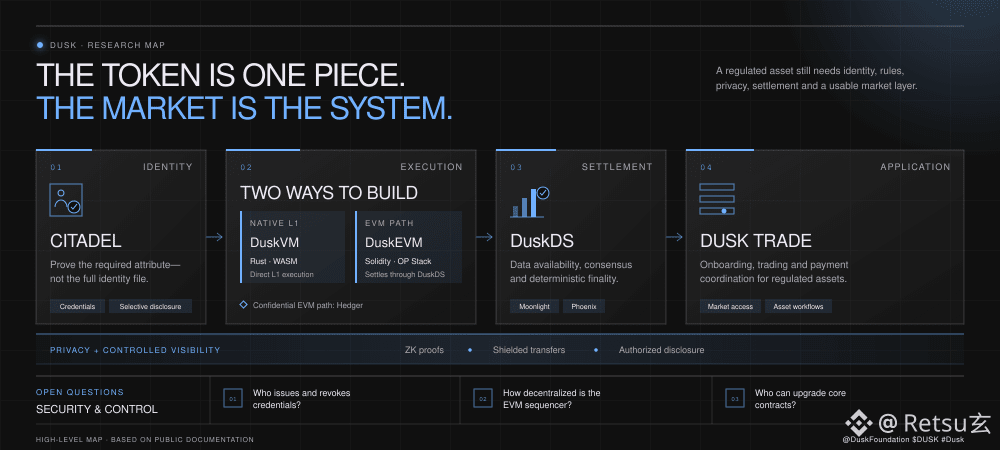
The DuskVM/DuskEVM split helped. DuskVM runs Rust/WASM contracts on the L1; DuskEVM lets Solidity apps publish data and settle through DuskDS. My read is that one path sits closer to Dusk’s native privacy tools, while the other lowers the barrier for Ethereum developers.
Citadel is where I still have questions. Proving “I’m eligible” without revealing a full identity record makes sense, but who issues and revokes credentials? What happens if an issuer is compromised? Who controls access when disclosure is legally required?
I’m also unsure how decentralization works across the stack. Succinct Attestation is described as permissionless and committee-based, but how decentralized is the DuskEVM sequencer? Who can upgrade bridges or core contracts, and what checks apply? The DIP process records proposals, but I couldn’t find a clear answer on final decisions.
Where is the biggest security assumption? Can privacy, regulatory control and credible neutrality coexist without one dominating?
I went back through Dusk’s documentation last night because “regulated DeFi” is easy to say, but harder to picture as a system.
I first thought the main idea was private tokenization. A few pages later, my view changed: the token is only one piece. The harder job is joining identity, transfer rules and settlement without exposing every balance or credential.
The DuskVM/DuskEVM split helped. DuskVM runs Rust/WASM contracts on the L1; DuskEVM lets Solidity apps publish data and settle through DuskDS. My read is that one path sits closer to Dusk’s native privacy tools, while the other lowers the barrier for Ethereum developers.
Citadel is where I still have questions. Proving “I’m eligible” without revealing a full identity record makes sense, but who issues and revokes credentials? What happens if an issuer is compromised? Who controls access when disclosure is legally required?
I’m also unsure how decentralization works across the stack. Succinct Attestation is described as permissionless and committee-based, but how decentralized is the DuskEVM sequencer? Who can upgrade bridges or core contracts, and what checks apply? The DIP process records proposals, but I couldn’t find a clear answer on final decisions.
Where is the biggest security assumption? Can privacy, regulatory control and credible neutrality coexist without one dominating?