I initially thought a DeFi vault was just a smarter “deposit and earn” button.
Then I looked closer at @TermMax , especially the V2 Vault design, and realized I was missing the more interesting part: what happens to the capital after I deposit?
The answer isn’t simply “it earns yield.”
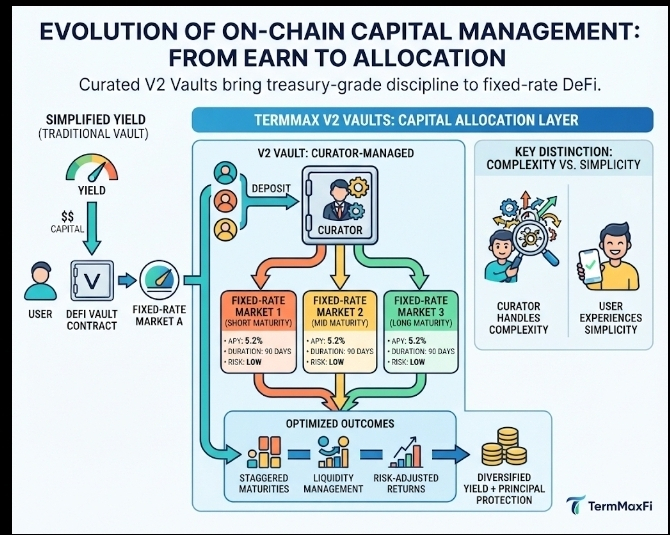
TermMax V2 Vaults let professional curators manage capital across different fixed-rate markets and maturities.
That changes the problem from “Which market should I pick today?” to “How should capital be allocated across several markets over time?”
That distinction sounds small, but for me it’s the whole point.
A treasury manager doesn’t normally put every dollar into one instrument just because its rate looks attractive.
They stagger maturities, manage liquidity and think about risk-adjusted returns.
TermMax is bringing a similar logic into on-chain fixed-rate markets.
And recent developments make this more tangible.
V2 Vault Architecture is live on mainnet, while TermMax has continued expanding its Earn products across chains, including RWA-oriented markets and Alpha products.
The infrastructure is starting to look less like a single lending product and more like a capital-allocation layer.
The funny part? 😅
The best vault may be the one that makes me think about my capital less, not more.
That’s where I see the practical value.
Curators handle the allocation complexity while vault rules can impose boundaries around capacity, supported markets and risk management. #TermMax .
With $TMX becoming part of the broader ecosystem, I’m more interested in one unanswered question:
Can curated on-chain capital management eventually become disciplined enough for serious treasury operations without turning the curator into the new single point of failure?
Then I looked closer at @TermMax , especially the V2 Vault design, and realized I was missing the more interesting part: what happens to the capital after I deposit?
The answer isn’t simply “it earns yield.”
TermMax V2 Vaults let professional curators manage capital across different fixed-rate markets and maturities.
That changes the problem from “Which market should I pick today?” to “How should capital be allocated across several markets over time?”
That distinction sounds small, but for me it’s the whole point.
A treasury manager doesn’t normally put every dollar into one instrument just because its rate looks attractive.
They stagger maturities, manage liquidity and think about risk-adjusted returns.
TermMax is bringing a similar logic into on-chain fixed-rate markets.
And recent developments make this more tangible.
V2 Vault Architecture is live on mainnet, while TermMax has continued expanding its Earn products across chains, including RWA-oriented markets and Alpha products.
The infrastructure is starting to look less like a single lending product and more like a capital-allocation layer.
The funny part? 😅
The best vault may be the one that makes me think about my capital less, not more.
That’s where I see the practical value.
Curators handle the allocation complexity while vault rules can impose boundaries around capacity, supported markets and risk management. #TermMax .
With $TMX becoming part of the broader ecosystem, I’m more interested in one unanswered question:
Can curated on-chain capital management eventually become disciplined enough for serious treasury operations without turning the curator into the new single point of failure?