I used to think tokenization had one obvious rule: if the asset is regulated, putting its ownership on a transparent ledger should make everything easier.
Then I started looking at what the ledger actually reveals.
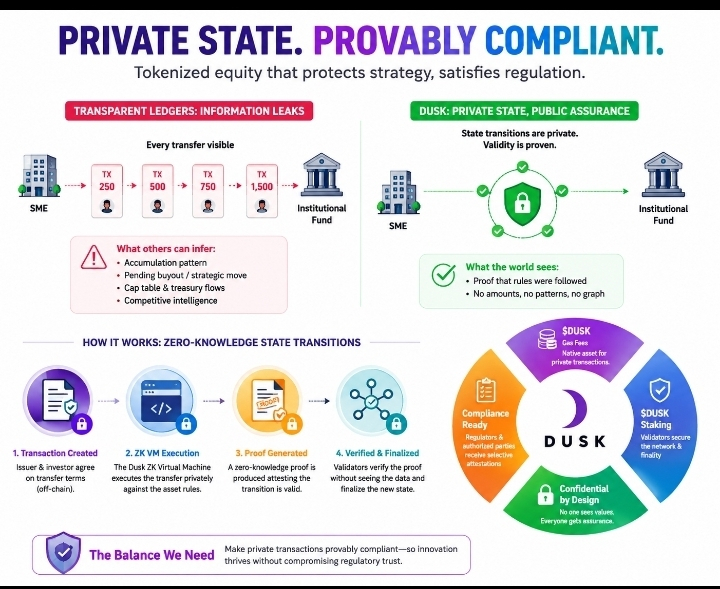
For an SME issuing private-market equity, “transparent” can quietly become “commercially exposed.”
Purchase timing, position changes and wallet activity can reveal accumulation patterns long before anyone knows the investor’s identity.
It reminded me of watching someone shop through a glass window.
You might not know their name, but after six months, you can probably guess what they’re planning. 😅
That’s the part of @Dusk I find more interesting than the usual privacy pitch.
Its architecture separates settlement from execution, while Phoenix supports shielded, note-based transfers where zero-knowledge proofs can verify correctness without exposing the amount or specific notes involved.
Selective disclosure can then provide information to authorized parties when required.
And there’s a useful recent development here: DuskEVM’s testnet went live in August, giving Solidity and Hardhat developers a familiar execution environment while still settling through DuskDS.
That matters because privacy infrastructure is only useful if developers can actually build market workflows around it. #dusk .
Imagine a fund accumulating restricted SME shares over six months.
The regulator may need proof of eligibility and ownership rules.
The issuer may need controlled visibility. But every competitor doesn’t need the entire trading trail.
That, to me, is the practical insight.
The goal isn’t hiding from regulation.
It’s reducing unnecessary information leakage while preserving verifiability.
$DUSK handles the network’s gas and staking layer.
So the question I’m still watching is: can private state become normal market infrastructure without making verification harder than transparency?
Then I started looking at what the ledger actually reveals.
For an SME issuing private-market equity, “transparent” can quietly become “commercially exposed.”
Purchase timing, position changes and wallet activity can reveal accumulation patterns long before anyone knows the investor’s identity.
It reminded me of watching someone shop through a glass window.
You might not know their name, but after six months, you can probably guess what they’re planning. 😅
That’s the part of @Dusk I find more interesting than the usual privacy pitch.
Its architecture separates settlement from execution, while Phoenix supports shielded, note-based transfers where zero-knowledge proofs can verify correctness without exposing the amount or specific notes involved.
Selective disclosure can then provide information to authorized parties when required.
And there’s a useful recent development here: DuskEVM’s testnet went live in August, giving Solidity and Hardhat developers a familiar execution environment while still settling through DuskDS.
That matters because privacy infrastructure is only useful if developers can actually build market workflows around it. #dusk .
Imagine a fund accumulating restricted SME shares over six months.
The regulator may need proof of eligibility and ownership rules.
The issuer may need controlled visibility. But every competitor doesn’t need the entire trading trail.
That, to me, is the practical insight.
The goal isn’t hiding from regulation.
It’s reducing unnecessary information leakage while preserving verifiability.
$DUSK handles the network’s gas and staking layer.
So the question I’m still watching is: can private state become normal market infrastructure without making verification harder than transparency?