#dusk @Dusk $DUSK
I used to think node recovery was basically just restarting a node and waiting for it to sync again.
After looking closer at how @Dusk approaches state recovery, I realized there is a more important question: what exactly is the node recovering?
The interesting part is that the state can be packaged and verified before being used for recovery. That changes the way I think about node downtime.
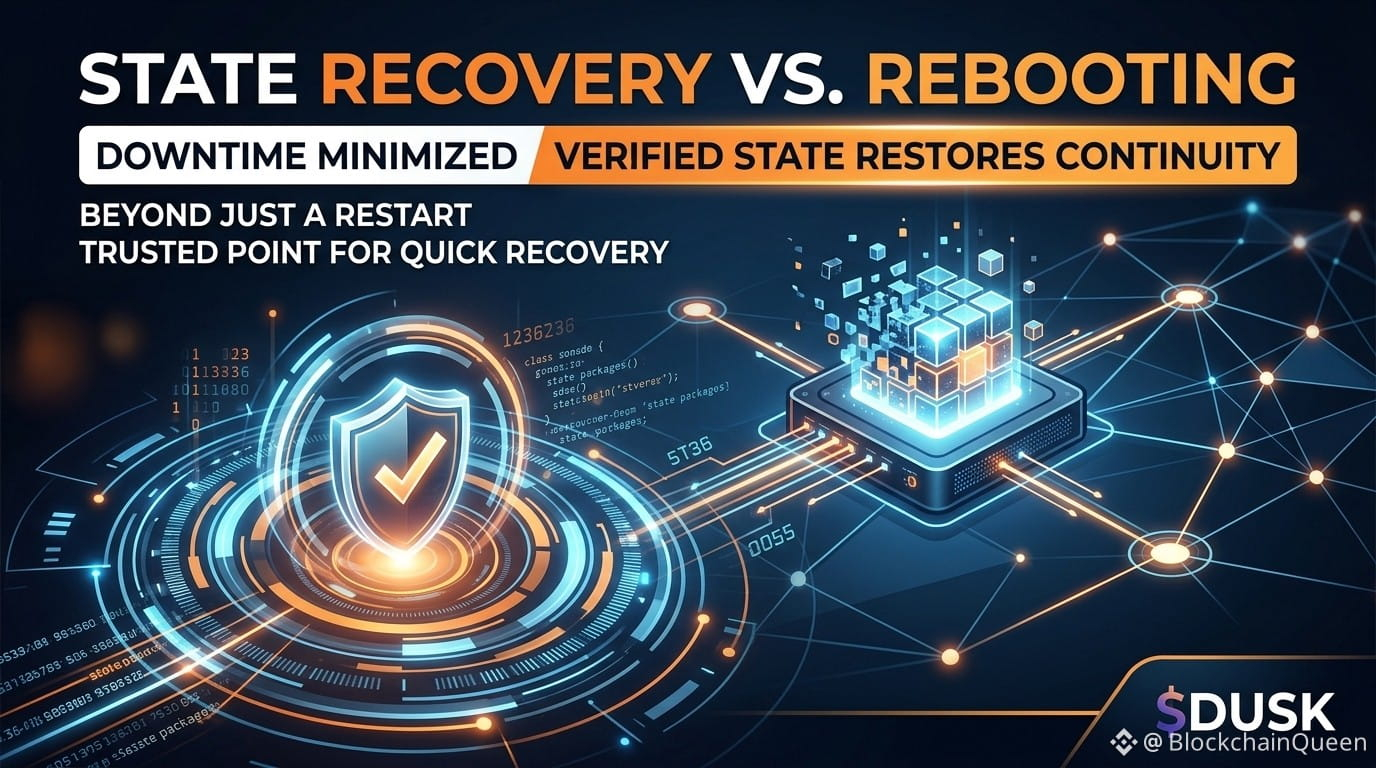
A restart gets a node running again. A verified state gives the node a trusted point to return to.
That distinction matters because rebuilding everything from scratch can mean repeating a lot of work just to reach a state the network has already established. If recovery can instead rely on a verified state, the process becomes less about starting over and more about restoring continuity.
I think this becomes increasingly relevant as the Dusk network grows. More nodes means recovery cannot just be an afterthought. Operators need a practical way to get back online without weakening the verification process that makes the network reliable in the first place.
What I find interesting about $DUSK is that these less visible infrastructure decisions can have a big effect on how a network behaves in the real world.
Would you trust a node more if it could recover from a verified state instead of rebuilding everything from scratch?
#dusk
I used to think node recovery was basically just restarting a node and waiting for it to sync again.
After looking closer at how @Dusk approaches state recovery, I realized there is a more important question: what exactly is the node recovering?
The interesting part is that the state can be packaged and verified before being used for recovery. That changes the way I think about node downtime.
A restart gets a node running again. A verified state gives the node a trusted point to return to.
That distinction matters because rebuilding everything from scratch can mean repeating a lot of work just to reach a state the network has already established. If recovery can instead rely on a verified state, the process becomes less about starting over and more about restoring continuity.
I think this becomes increasingly relevant as the Dusk network grows. More nodes means recovery cannot just be an afterthought. Operators need a practical way to get back online without weakening the verification process that makes the network reliable in the first place.
What I find interesting about $DUSK is that these less visible infrastructure decisions can have a big effect on how a network behaves in the real world.
Would you trust a node more if it could recover from a verified state instead of rebuilding everything from scratch?
#dusk