
#dusk $DUSK
I initially thought DuskEVM was mainly an EVM onboarding play. Then I looked at the market and the architecture together, and the contradiction became harder to ignore.
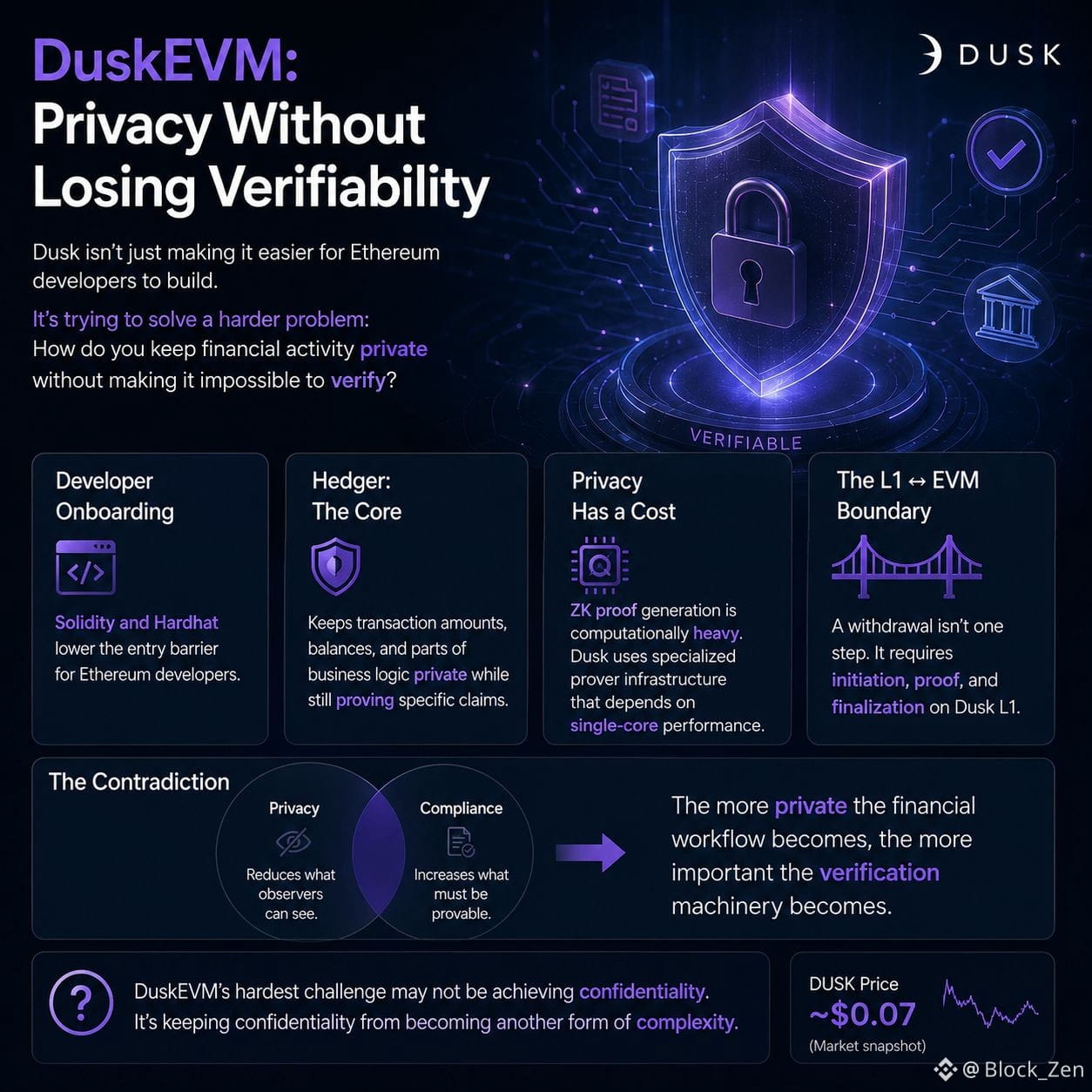
DUSK is trading around the ~$0.07 area, while the protocol is trying to solve a problem that is not really about price: how do you make financial activity private without making it impossible to verify?
Solidity and Hardhat lower the developer barrier, but Hedger is where my attention stayed.
The interesting part isn't simply hiding balances or transaction data. It's that Dusk is trying to keep sensitive information protected while still allowing specific claims to be proven.
But privacy has a cost.
ZK proof generation is computationally heavy enough that Dusk separates prover work into specialized infrastructure, with performance depending heavily on single-core capacity.
And then there is the bridge between Dusk L1 and DuskEVM. A withdrawal isn't just one action; it requires initiation, proof, and finalization on the L1.
So the contradiction I keep coming back to is this:
The more private the financial workflow becomes, the more important the verification machinery becomes.
Privacy reduces what observers can see.
Compliance increases what must be provable.
Maybe DuskEVM's hardest problem isn't achieving confidentiality.
It’s keeping confidentiality from becoming another form of complexity.
That’s the part I’m still watching.
@Dusk #dusk $DUSK
I initially thought DuskEVM was mainly an EVM onboarding play. Then I looked at the market and the architecture together, and the contradiction became harder to ignore.
DUSK is trading around the ~$0.07 area, while the protocol is trying to solve a problem that is not really about price: how do you make financial activity private without making it impossible to verify?
Solidity and Hardhat lower the developer barrier, but Hedger is where my attention stayed.
The interesting part isn't simply hiding balances or transaction data. It's that Dusk is trying to keep sensitive information protected while still allowing specific claims to be proven.
But privacy has a cost.
ZK proof generation is computationally heavy enough that Dusk separates prover work into specialized infrastructure, with performance depending heavily on single-core capacity.
And then there is the bridge between Dusk L1 and DuskEVM. A withdrawal isn't just one action; it requires initiation, proof, and finalization on the L1.
So the contradiction I keep coming back to is this:
The more private the financial workflow becomes, the more important the verification machinery becomes.
Privacy reduces what observers can see.
Compliance increases what must be provable.
Maybe DuskEVM's hardest problem isn't achieving confidentiality.
It’s keeping confidentiality from becoming another form of complexity.
That’s the part I’m still watching.
@Dusk #dusk $DUSK