I expected "Dusk partners with Chainlink" to mean the usual pitch. A bridge. Tokens moving across chains. The standard interoperability story every project eventually announces.
That's part of it, but it's the smaller part.
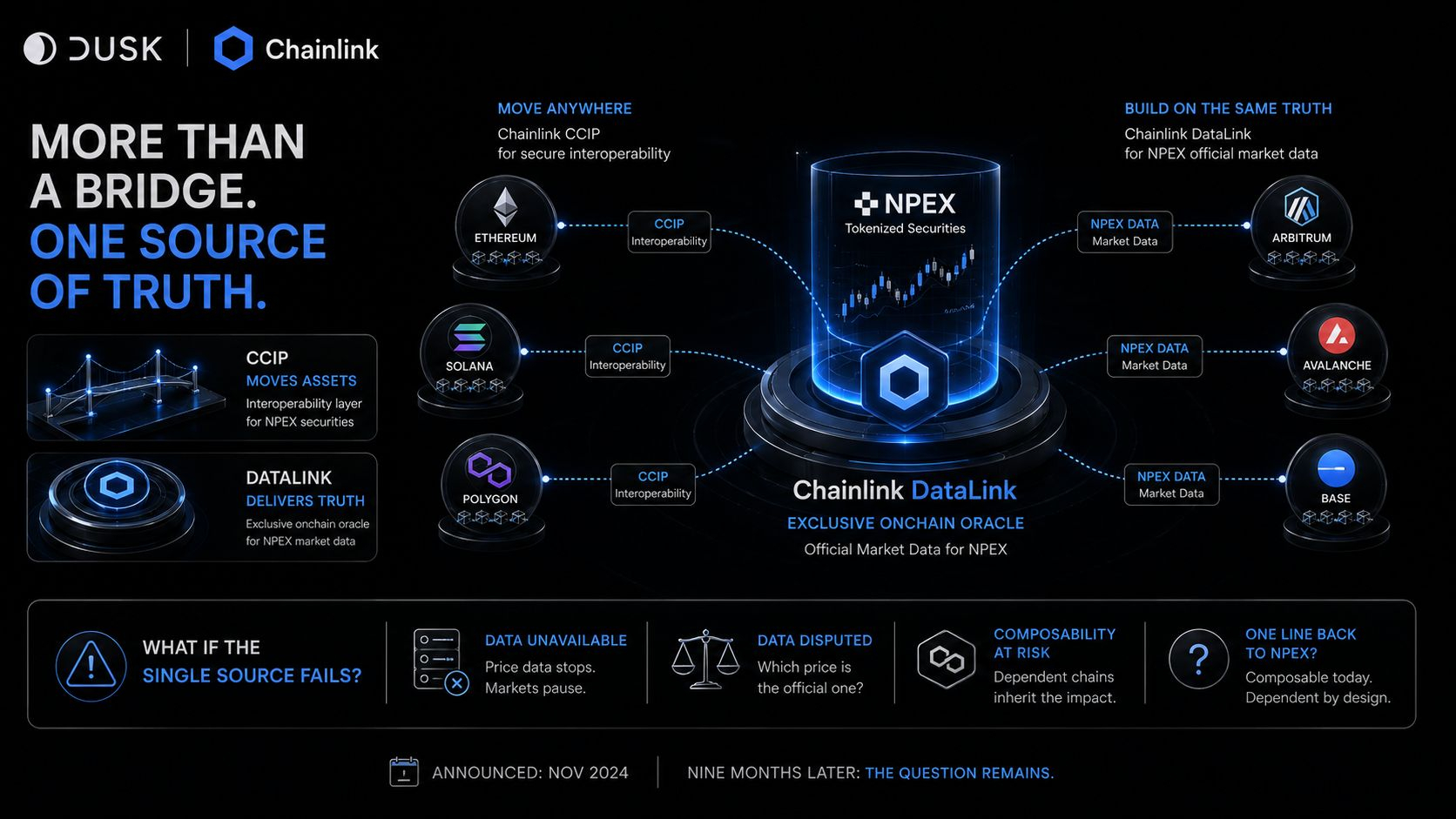
Announced back in November, the deal pairs Chainlink CCIP as the interoperability layer for NPEX's tokenized securities with something easy to skim past: Chainlink DataLink becoming the exclusive onchain data oracle for NPEX. Not one of several price feeds. The exclusive one. The same agreement also lets DUSK itself move natively between Ethereum and Solana through Chainlink's CCT standard, so the token gets the bridge story too.
Nine months on, that's the part worth separating out. CCIP lets an asset move across ecosystems. DataLink delivers the NPEX market data the receiving system can rely on. One is about reach. The other is about who gets to be believed. Any chain consuming that NPEX data is building on the same official market-data source.
I don't think that's automatically a flaw. Regulated markets already depend on authoritative market-data sources. But it does mean cross-chain composability here isn't completely neutral infrastructure. It's composability built around an exclusive source for NPEX's official market data, wherever that data eventually gets read.
"Being able to move an asset across chains and being the exclusive source for its official market data are two different kinds of power, even when one deal grants both."
What I'd actually want to know nine months in: what happens on the other chains if that exclusive NPEX data source becomes unavailable or disputed, and whether "composable" quietly means "dependent on one exclusive line back to NPEX."
#dusk $DUSK @Dusk
That's part of it, but it's the smaller part.
Announced back in November, the deal pairs Chainlink CCIP as the interoperability layer for NPEX's tokenized securities with something easy to skim past: Chainlink DataLink becoming the exclusive onchain data oracle for NPEX. Not one of several price feeds. The exclusive one. The same agreement also lets DUSK itself move natively between Ethereum and Solana through Chainlink's CCT standard, so the token gets the bridge story too.
Nine months on, that's the part worth separating out. CCIP lets an asset move across ecosystems. DataLink delivers the NPEX market data the receiving system can rely on. One is about reach. The other is about who gets to be believed. Any chain consuming that NPEX data is building on the same official market-data source.
I don't think that's automatically a flaw. Regulated markets already depend on authoritative market-data sources. But it does mean cross-chain composability here isn't completely neutral infrastructure. It's composability built around an exclusive source for NPEX's official market data, wherever that data eventually gets read.
"Being able to move an asset across chains and being the exclusive source for its official market data are two different kinds of power, even when one deal grants both."
What I'd actually want to know nine months in: what happens on the other chains if that exclusive NPEX data source becomes unavailable or disputed, and whether "composable" quietly means "dependent on one exclusive line back to NPEX."
#dusk $DUSK @Dusk