I have seen tokenization described as an access challenge for a long time, but lately I’ve started asking myself: are we overlooking the tougher issue?
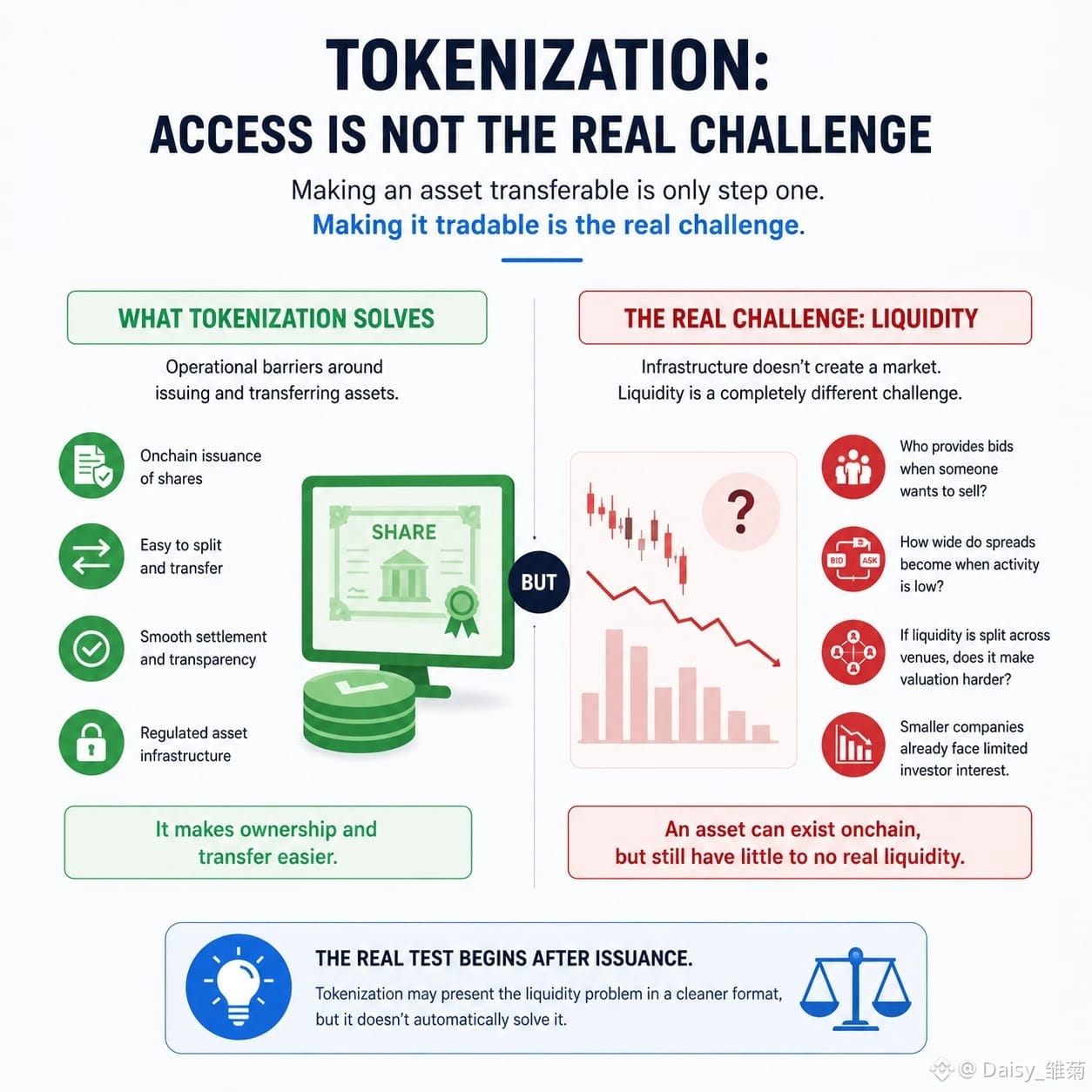
Putting shares of a smaller company onchain can make ownership easier to split and transfer. But that alone doesn’t mean people will actually want to buy those shares.
That’s the point I keep thinking about @Dusk .
A token can be created, transactions can settle smoothly, and everything can work technically—yet the market can still have almost no genuine liquidity.
Smaller companies already face limited investor interest. Moving their assets onchain doesn’t instantly create buyers, market makers, research coverage, or dependable price discovery.
This is where Dusk becomes more interesting.
Regulated asset infrastructure can remove some of the operational barriers around issuing and transferring assets. I understand why that matters. But infrastructure and liquidity are two different things, and the crypto space can sometimes treat them as if they are the same.
For me, the real test begins after issuance.
Who steps in with bids when someone wants to sell?
How large do spreads become when trading activity is weak?
And if liquidity is divided across different venues, does that actually make the asset more difficult to value instead of easier?
I amm still unsure whether tokenization truly fixes the liquidity challenge faced by smaller companies or simply presents that same problem in a cleaner, more efficient format.
Maybe making an asset transferable is only step one.
Making that asset genuinely tradable is a completely different challenge.
@Dusk #dusk $DUSK
Putting shares of a smaller company onchain can make ownership easier to split and transfer. But that alone doesn’t mean people will actually want to buy those shares.
That’s the point I keep thinking about @Dusk .
A token can be created, transactions can settle smoothly, and everything can work technically—yet the market can still have almost no genuine liquidity.
Smaller companies already face limited investor interest. Moving their assets onchain doesn’t instantly create buyers, market makers, research coverage, or dependable price discovery.
This is where Dusk becomes more interesting.
Regulated asset infrastructure can remove some of the operational barriers around issuing and transferring assets. I understand why that matters. But infrastructure and liquidity are two different things, and the crypto space can sometimes treat them as if they are the same.
For me, the real test begins after issuance.
Who steps in with bids when someone wants to sell?
How large do spreads become when trading activity is weak?
And if liquidity is divided across different venues, does that actually make the asset more difficult to value instead of easier?
I amm still unsure whether tokenization truly fixes the liquidity challenge faced by smaller companies or simply presents that same problem in a cleaner, more efficient format.
Maybe making an asset transferable is only step one.
Making that asset genuinely tradable is a completely different challenge.
@Dusk #dusk $DUSK