One detail in @Dusk ’s transaction design caught my attention.
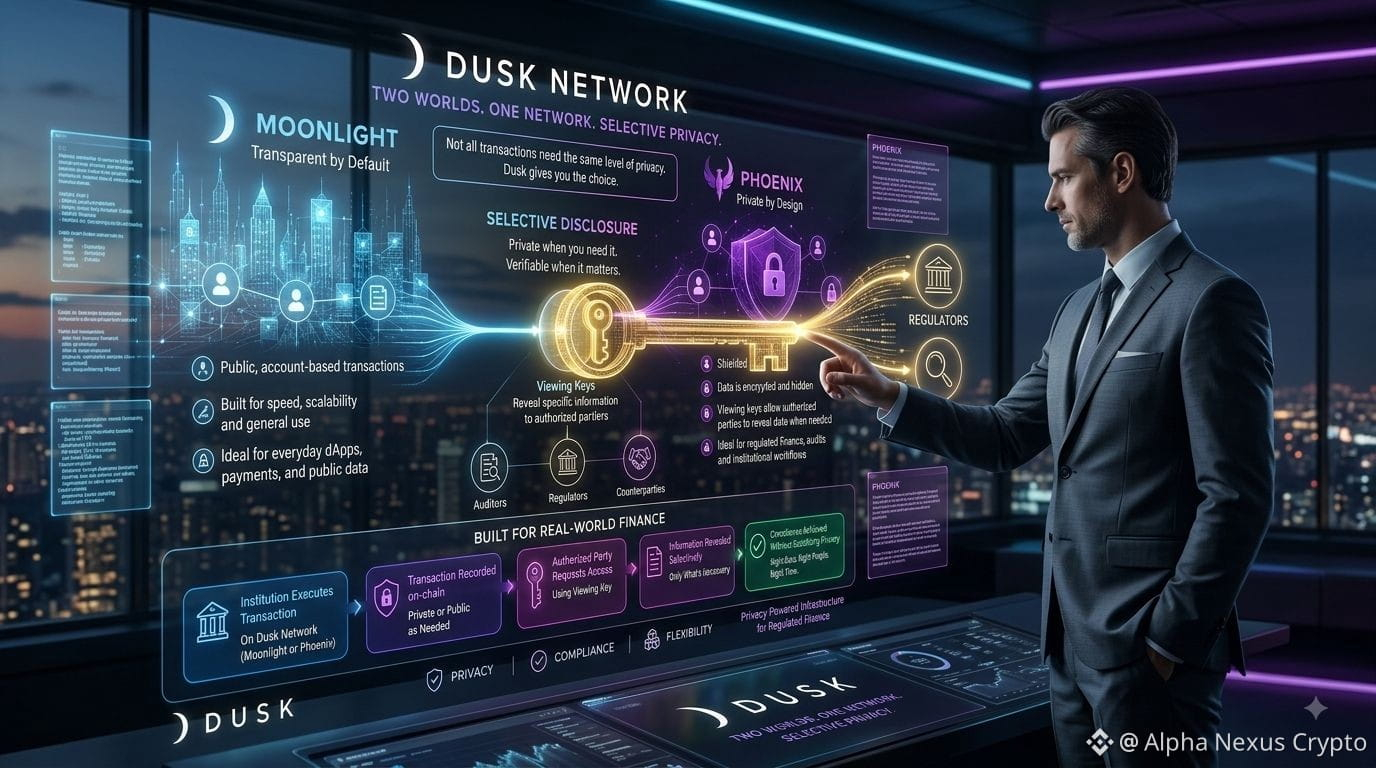
#Dusk doesn’t force every transaction into the same privacy model. It has Moonlight for public account-based activity and Phoenix for shielded transfers. The interesting part is what Phoenix does with information: transactions can remain private while viewing keys can allow information to be revealed when regulation or auditing requires it.
That sounds like a small technical choice.
I think it says something much bigger about the market @Dusk is targeting.
Traditional finance rarely wants “everything private.” It wants the right information visible to the right party.
A fund may not want every transaction exposed publicly, but an auditor, regulator or authorized counterparty may still need to verify what happened.
That makes selective disclosure more interesting than simple anonymity.
There is also a second-order effect.
If privacy becomes configurable rather than absolute, blockchain infrastructure becomes easier to fit into existing financial processes. But it also means Dusk is competing on something more demanding than cryptography: whether institutions actually prefer this model enough to change existing settlement infrastructure.
That is where the thesis gets interesting.
The difficult question for #Dusk isn’t whether private transactions can work.
It is whether selective privacy becomes valuable enough to become part of real financial workflows.
That is the adoption signal I would watch.
#dusk $DUSK @Dusk
$HEMI
$COW
#Dusk doesn’t force every transaction into the same privacy model. It has Moonlight for public account-based activity and Phoenix for shielded transfers. The interesting part is what Phoenix does with information: transactions can remain private while viewing keys can allow information to be revealed when regulation or auditing requires it.
That sounds like a small technical choice.
I think it says something much bigger about the market @Dusk is targeting.
Traditional finance rarely wants “everything private.” It wants the right information visible to the right party.
A fund may not want every transaction exposed publicly, but an auditor, regulator or authorized counterparty may still need to verify what happened.
That makes selective disclosure more interesting than simple anonymity.
There is also a second-order effect.
If privacy becomes configurable rather than absolute, blockchain infrastructure becomes easier to fit into existing financial processes. But it also means Dusk is competing on something more demanding than cryptography: whether institutions actually prefer this model enough to change existing settlement infrastructure.
That is where the thesis gets interesting.
The difficult question for #Dusk isn’t whether private transactions can work.
It is whether selective privacy becomes valuable enough to become part of real financial workflows.
That is the adoption signal I would watch.
#dusk $DUSK @Dusk
$HEMI
$COW