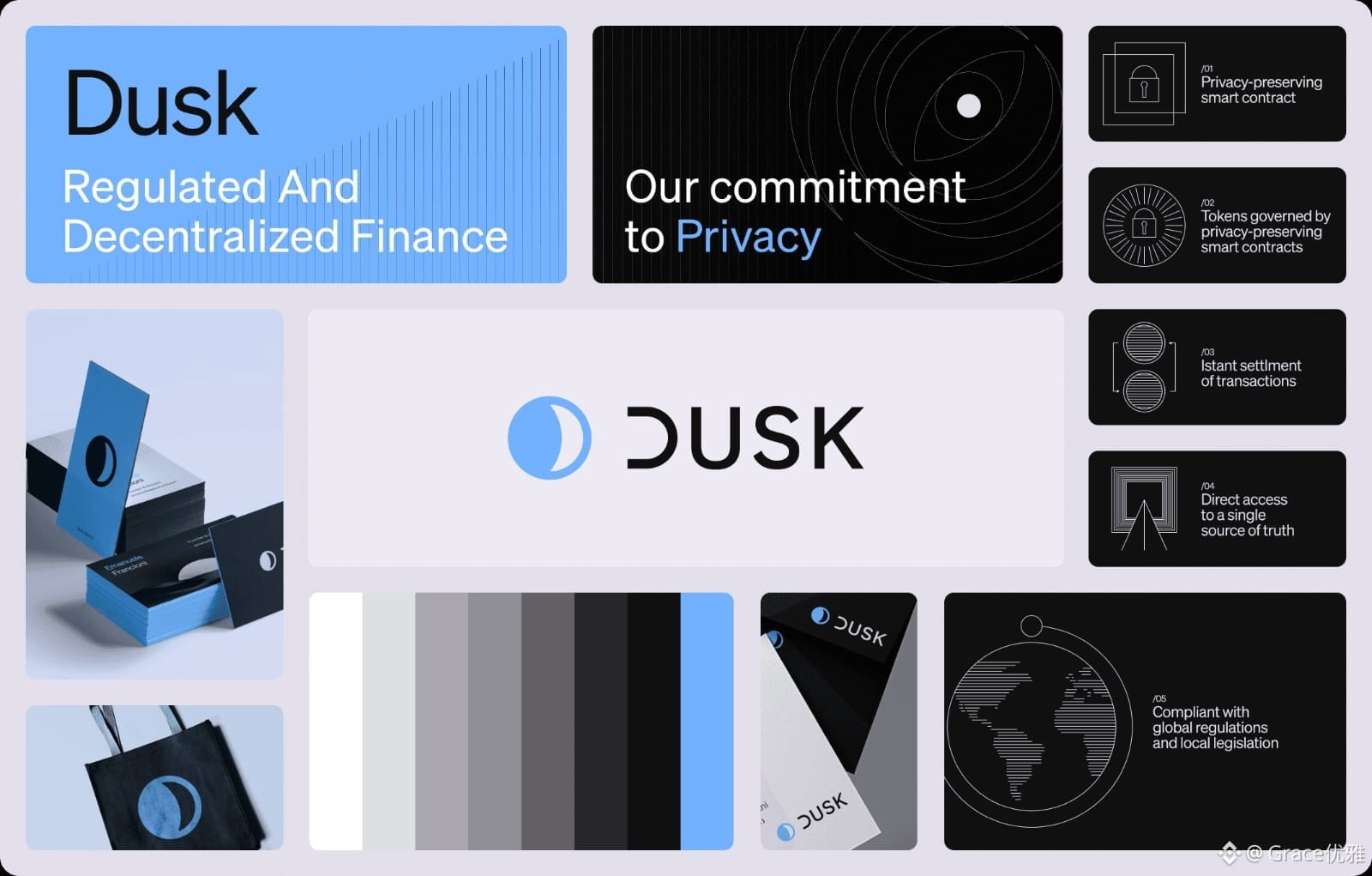
@Dusk is taking a very spcific approach to one of blockchain’s hardest problems how do you bring financial assets on-chain without forcing institutions to choose between privacy and complince?
That trade-off is where things get interesting.
Dusk is a Layer-1 built around privacy-focused financial applications, with its Confidential Security Contract (XSC) standard designed for tokenized securities and confidential smart contracts and the network uses Proof of Blind Bid, a consensus design intended to make block-producer selction harder to predict and manipulate.
The architecture goes deeper than DuskEVM. Its native Piecrust VM is built around Rust and is designed for efficient execution of zero-knowledge workloads, while DuskEVM gives Solidity developers a familiar route into the ecOsystem.
Security is decentralized, with a minimum stake of 1,000 DUSK required to participate in consensus, while node operations rotate across 6-to-12-hour epoch boundaries.
Then there is Citadel, Dusk’s ZK-KYC framework. Instead of repeatedly exposing personal information, users can prove they satisfy compliance requirements while keeping sensitive data private. That matters because KYC is one of the biggest friction points in institutional blockchain adoption.
Since its historical mainnet rollout completed in January 2025, Dusk has focused on real-world financial infrastructure, including collaborations involving NPEX and Quantoz around digital securities and regulated assets.
The technology is interesting. The harder question is execution with a fixed 1 billion token supply cap, can Dusk turn these privacy and compliance tools into meaningful liquidity, institutional usage, and real financial-market activity?
#dusk $DUSK
That trade-off is where things get interesting.
Dusk is a Layer-1 built around privacy-focused financial applications, with its Confidential Security Contract (XSC) standard designed for tokenized securities and confidential smart contracts and the network uses Proof of Blind Bid, a consensus design intended to make block-producer selction harder to predict and manipulate.
The architecture goes deeper than DuskEVM. Its native Piecrust VM is built around Rust and is designed for efficient execution of zero-knowledge workloads, while DuskEVM gives Solidity developers a familiar route into the ecOsystem.
Security is decentralized, with a minimum stake of 1,000 DUSK required to participate in consensus, while node operations rotate across 6-to-12-hour epoch boundaries.
Then there is Citadel, Dusk’s ZK-KYC framework. Instead of repeatedly exposing personal information, users can prove they satisfy compliance requirements while keeping sensitive data private. That matters because KYC is one of the biggest friction points in institutional blockchain adoption.
Since its historical mainnet rollout completed in January 2025, Dusk has focused on real-world financial infrastructure, including collaborations involving NPEX and Quantoz around digital securities and regulated assets.
The technology is interesting. The harder question is execution with a fixed 1 billion token supply cap, can Dusk turn these privacy and compliance tools into meaningful liquidity, institutional usage, and real financial-market activity?
#dusk $DUSK