#usjulyretailsalesfall0.6%
U.S. consumers pulled back sharply in July. 🇺🇸
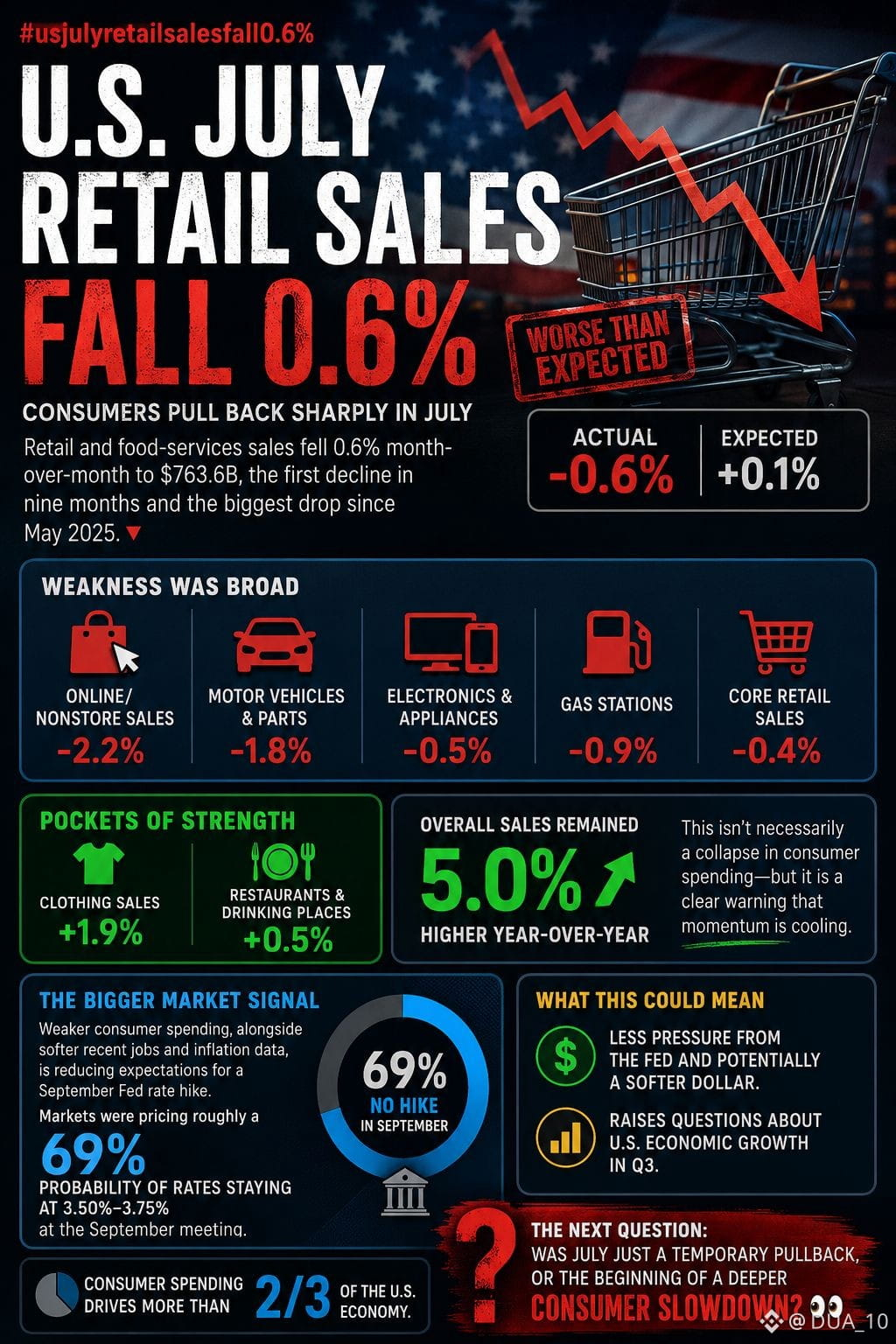
Retail and food-services sales fell 0.6% month-over-month to $763.6B, the first decline in nine months and the biggest drop since May 2025. Economists were expecting a 0.1% increase, making the miss significant.
The weakness was broad:
• Online/nonstore sales: -2.2%
• Motor vehicles & parts: -1.8%
• Electronics & appliances: -0.5%
• Gas stations: -0.9%
• Core retail sales: -0.4%
There were still pockets of strength. Clothing sales rose 1.9%, while restaurants and drinking places gained 0.5%. Overall sales remained 5.0% higher year-over-year, so this isn't necessarily a collapse in consumer spending—but it is a clear warning that momentum is cooling.
The bigger market signal: weaker consumer spending, alongside softer recent jobs and inflation data, is reducing expectations for a September Fed rate hike. Markets were pricing roughly a 69% probability of rates staying at 3.50%–3.75% at the September meeting.
For markets, this could mean less pressure from the Fed and potentially a softer dollar, but it also raises questions about U.S. economic growth in Q3.
Consumer spending drives more than two-thirds of the U.S. economy.
The next question: was July just a temporary pullback, or the beginning of a deeper consumer slowdown? 👀
#USJulyRetailSalesFall0.6%
$WAL
$LAB $CYS
U.S. consumers pulled back sharply in July. 🇺🇸
Retail and food-services sales fell 0.6% month-over-month to $763.6B, the first decline in nine months and the biggest drop since May 2025. Economists were expecting a 0.1% increase, making the miss significant.
The weakness was broad:
• Online/nonstore sales: -2.2%
• Motor vehicles & parts: -1.8%
• Electronics & appliances: -0.5%
• Gas stations: -0.9%
• Core retail sales: -0.4%
There were still pockets of strength. Clothing sales rose 1.9%, while restaurants and drinking places gained 0.5%. Overall sales remained 5.0% higher year-over-year, so this isn't necessarily a collapse in consumer spending—but it is a clear warning that momentum is cooling.
The bigger market signal: weaker consumer spending, alongside softer recent jobs and inflation data, is reducing expectations for a September Fed rate hike. Markets were pricing roughly a 69% probability of rates staying at 3.50%–3.75% at the September meeting.
For markets, this could mean less pressure from the Fed and potentially a softer dollar, but it also raises questions about U.S. economic growth in Q3.
Consumer spending drives more than two-thirds of the U.S. economy.
The next question: was July just a temporary pullback, or the beginning of a deeper consumer slowdown? 👀
#USJulyRetailSalesFall0.6%
$WAL
$LAB $CYS