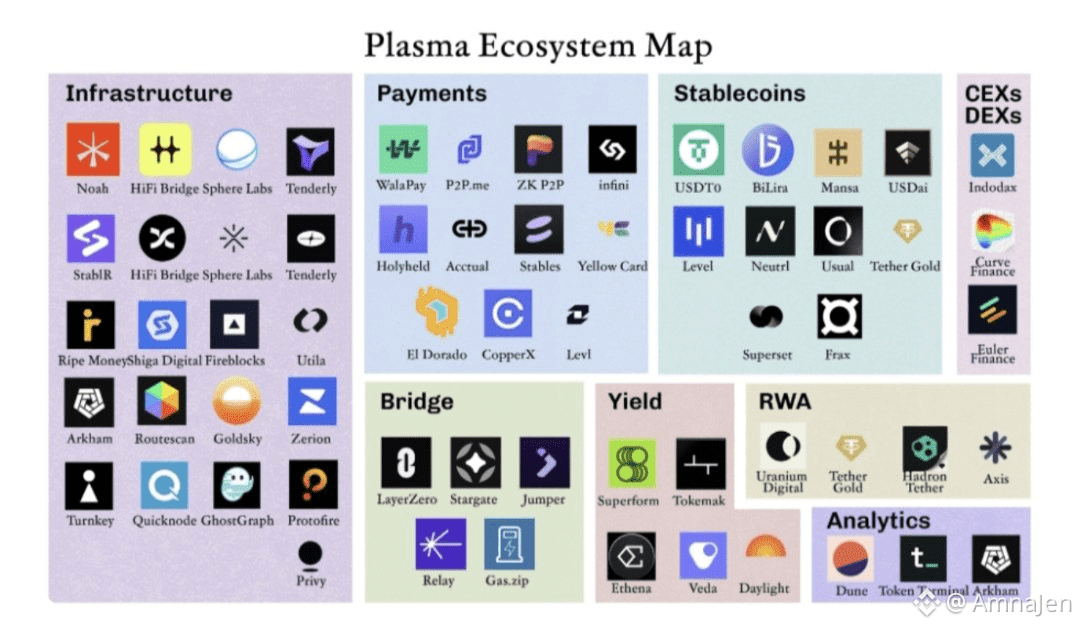


#Plasma @Plasma The Emergence of Financial Layer-1s: How Ethereum and Plasma's Payment-Focused Chains Compete,
Introduction: Financial Infrastructure and General-Purpose Blockchains
Ethereum has been the leading platform for decentralized applications since its launch. The emergence of DeFi, NFTs, DAOs, and numerous Web3 innovations was made possible by its versatile design. Financial Layer-1s, or blockchains primarily intended for payments, settlement, and monetary infrastructure, are a new class of networks that are emerging as blockchain technology develops.plasma
One of the most notable instances of this change is plasma. Instead of competing with Ethereum in every application domain, Plasma concentrates on developing into a specialized settlement layer for digital payments and stablecoins. This area of expertise is a reflection of the industry's larger shift from experimental platforms to operational financial networks.XPL
General-purpose blockchains' limitations
Ethereum's adaptability is the key to its success. Almost anything can be built on it by developers. However, when it comes to financial settlement, this strength is also a weakness.Plasma
Variability in Costs
Transaction fees on Ethereum are settled in ETH. Gas prices increase when network demand increases. Even basic stablecoin transfers can cost several dollars during busy times. Unpredictable fees damage the usability and trust of payment systems.XPL
Conflicts over Priorities and Congestion
Ethereum needs to handle:
Minting NFT
Speculation about tokens
Transactions in gaming
Liquidations of DeFi
Votes on governance
All of these activities are in competition with stablecoin payments. Payments are frequently priced out or delayed during congestion.Plasma is a Layer 1 blockchain tailored for stablecoin settlement. It combines full EVM compatibility (Reth) with sub-second finality (PlasmaBFT) and introduces stablecoin-centric features such as gasless USDT transfers and stablecoin-first gas. Bitcoin-anchored security is designed to increase neutrality and censorship resistance. Target users span retail in high-adoption markets and institutions in payments/finance.XPL Plasma
The Payment-First Architecture of Plasma
Native Infrastructure with Stablecoins
Custom gas tokens and zero-cost stablecoin transfers are supported by Plasma. Stablecoins themselves serve as network fuel rather than depending on erratic native assets for fees.
This gets rid of:
Risk associated with exchange rates
Uncertainty about fees
Friction for regular users
Because of this, Plasma functions less like a speculative blockchain and more like a digital payment network.
Consensus on PlasmaBFT
Fast HotStuff is the source of PlasmaBFT, a pipelined Byzantine Fault Tolerance consensus method.
The parallel operation of its multi-stage process—proposal, voting, and commitment—allows:
Sub-second finality
Elevated throughput
High fault tolerance
Finality is more crucial for settlements and payments than peak TPS. Accordingly, Plasma's consensus is built.
Integration of Native Bitcoin
Plasma seeks to offer trust-minimized BTC integration through its Native Bitcoin Bridge.
This system uses validator consensus to confirm cross-chain transfers, in contrast to centralized wrappers. This lowers custodial risk and adds Bitcoin liquidity to Plasma's ecosystem.
Liquidity backed by Bitcoin improves system credibility and fortifies stablecoin infrastructure.
Plasma’s has been rising signalsthe future of blockchain might be not belonging to universal platforms alone—but to specialized networks built for real economic activity. trade$XPL