



1) Executive summary
Aave $AAVE is an onchain lending network where users deposit assets to earn yield and borrow against their collateral. It is the largest lending project onchain by active loans, with V3 markets on more than a dozen networks, the V4 deployment on Ethereum and, since July, Avalanche, the specialized Horizon market for tokenized real-world assets, the GHO stablecoin, and the AAVE governance token.
Credit is the core business of traditional finance, and most of it runs through intermediaries whose balance sheets and risk are opaque to the people funding them. Aave replaces that intermediation with transparent, programmatic markets: collateral, outstanding borrows, rates, and liquidations are all verifiable onchain in real time. Value accrues to the project through the spread between what borrowers pay and what depositors earn, a share of which flows to the Aave DAO as revenue, alongside liquidation fees, oracle-related MEV recaptured via Chainlink SVR, flash loan fees, and treasury management.
The current product set splits the strategy three ways: V3 carries the bulk of TVL and active loans across chains, V4 introduces a hub-and-spoke architecture designed for modular, risk-isolated credit markets, and Horizon serves institutions borrowing stablecoins against tokenized real-world assets. GHO, the DAO's native stablecoin, is minted against Aave collateral and adds a savings product in sGHO. Around these, the team is building distribution: the Aave App, a consumer savings app in waitlist ahead of launch, and Stable Vaults, introduced in July as an embeddable fixed-rate stablecoin yield product for businesses.
Aave held 46.4% of lending-market active loans in July, roughly the share of the entire rest of the sector combined. Aave was founded by Stani Kulechov, who leads Aave Labs, the main development company behind the project. The Aave DAO, governed by AAVE tokenholders, directs the project's markets, risk parameters, and treasury.
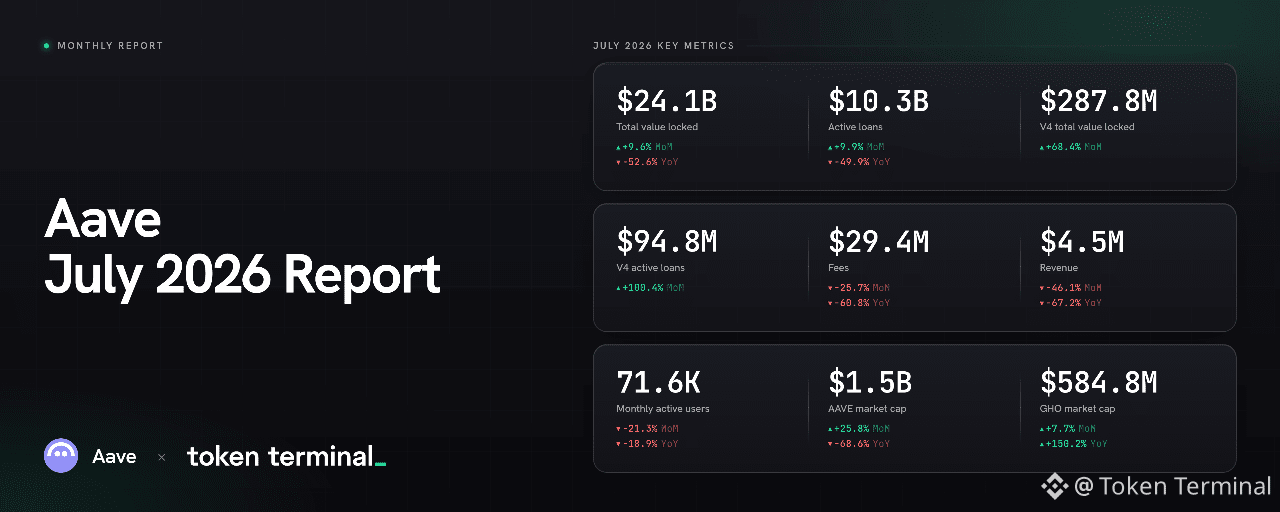
July was the month the drawdown turned. After five consecutive monthly declines, TVL, active loans, market share, and both token market caps rose together for the first time this year, while fees and revenue normalized to an interest-led mix after June's liquidation-heavy month and user counts continued to fall. The period's shaping events came at a fast cadence: Aave deployed V3 on Monad, took V4 multi-chain with an Avalanche launch, opened the Global Dollar Hub as V4's first new Liquidity Hub, introduced Stable Vaults, and ran the Aave App waitlist campaign throughout the month, pairing each growth milestone with independent security verification. V4 deposit and borrowing activity reached new highs through the month.
👥 Aave Labs team commentary
"July was a big month for Aave. Liquidity is flowing back: more than $600 M in stablecoins moved into Aave over an 11-day stretch, USDT active loans on Aave V3 hit $2.5 B, up $400 M in 30 days, and ETH and ETH-correlated assets on Aave grew by more than $2 B during the month. Aave V3 also went live on Monad and approached $400 M in deposits just two weeks after launch.
Aave V4 had its biggest month yet. Deposits nearly doubled over the month, crossing $300 M, active loans crossed their first $100 M, and deposit and borrow caps were raised for the eleventh time to keep up with demand. V4 expanded beyond Ethereum for the first time with its launch on Avalanche, and the Global Dollar Hub went live as the first new Liquidity Hub, with USDG deposits surpassing $60 M in its first month. Certora has formally verified V4 and a new ChainSecurity audit is available, so outside of growth we’re very focused on V4’s security profile.
We also introduced Stable Vaults, an all-in-one way to embed fixed-rate stablecoin yield into any product. Stable Vaults are a production system, already running in the Aave App, now formally verified by Certora, and any business can build on them. The Aave App waitlist grew throughout July, and the app is coming very soon to iOS.
On the RWA side, securities finance remains the multi-trillion dollar market Aave V4 is built for, and RWA-backed loans across Aave markets started July above $500 M. DAO income normalized in July as June's elevated liquidation activity slowed, while borrow interest, the treasury's core income stream, grew alongside the loan book. GHO's market cap grew for a thirteenth consecutive month, and the Staked GHO to Savings GHO migration tool is now live.
Lastly, Aave Labs voiced support for the Clarity Act, which protects writing and publishing code and gives developers the legal certainty to build the next generation of DeFi in the United States."
2) Total value locked
Total value locked measures the total USD value of assets supplied to Aave's markets: liquidity sitting idle plus liquidity lent out as outstanding loans. It is the broadest gauge of how much capital the project's markets hold.
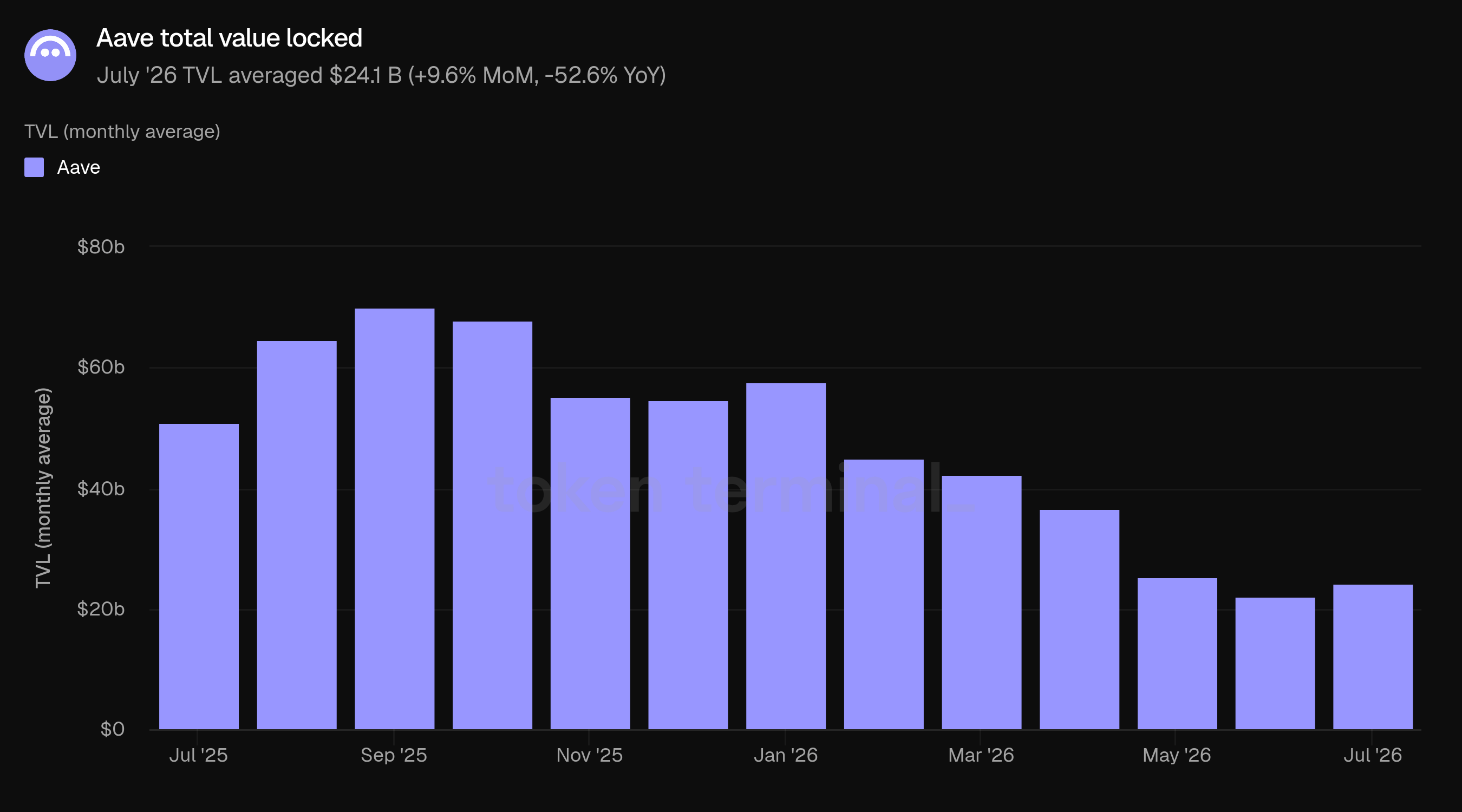
TVL averaged $24.1 B in July, up 9.6% MoM though still down 52.6% YoY. The wider DeFi market's TVL was roughly flat month-over-month, so the increase reflects flows into Aave rather than a market-wide move.
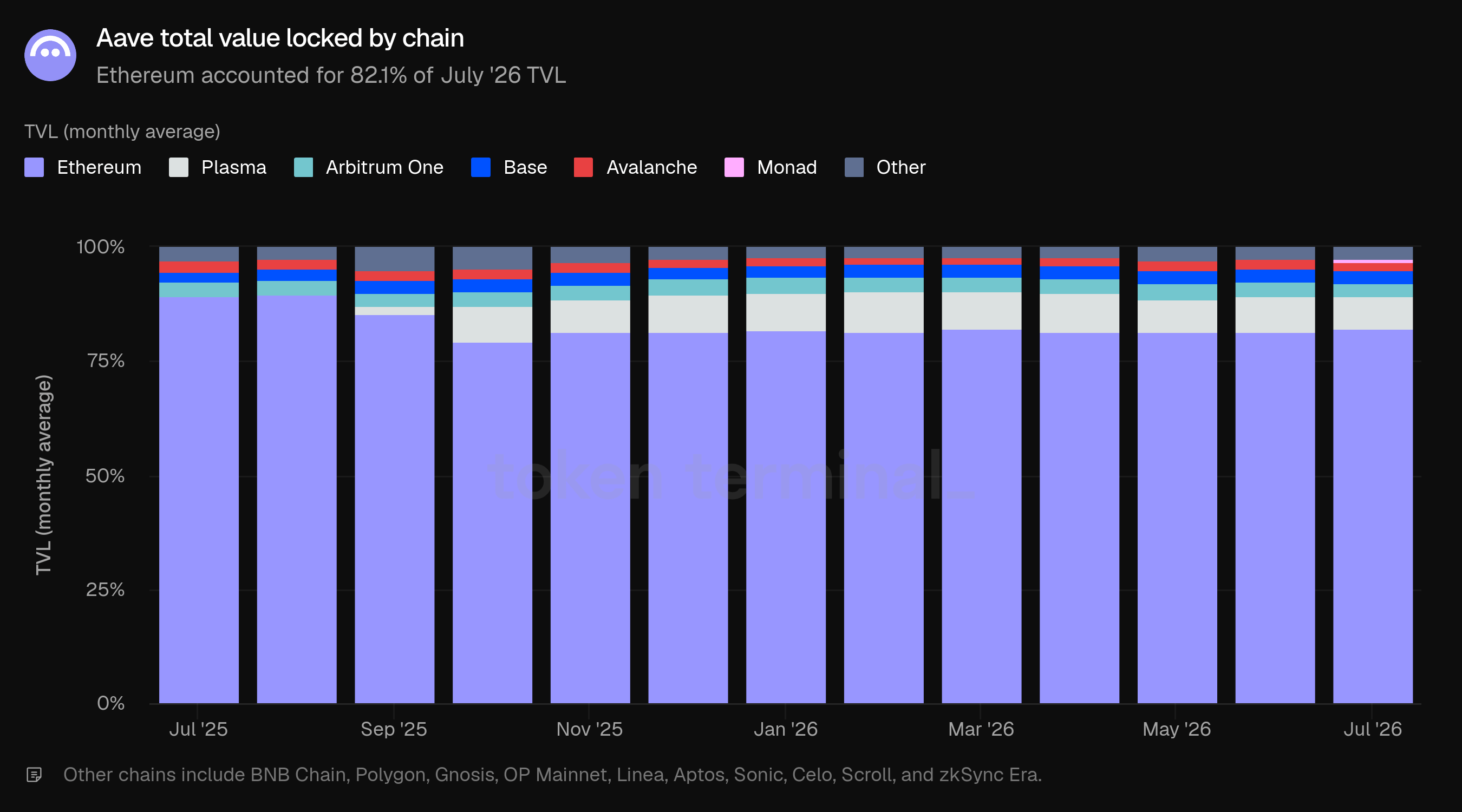
The chain mix stayed concentrated through the turn. Ethereum held 82.1% of July TVL ($19.8 B), with Plasma second at 7.1% ($1.7 B), Arbitrum One at 3.0%, Base at 2.9%, and Avalanche at 1.7%. Monad, where Aave deployed V3 on July 2, entered the chain mix in its first month.
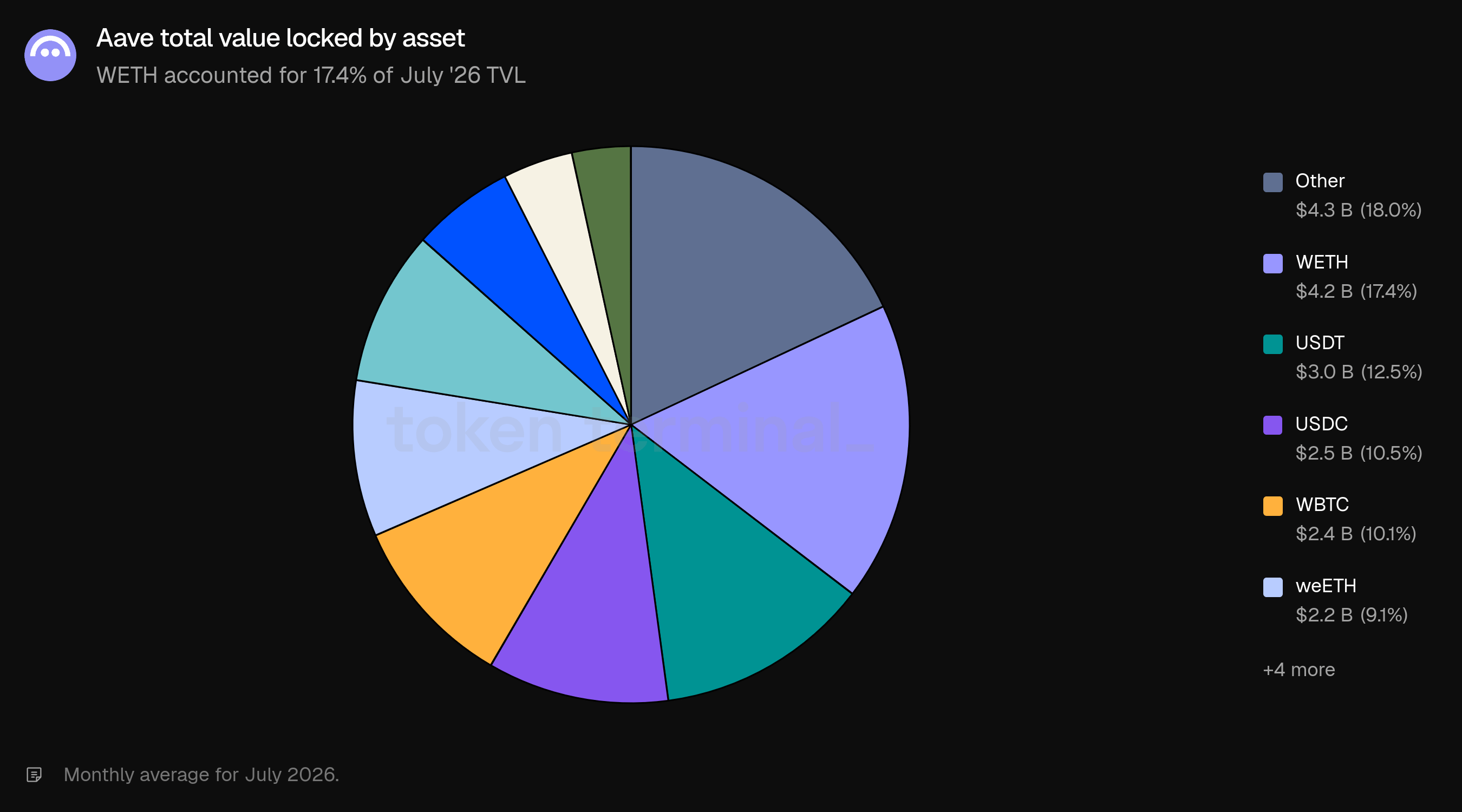
By asset, July TVL was led by WETH at 17.4% ($4.2 B), with USDT (12.5%) and USDC (10.5%) the largest stablecoins and WBTC (10.1%) and cbBTC (6.0%) the largest BTC wrappers. ETH-linked assets remain the backbone of the mix: WETH plus the liquid staking tokens weETH and wstETH together accounted for roughly 36% of July TVL, consistent with the ETH-heavy inflows that marked the back half of the month.
3) Active loans
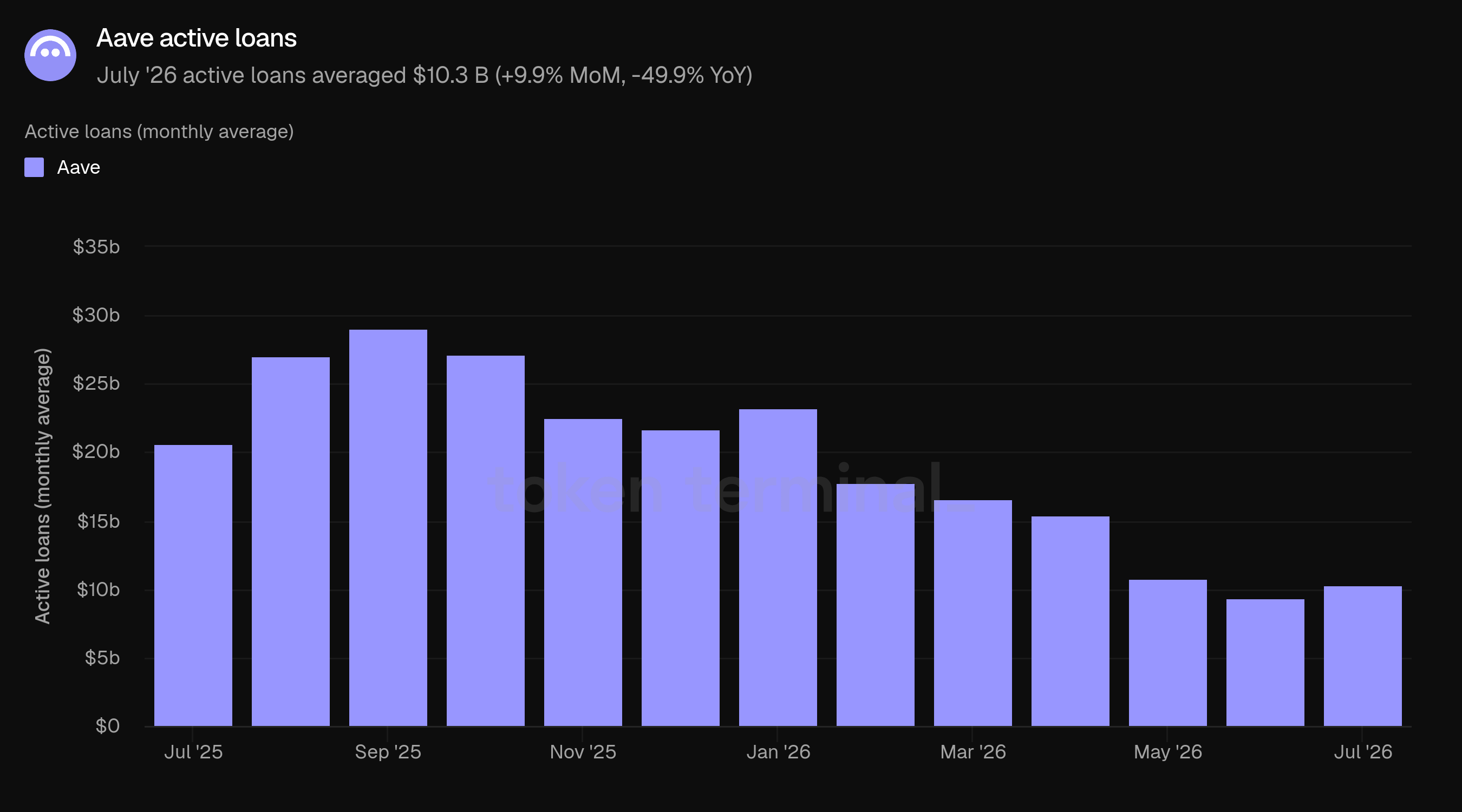
Active loans measure the total USD value of outstanding borrows across all Aave lending markets. Where TVL captures the capital sitting in Aave's markets, active loans capture the credit actually extended, the metric the team itself points to as the one that matters for a lending market.
Active loans averaged $10.3 B in July, up 9.9% MoM and down 49.9% YoY, the first monthly increase since January. The wider lending sector's loan book grew roughly 7% month-over-month, so Aave's borrowing recovered slightly faster than the market it leads.
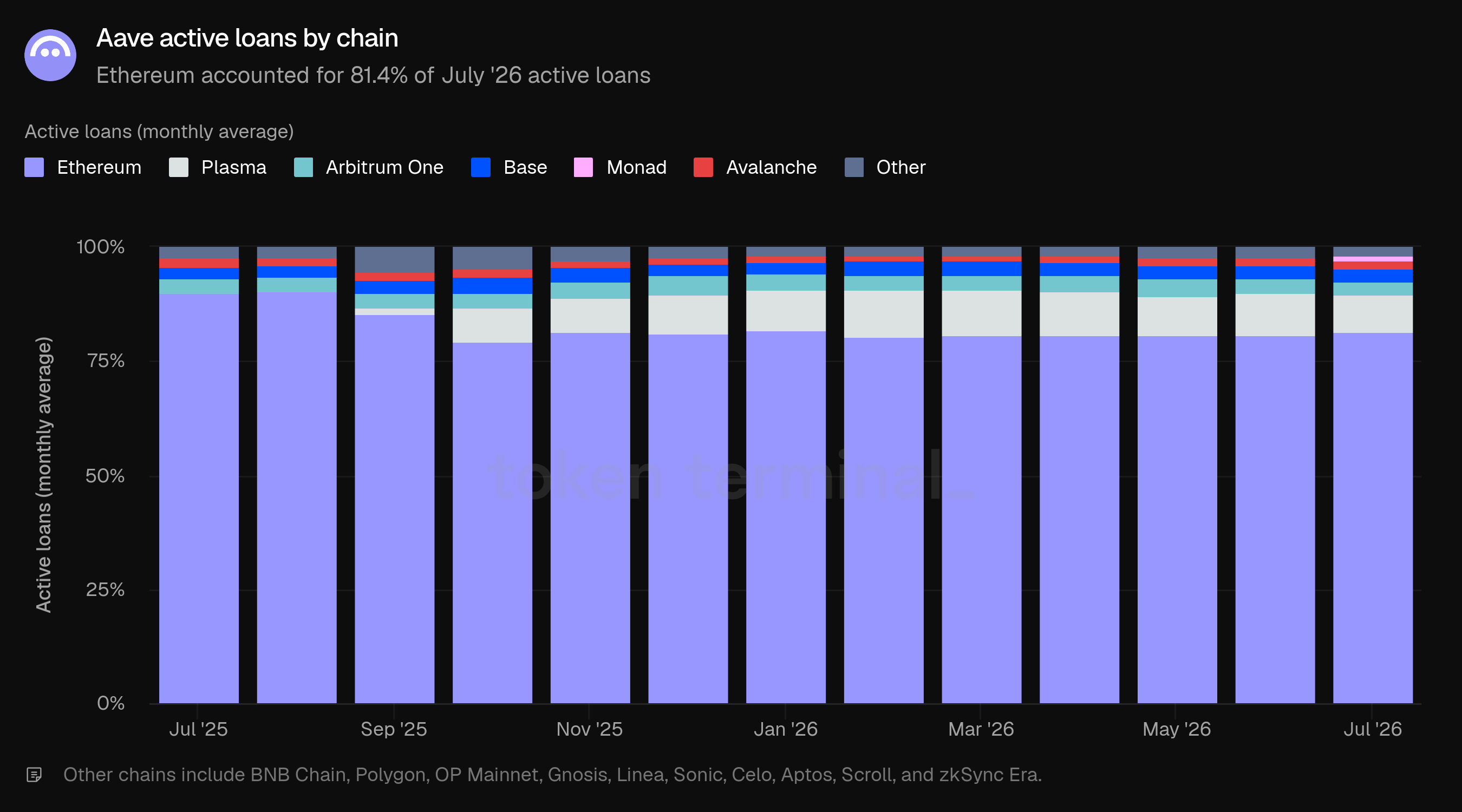
Ethereum accounted for 81.4% of July active loans ($8.4 B), with Plasma at 8.2% ($851.8 M) holding the second position it has occupied since late 2025. Arbitrum One (3.0%), Base (2.9%), and Avalanche (1.5%) round out the larger deployments.
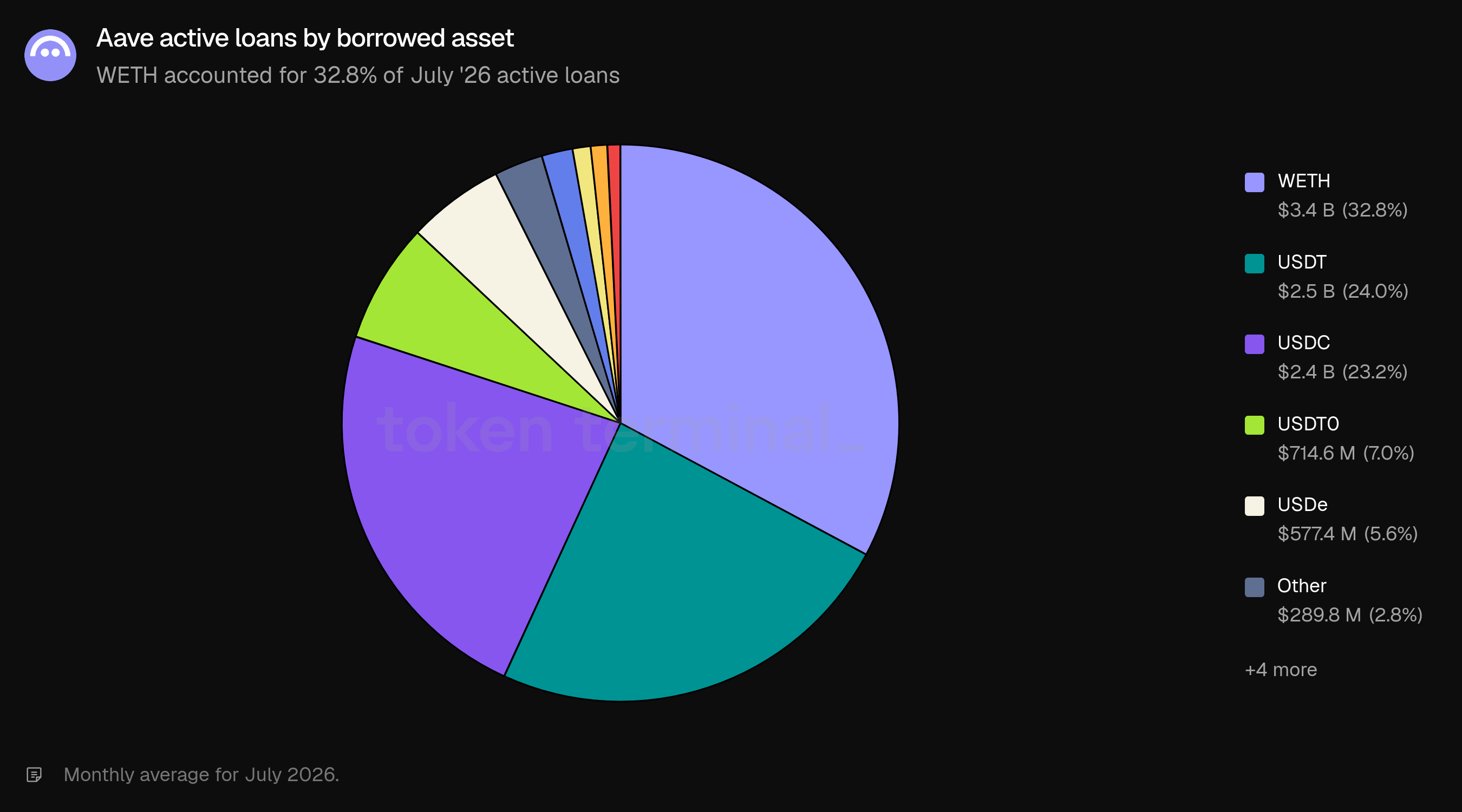
The borrow side remains stablecoin-heavy: USDT (24.0%), USDC (23.2%), USDT0 (7.0%), and USDe (5.6%) together made up roughly 60% of July active loans, against a collateral mix led by ETH- and BTC-linked assets. WETH was the single largest borrowed asset at 32.8% ($3.4 B).
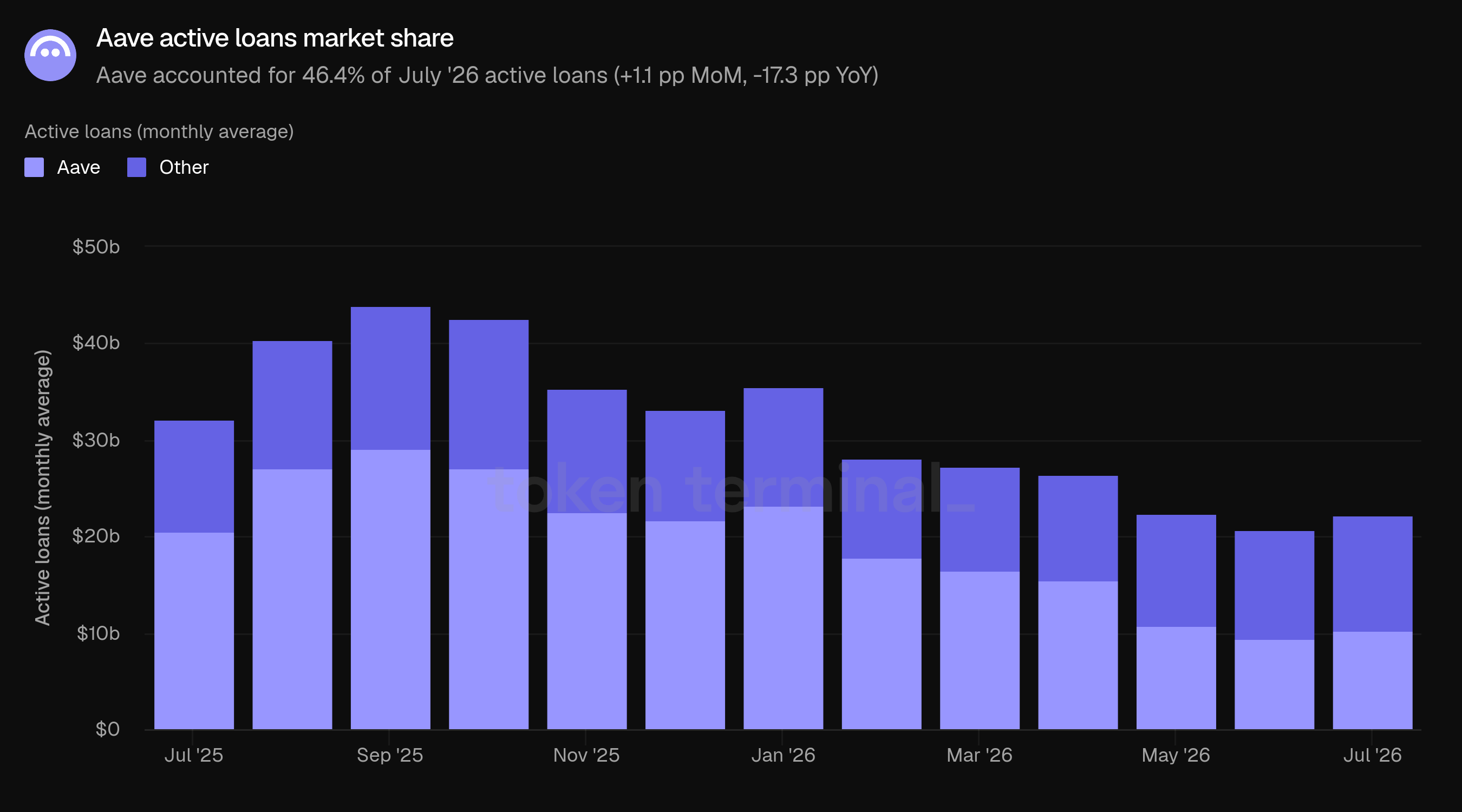
Market share measures Aave's share of active loans relative to other lending projects. Aave held 46.4% of lending-market active loans in July, up 1.1 pp MoM and down 17.3 pp YoY: the sector grew in July, and Aave's loan book grew faster still. The project remains nearly as large as the rest of the tracked sector combined.
4) Aave V4
Aave V4 launched on Ethereum in late March 2026 and introduces a hub-and-spoke architecture where shared liquidity pools (hubs) connect to modular borrowing strategies (spokes). July was its most expansive month yet: the Global Dollar Hub, the first new Liquidity Hub since launch, opened on Ethereum on July 1 for USDG-correlated assets, and on July 15 V4 made its first multi-chain expansion, launching on Avalanche with a Core Liquidity Hub spanning Main, AVAX Correlated, and Forex markets.
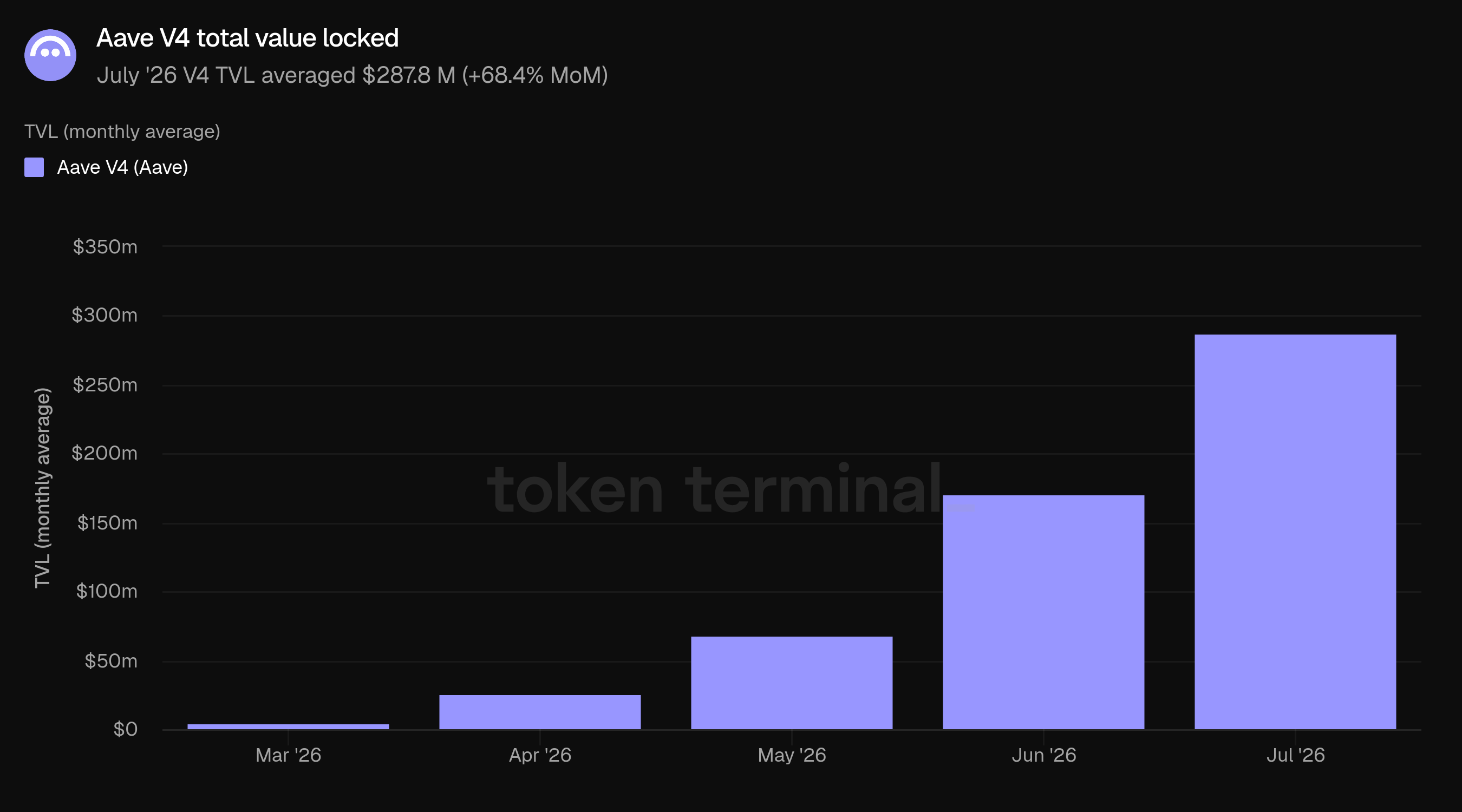
V4 TVL averaged $287.8 M in July, up 68.4% MoM in its fourth full month, and ended the month at $335.7 M. The series has compounded every month since launch: $4.5 M in March, $25.4 M in April, $68.2 M in May, $170.9 M in June, $287.8 M in July, growth that governance tracked with repeated deposit and borrow cap raises across the month.
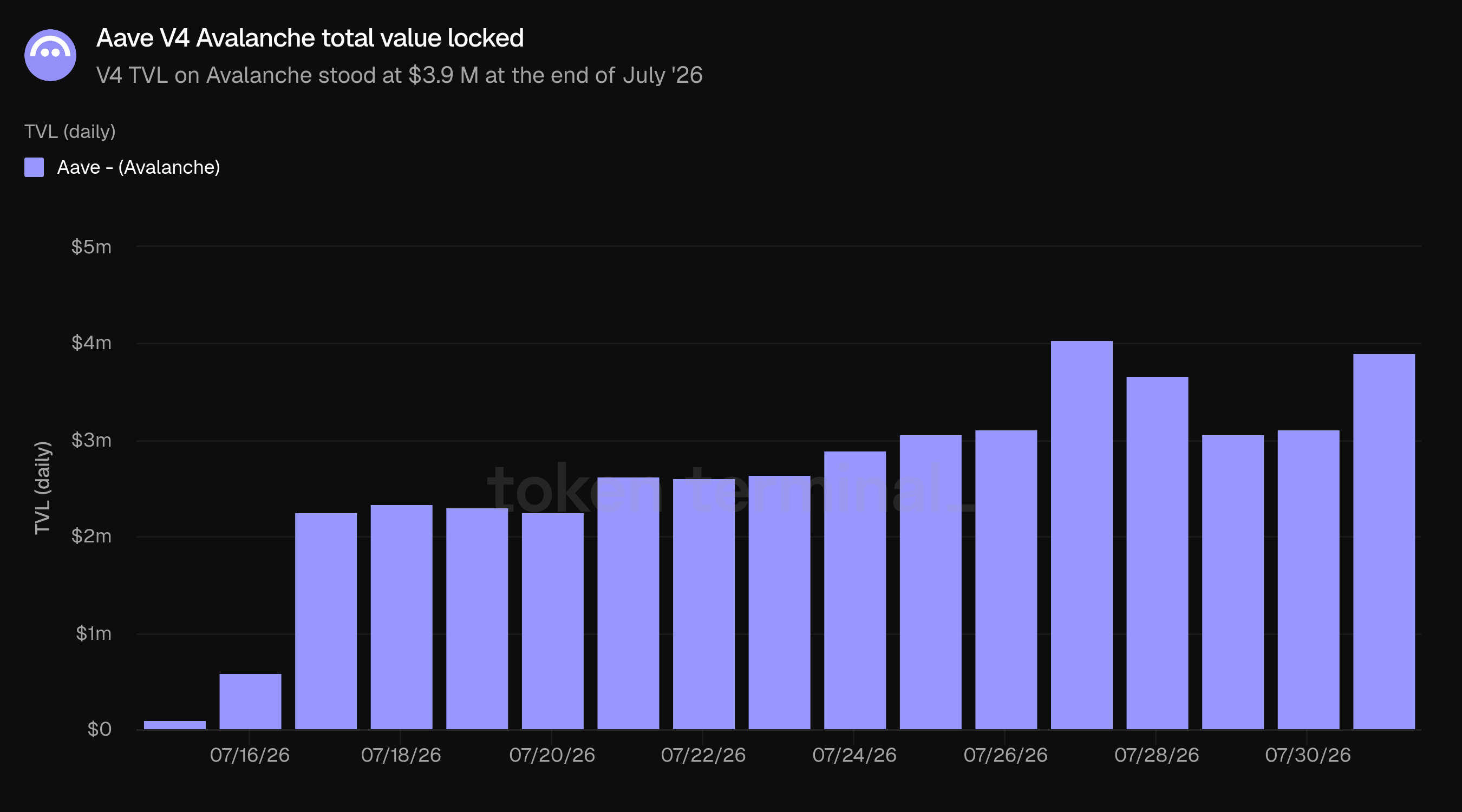
The Avalanche deployment is small, but growing with smaller supply and borrow caps. New TVL reached $3.9 M within the first few weeks of launch.
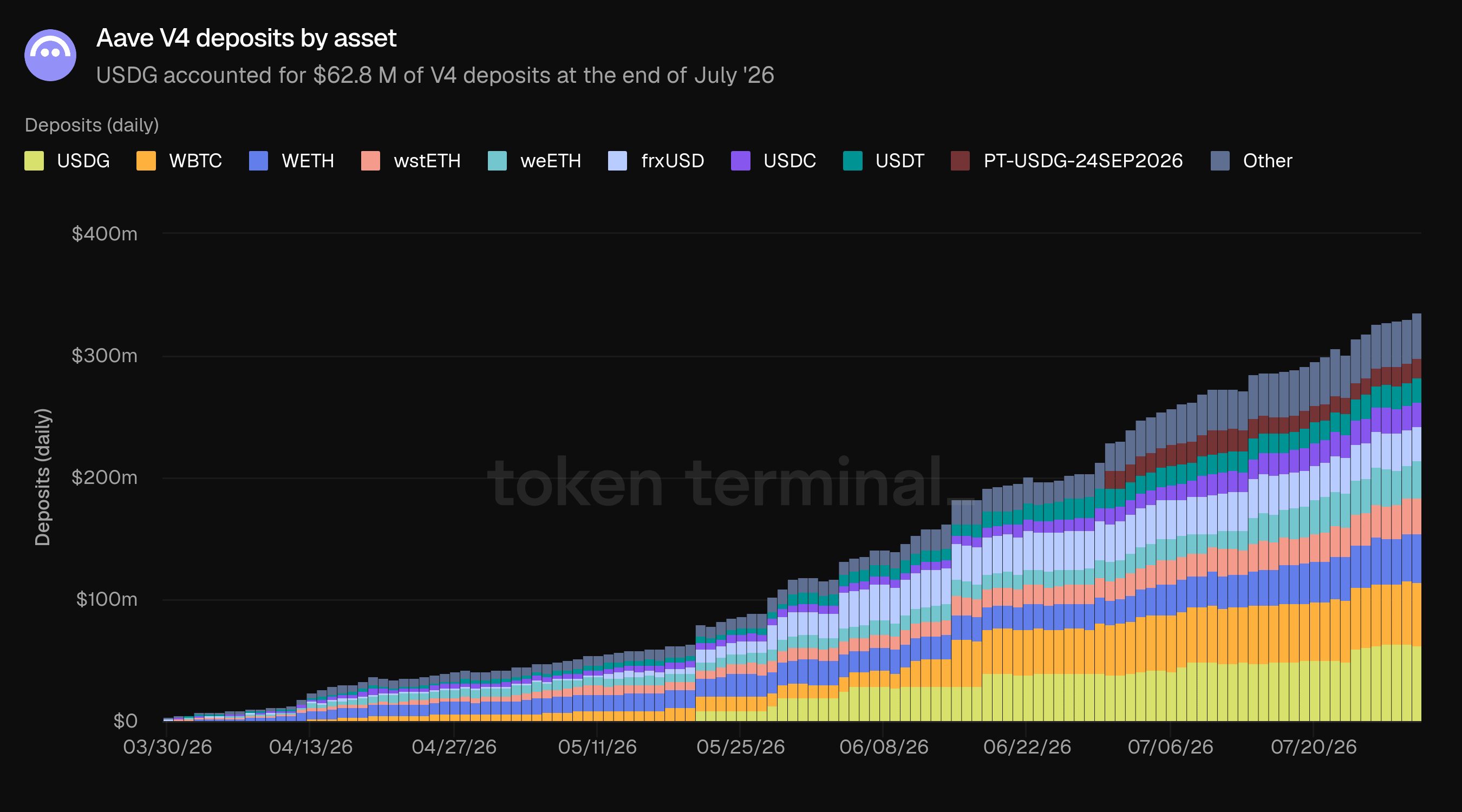
Deposits measure the total USD value of assets supplied to Aave's markets. V4 deposits ended July led by USDG at $62.8 M, the direct read on the Global Dollar Hub's first month, with WBTC ($52.1 M), June's leader, second and WETH third at $39.8 M. The ETH liquid staking tokens wstETH ($29.7 M) and weETH ($29.6 M) followed alongside frxUSD ($29.0 M), with USDC ($20.2 M), USDT ($19.2 M), the Pendle principal token PT-USDG-24SEP2026 ($15.9 M), and cbBTC ($13.9 M) rounding out the top ten. XAUT, the tokenized gold collateral spotlighted in June, continued to grow, ending July at $7.0 M. The breadth of the mix (stablecoins, BTC wrappers, ETH staking tokens, gold, and a Pendle principal token) reflects V4's spoke design onboarding distinct collateral types in parallel.
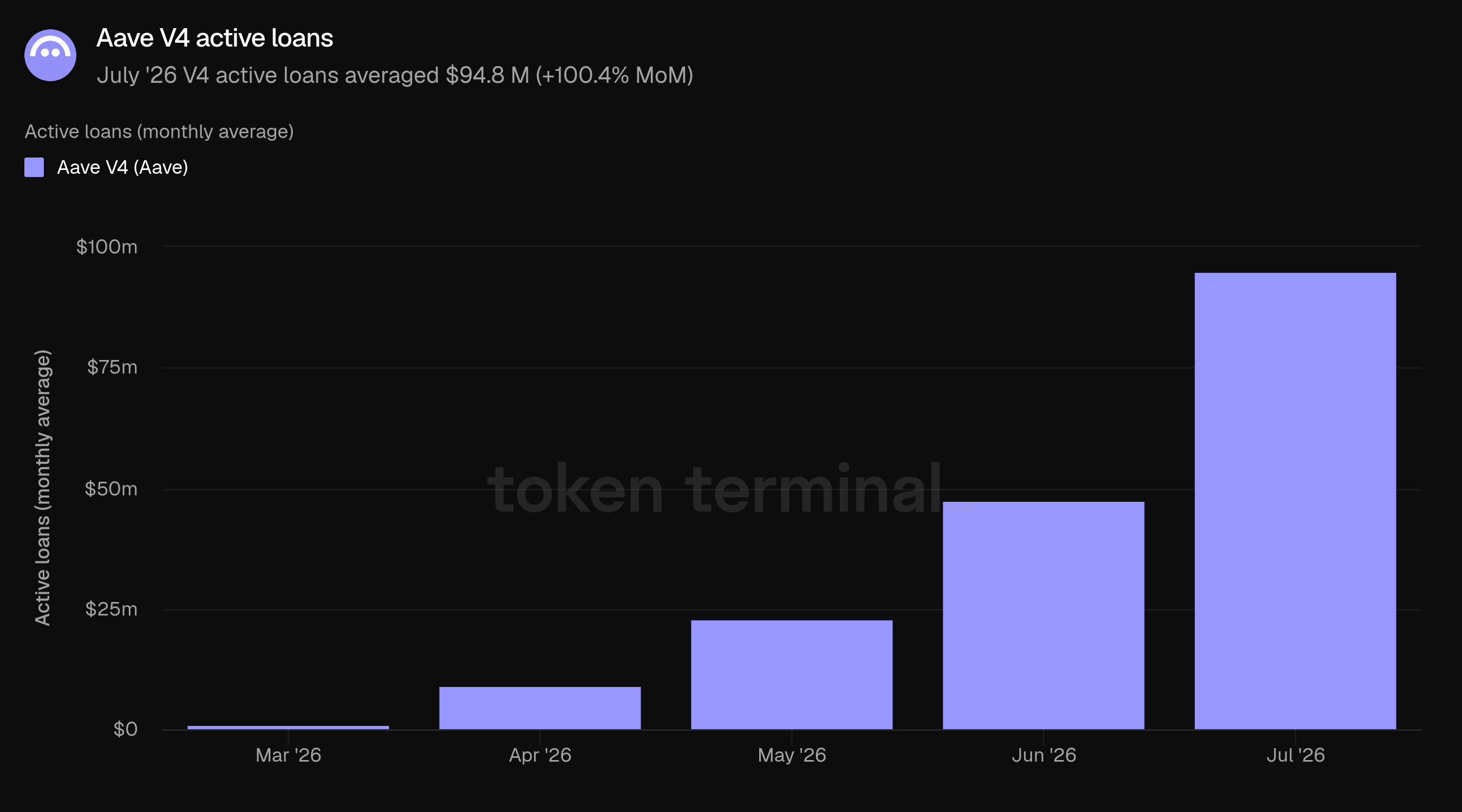
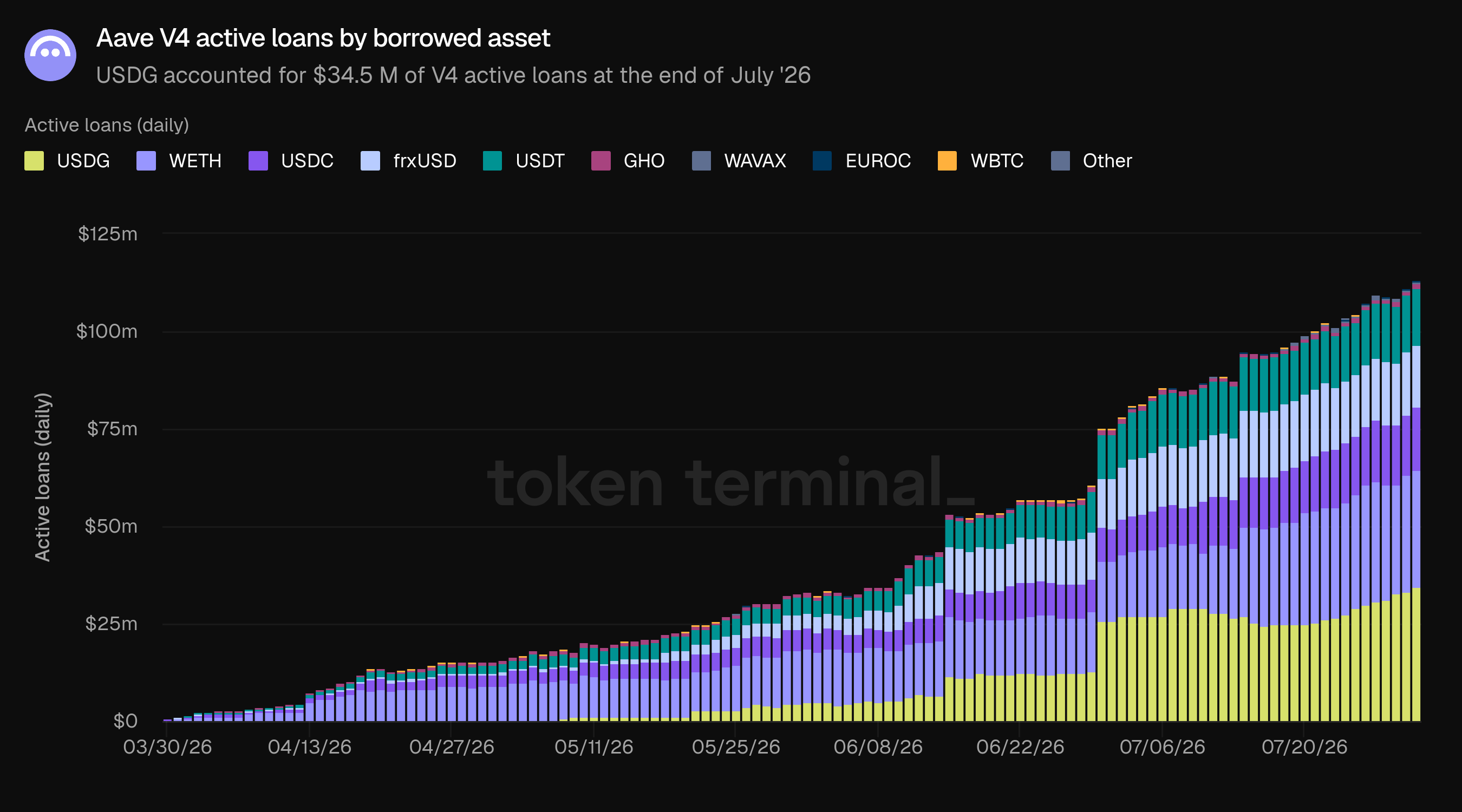
V4 active loans averaged $94.8 M in July, up 100.4% MoM, and ended the month at $113.4 M, crossing $100 M for the first time. Borrowing has scaled slightly ahead of deposits since launch, an early sign that the new markets are being used for credit rather than parked liquidity.
USDG led V4 borrowing at 30.4% ($34.5 M) of the end-July total, with WETH at 26.5% ($30.0 M) and USDC ($16.1 M), frxUSD ($16.0 M), and USDT ($14.7 M) making up most of the remainder. WAVAX and EUROC entered the mix via the Avalanche deployment. The borrow mix on V4 is developing along the same lines as the main deployment: stablecoins and WETH against diversified collateral.
5) Aave Horizon
Aave Horizon is a specialized lending market for tokenized real-world assets, launched in August 2025. Stablecoin supply is permissionless, while collateral onboarding is managed by tokenization issuers, giving institutions a compliant venue to borrow against tokenized funds and treasuries.
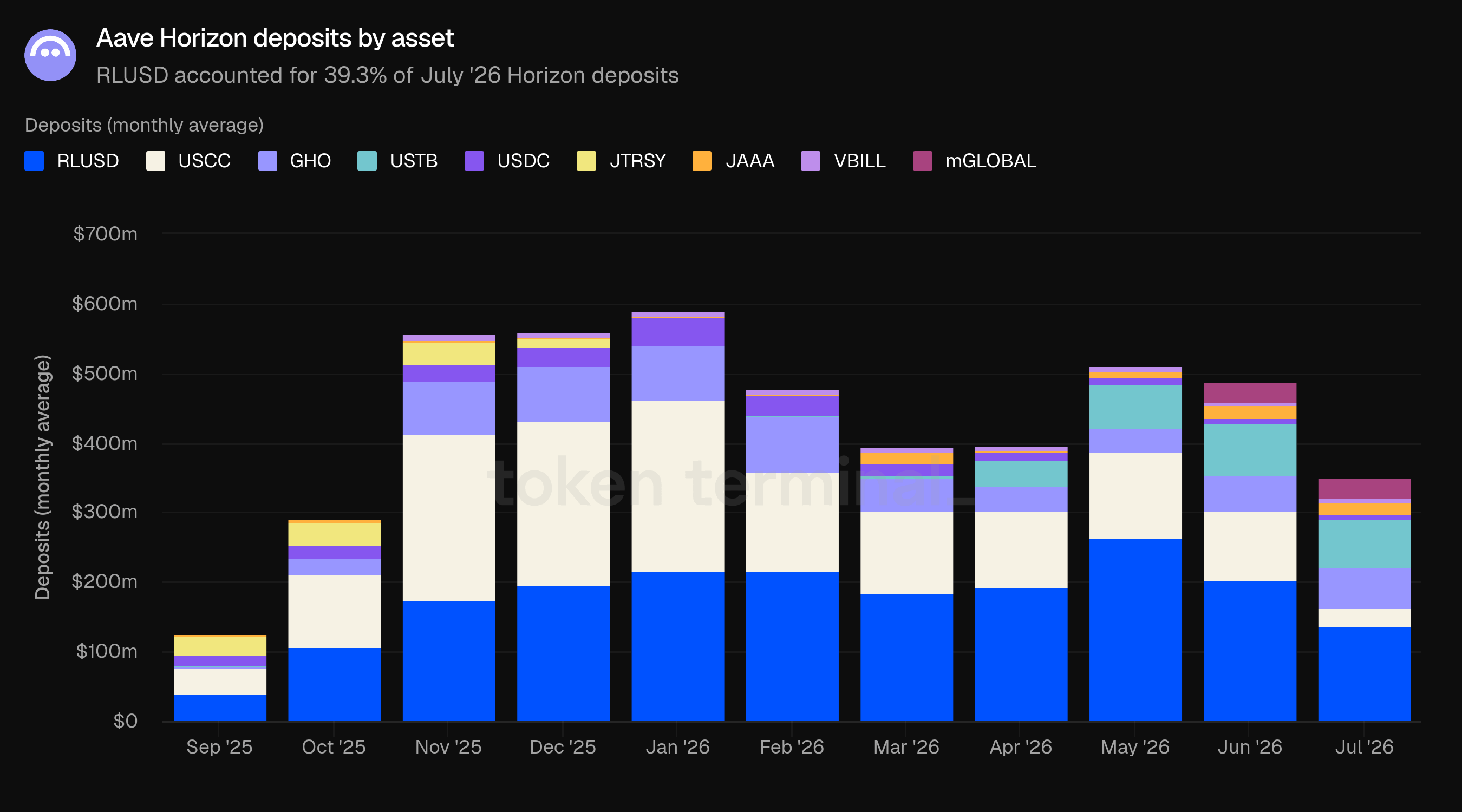
Horizon TVL averaged $350.2 M in July, down 28.0% MoM. RLUSD remained the anchor of the deposit base at 39.3% of July deposits ($137.7 M). GHO deposits rose to $59.7 M and mGLOBAL, the Midas fund that entered the mix in June, grew to $28.4 M in its second month, with USTB ($68.8 M) and JAAA ($17.9 M) rounding out the fund roster.
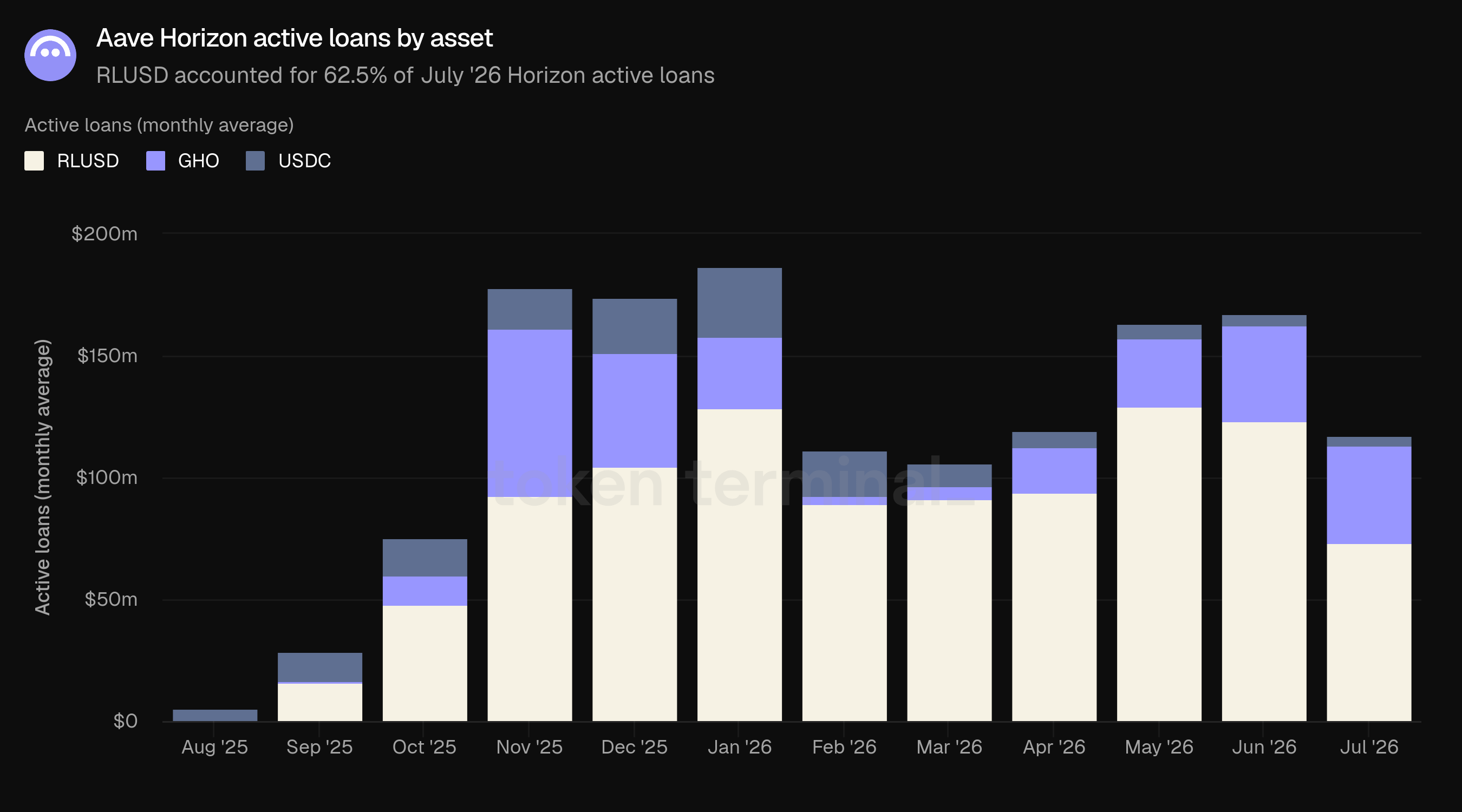
Borrowing on Horizon fell alongside deposits: active loans averaged $117.4 M in July, down 30.0% MoM, ending a three-month run of growth in the loan book. RLUSD carried the decline, falling to $73.3 M from $123.3 M, while GHO borrowing held essentially flat at $40.3 M and USDC remained small at $3.7 M.
6) Fees
Fees measure the total USD value of fees paid by users across all of Aave's lending markets, aggregated across all income types: interest, liquidations, SVR, flash loans, and treasury activity.
Fees totaled $29.4 M in July, down 25.7% MoM and 60.8% YoY. The decline is a composition story rather than a demand story: June's total was lifted by elevated liquidation activity, and with markets steadier in July that income faded, while interest fees, the underlying rate-driven base, actually rose from $25.8 M to $29.1 M as the loan book grew. Cumulative fees over the trailing 13 months shown reached $912.5 M.
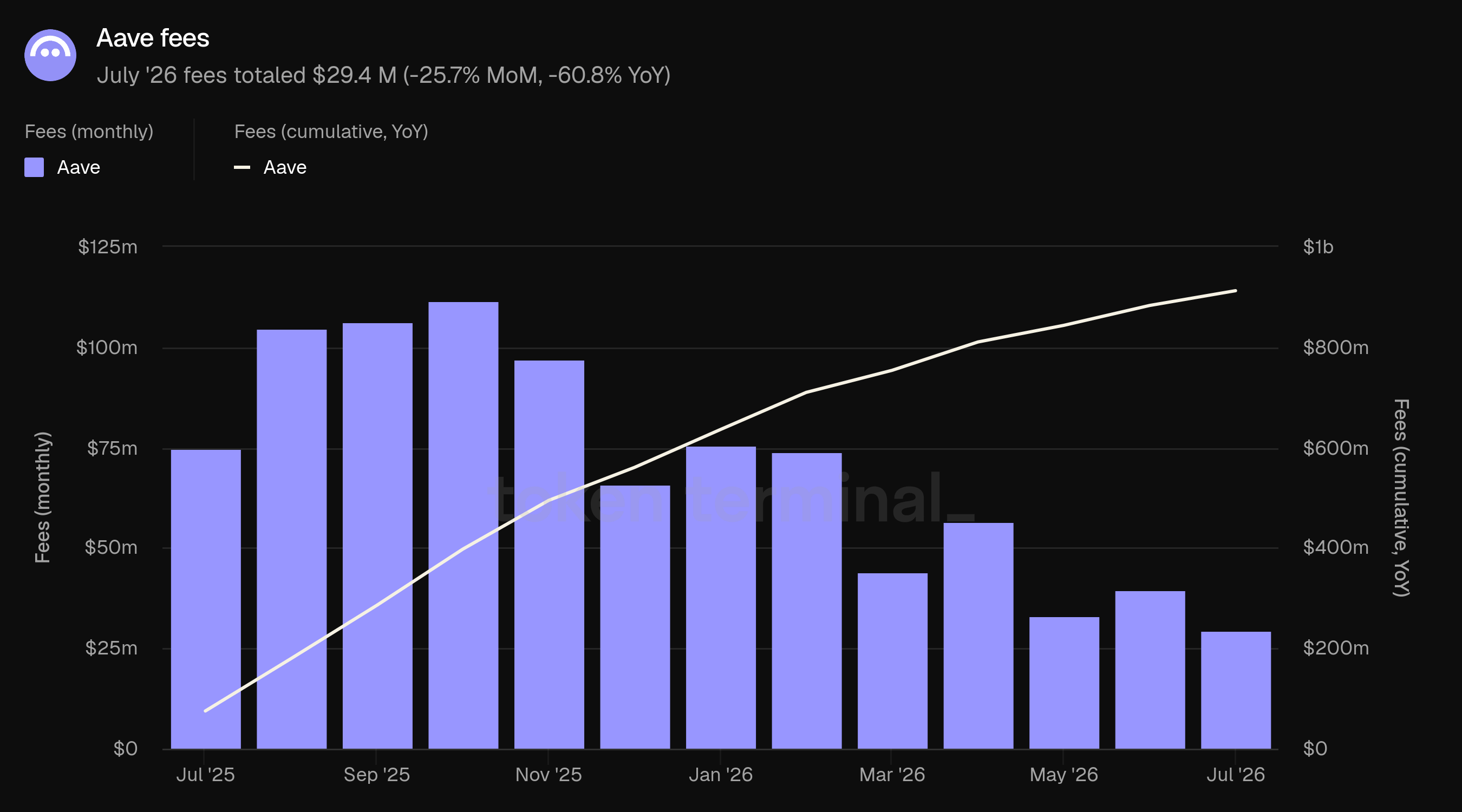
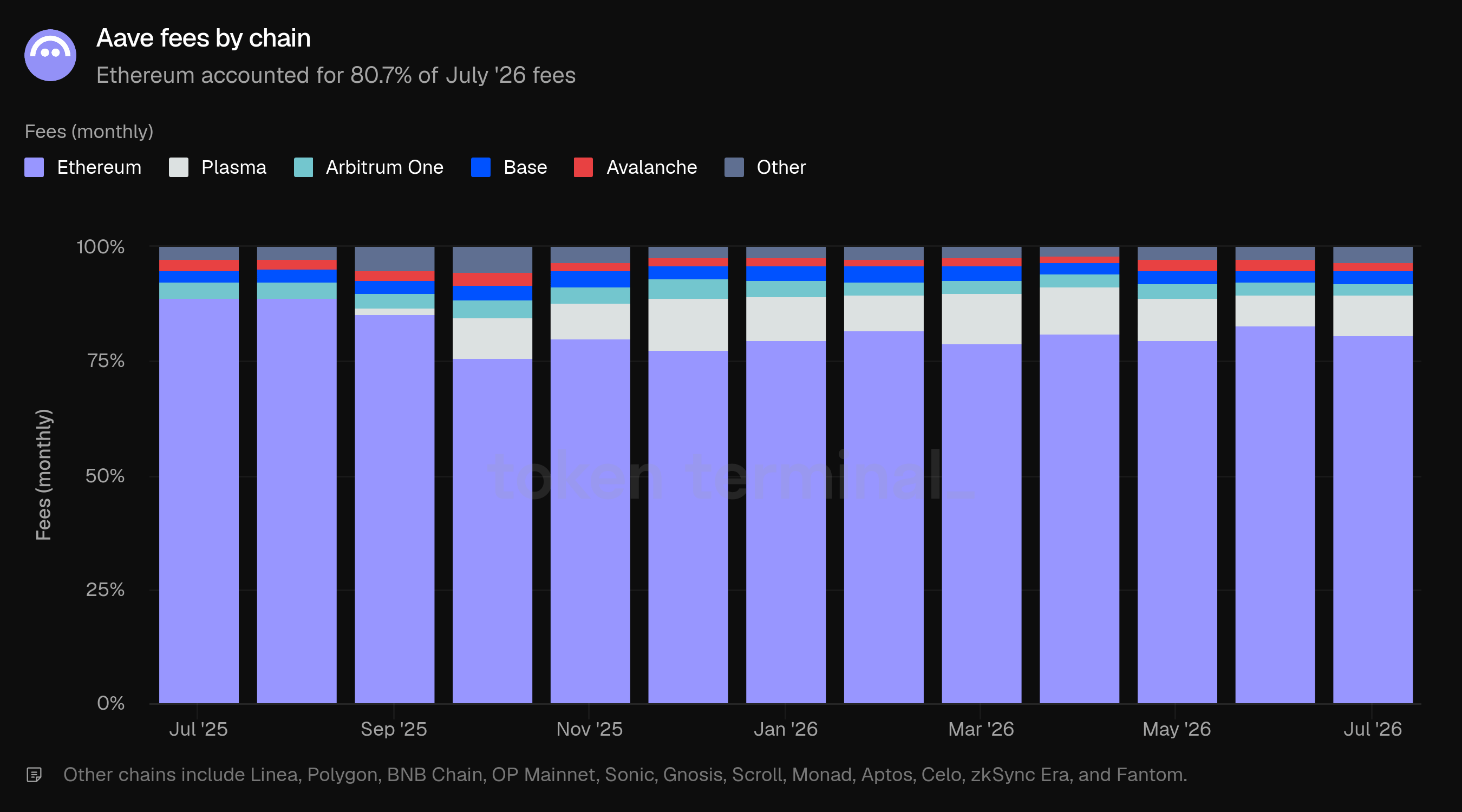
Ethereum generated 80.7% of July fees ($23.7 M), down from 83.1% in June as the liquidation-heavy mainnet income of that month normalized, with Plasma at 9.0% and no other chain above 3%.
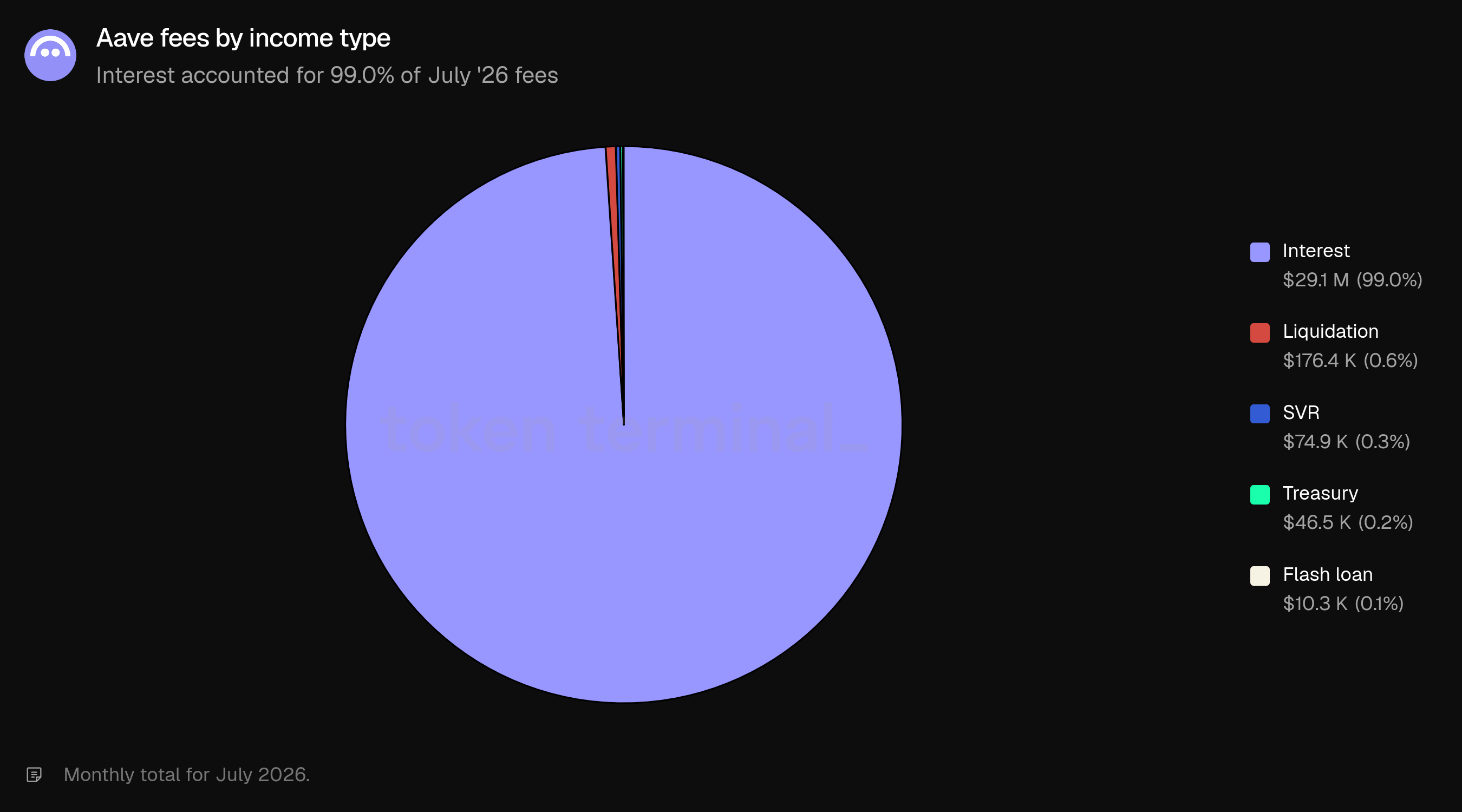
The income mix makes the normalization visible. Interest made up 99.0% of July fees ($29.1 M), with liquidation fees at $176.4 K and SVR at $74.9 K, against $11.1 M and $2.6 M respectively in June, when over a third of the fee base came from liquidation-linked income.
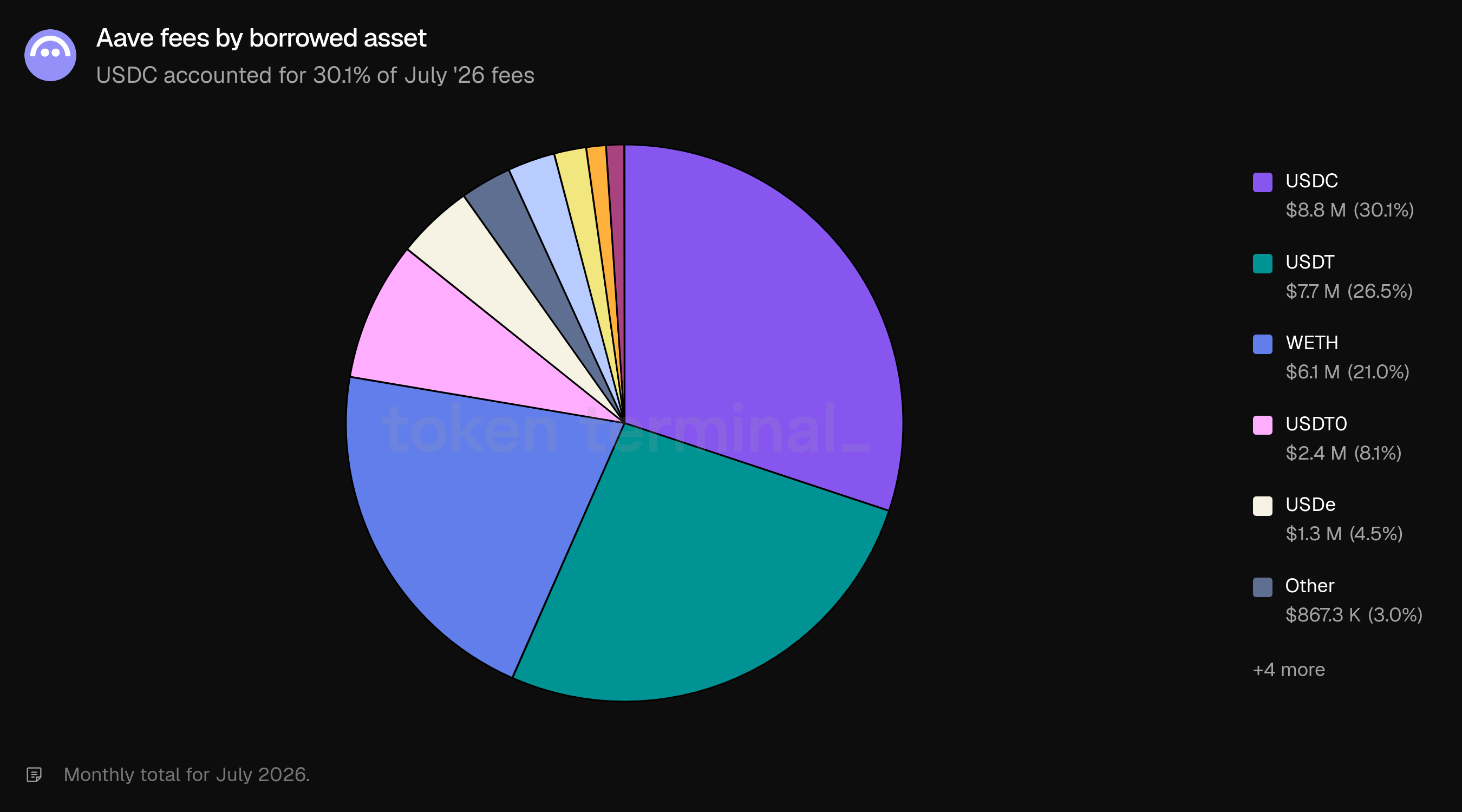
By borrowed asset, the fee base followed the loan book back to stablecoins: USDC generated 30.1% of July fees ($8.8 M), USDT 26.5% ($7.7 M), and WETH 21.0% ($6.1 M). In June, WETH had led at 37.5% of a liquidation-inflated total.
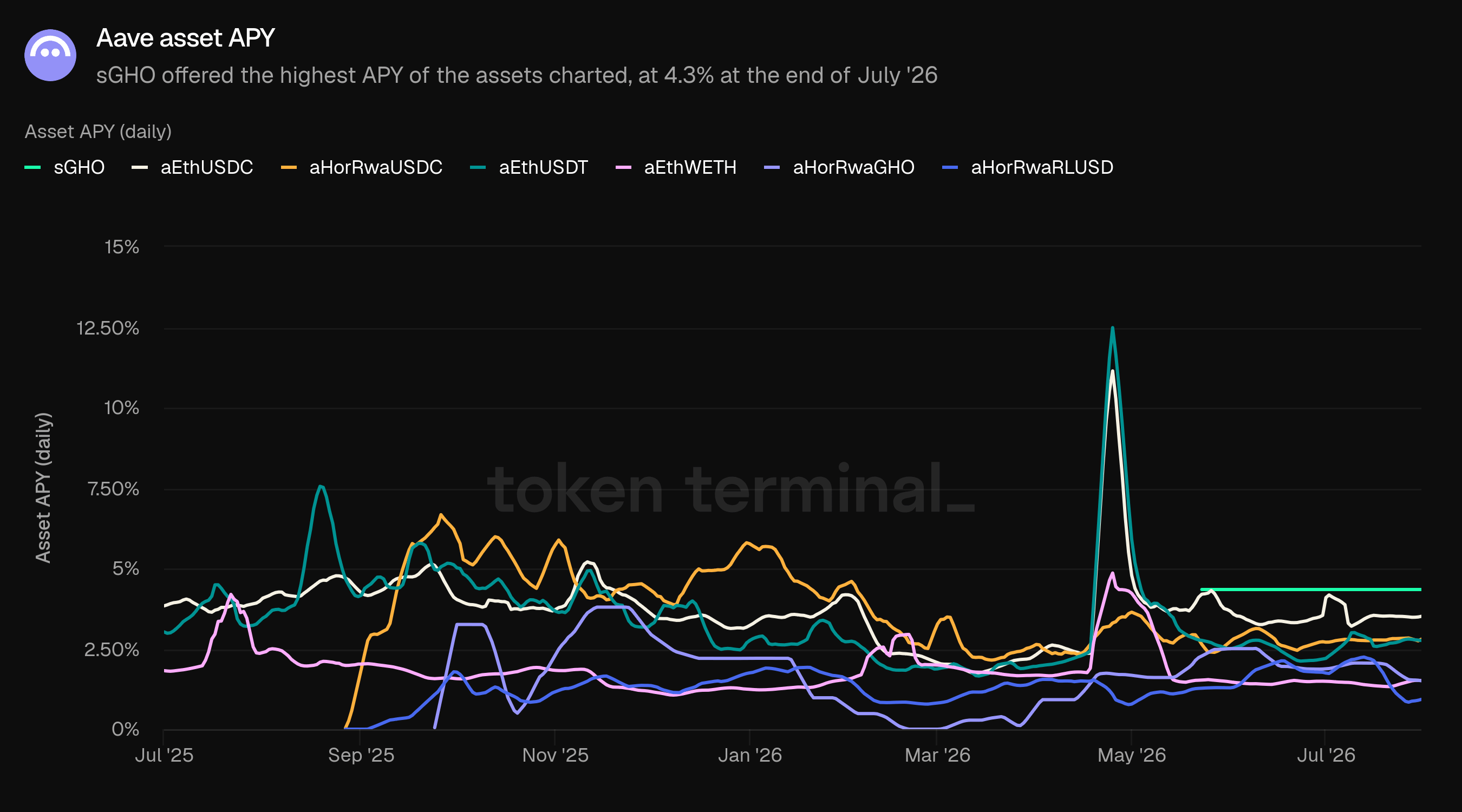
Asset APY measures the annualized yield accrued by holding a yield-bearing token, calculated from a standardized onchain yield index over a 7-day trailing window; for Aave it applies to aTokens and sGHO and reflects supply-side yield, not borrow rates. Across the yield-bearing tokens charted here, sGHO ended July at 4.3%, the highest of the set, reflecting its governance-set savings rate, while stablecoin supply yields firmed alongside the growing loan book: aEthUSDC ended the month at 3.5%, aEthUSDT at 2.8%, and aEthWETH at 1.5%.
7) Revenue
Revenue measures the total USD value of fees retained by the Aave DAO, aggregated across the same income types as fees.
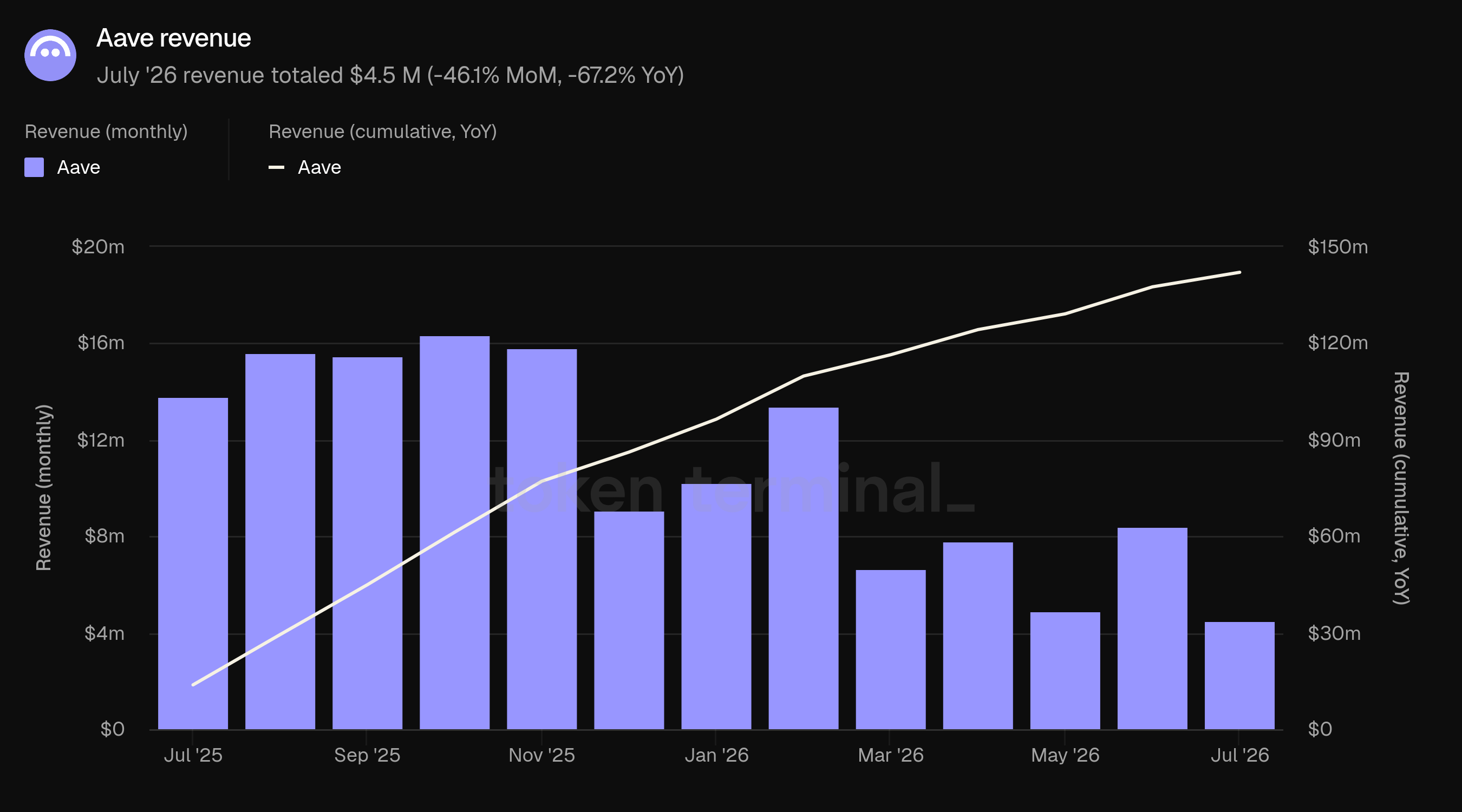
Revenue totaled $4.5 M in July, down 46.1% MoM and 67.2% YoY. The drop mirrors the fee mix: June's DAO income was disproportionately boosted by SVR and liquidations, which flow to the treasury at a far higher rate than interest, and both faded in July. Interest revenue itself was essentially flat month-over-month at $4.4 M.
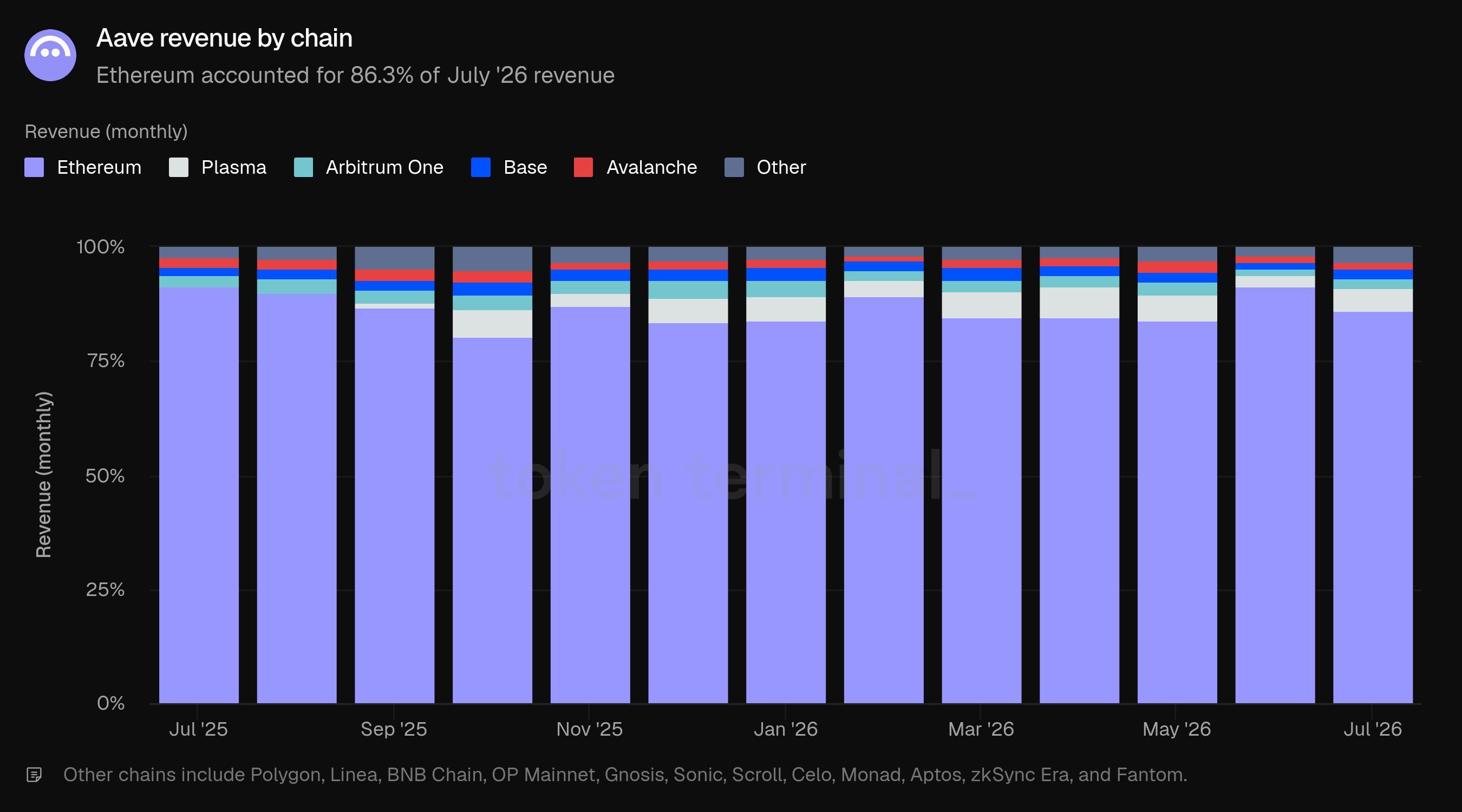
Ethereum accounted for 86.3% of July revenue ($3.9 M), down from 91.4% in June, when the month's liquidation and SVR income accrued largely on mainnet markets.
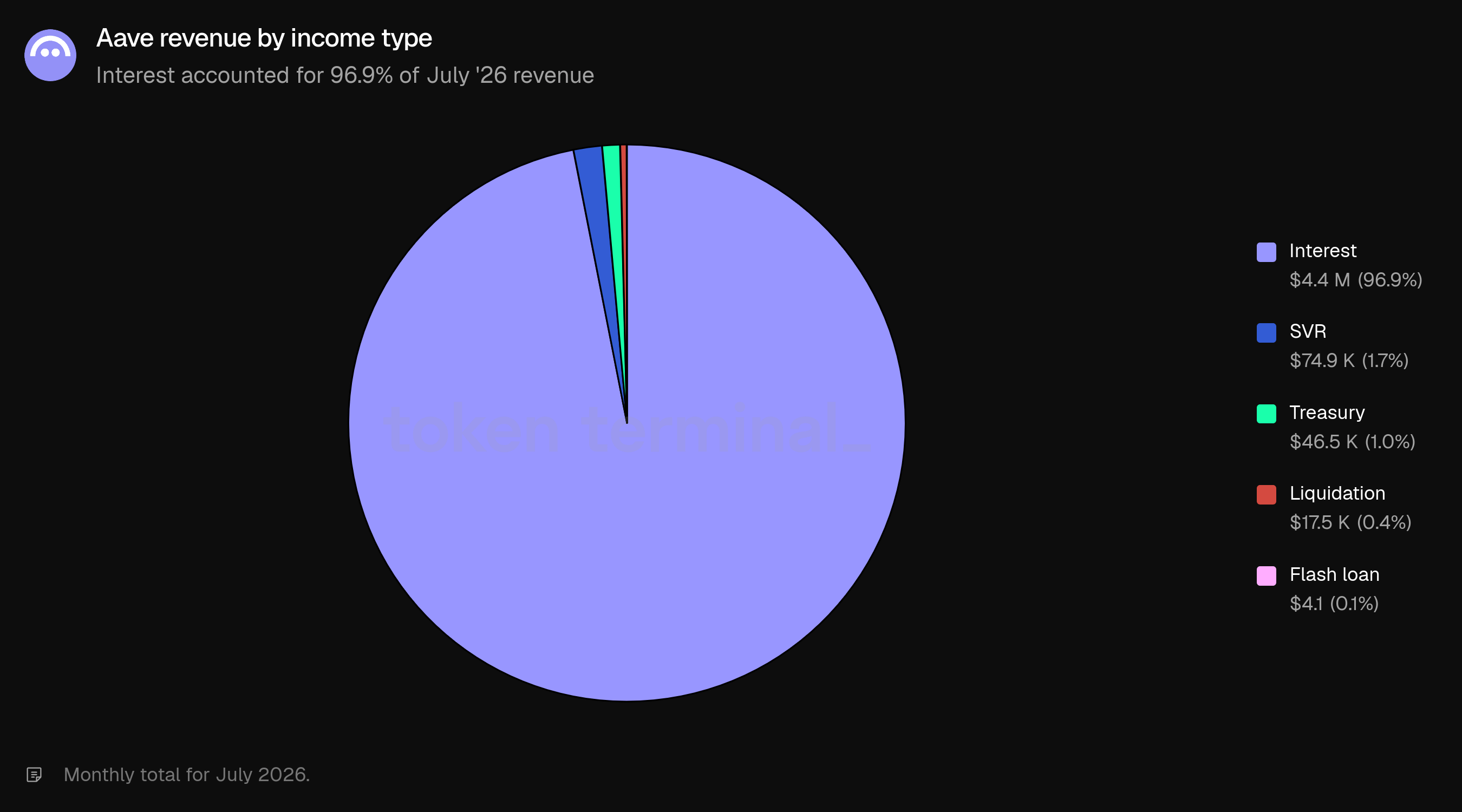
Interest contributed 96.9% of July revenue ($4.4 M), with SVR at $74.9 K, treasury at $46.5 K, and liquidations at $17.5 K. The DAO's income normalizes toward the interest spread when liquidation events fade.
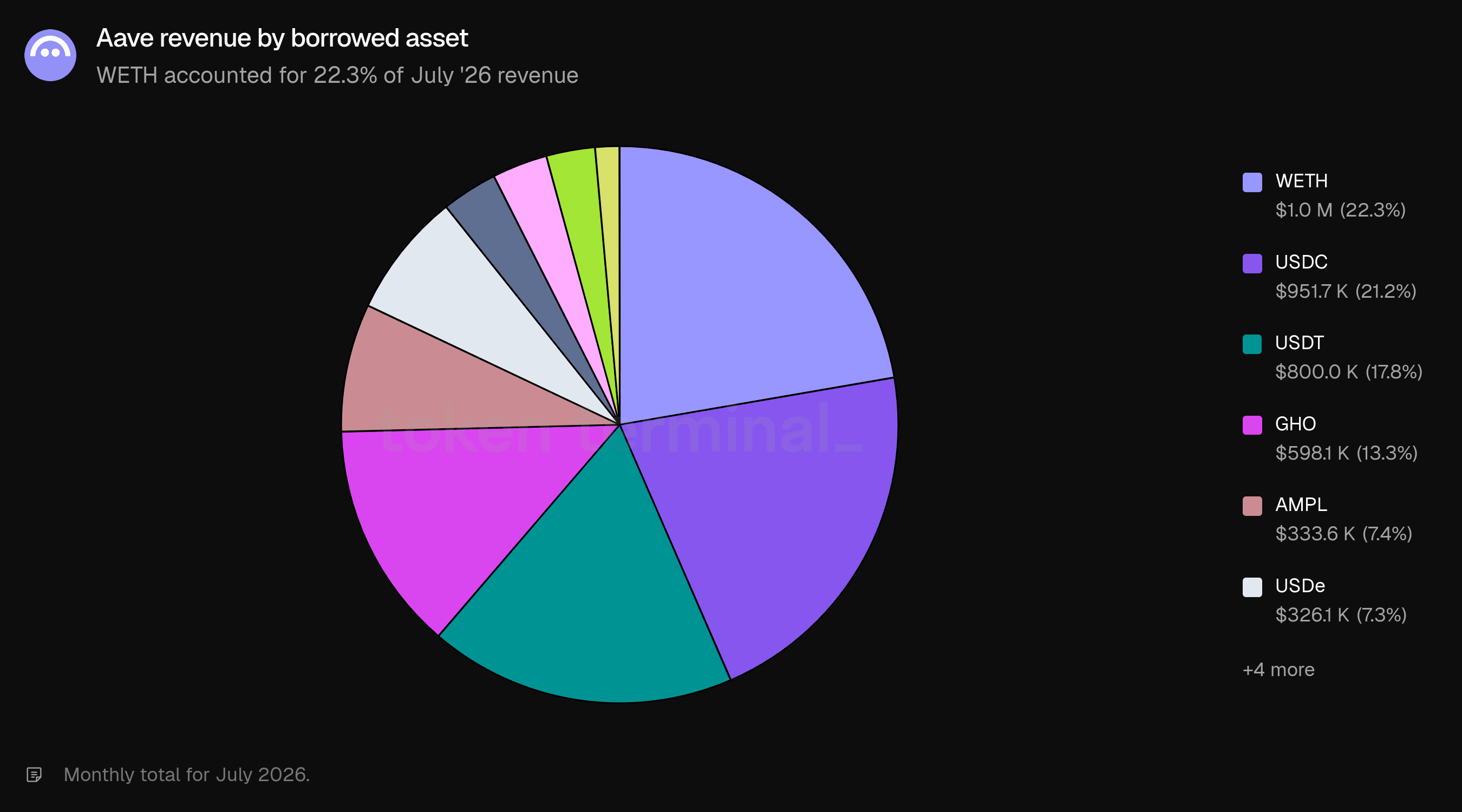
WETH markets generated 22.3% of July revenue ($1.0 M), with USDC (21.2%) and USDT (17.8%) close behind and GHO at 13.3%. AMPL contributed 7.4% ($333.6 K), again a notably large share relative to its footprint in TVL and active loans, where it does not appear among the top assets.
8) Monthly active users
Monthly active users measure the number of unique wallet addresses that have interacted with Aave over a rolling 30-day period.
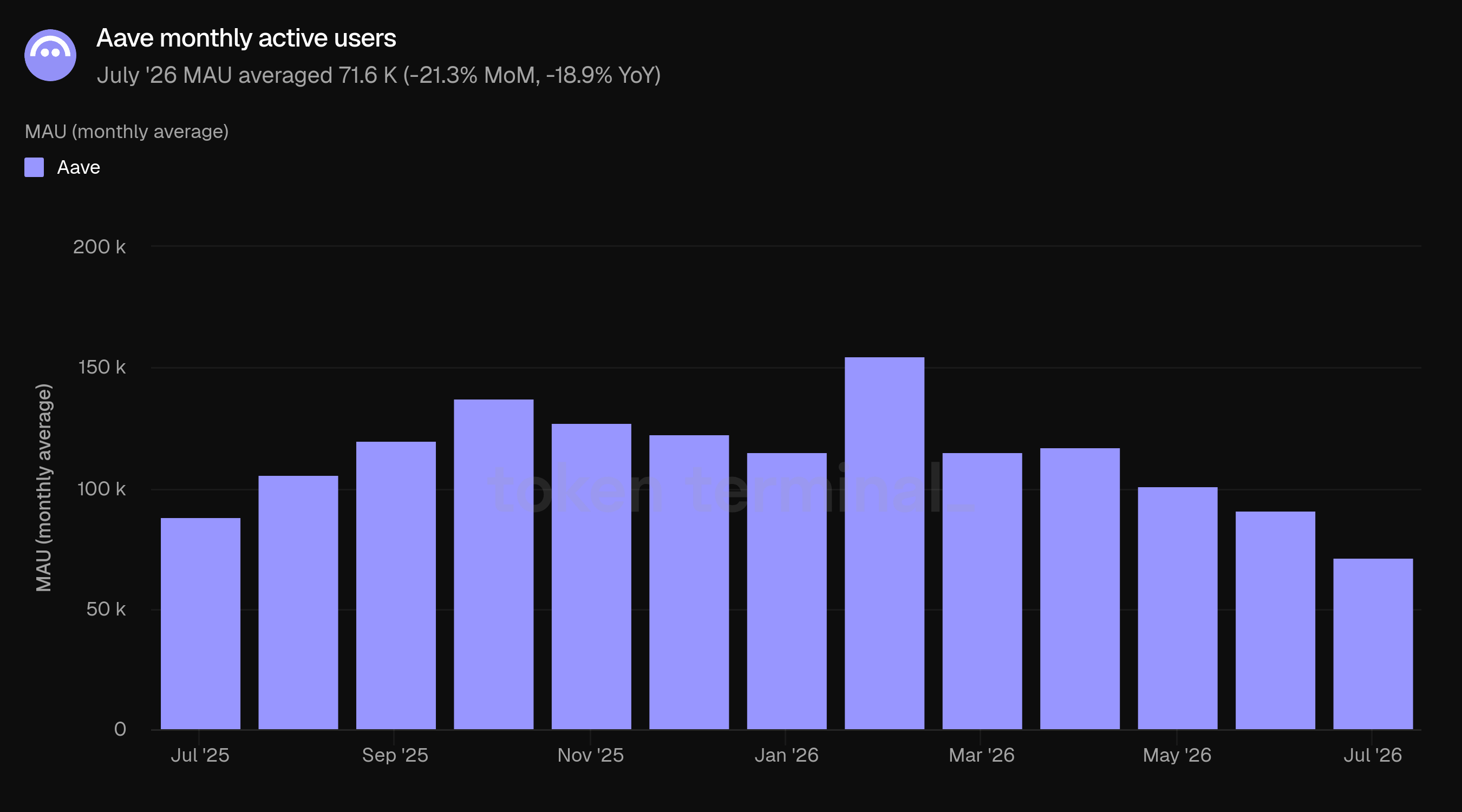
MAU averaged 71.6 K in July, down 21.3% MoM and 18.9% YoY, a third consecutive monthly decline and the lowest monthly average since February 2024. July inverts the pattern the drawdown had shown so far: capital metrics turned up while the user count fell, so the month's recovery was carried by fewer, larger participants.
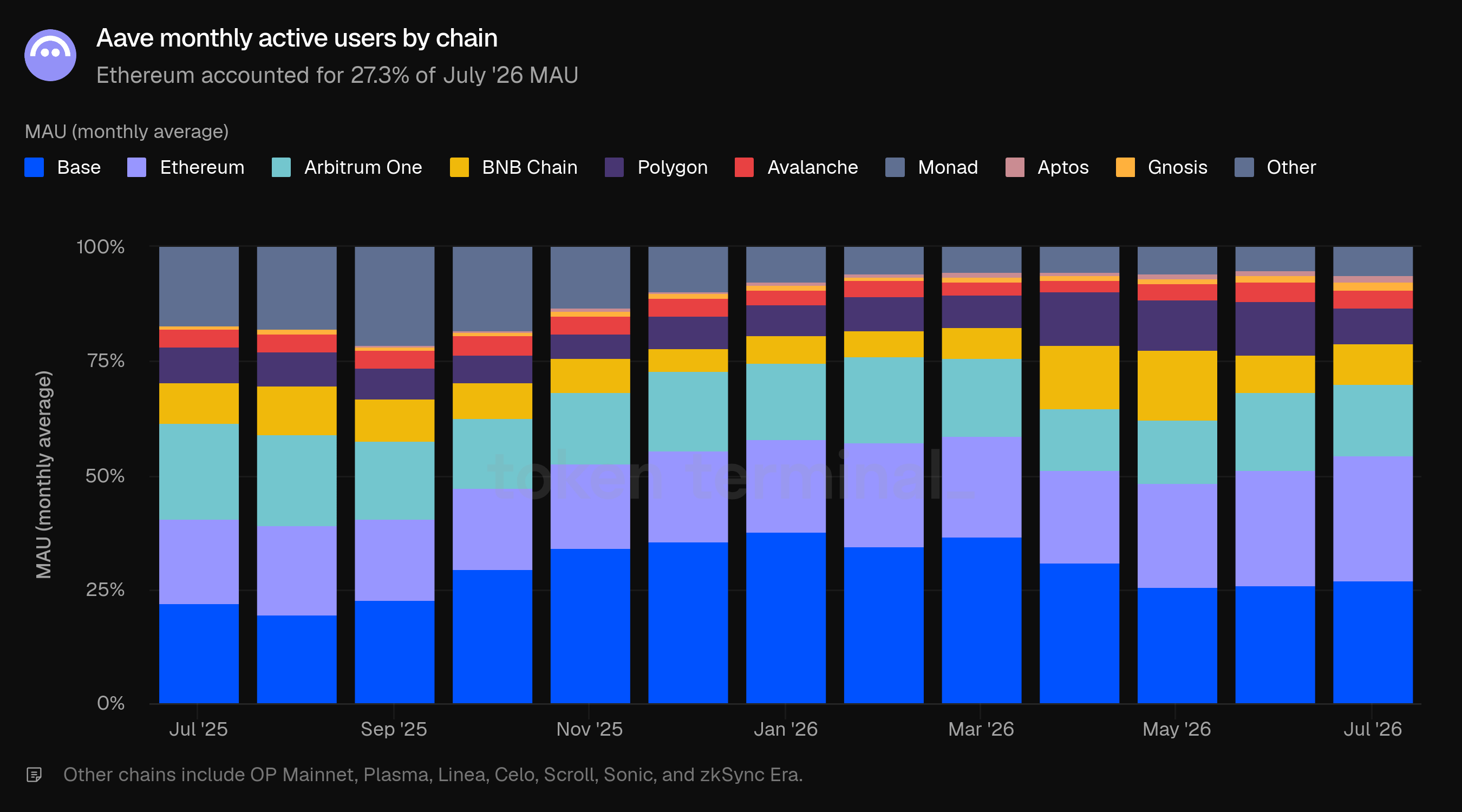
Ethereum and Base were nearly even as the largest user bases, at 27.3% (21.1 K) and 27.0% (20.9 K) of July MAU respectively, with Ethereum narrowly retaking the lead Base held in June, followed by Arbitrum One at 15.7% and BNB Chain at 9.0%. The user mix remains far less concentrated than the capital mix: Ethereum holds four-fifths of TVL but little more than a quarter of users.
9) AAVE
AAVE is the project's native governance token. AAVE holders govern the Aave DAO, and the token can be staked in the Safety Module, which backstops the project against shortfall events. AAVE market cap here measures the token's fully diluted valuation.
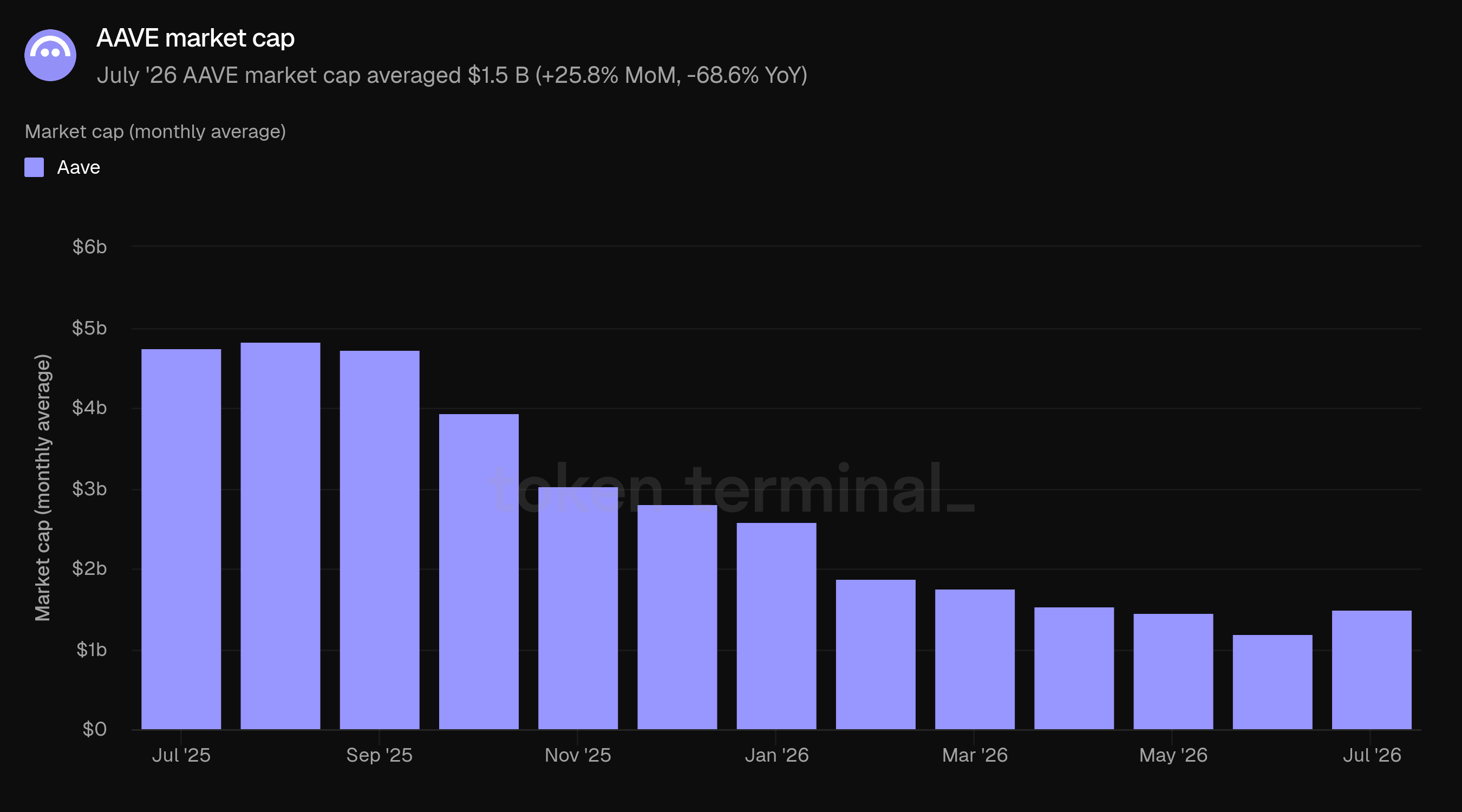
AAVE market cap averaged $1.5 B in July, up 25.8% MoM though still down 68.6% YoY, the first monthly increase since August 2025 and the end of ten consecutive monthly declines. The token's recovery, which had begun from an early-June low, extended through July alongside the turn in the project's capital metrics.
10) GHO
GHO is Aave's native decentralized stablecoin, launched in 2023. Borrowers mint GHO using their Aave collateral, and its market cap measures the fully diluted valuation of GHO in circulation.
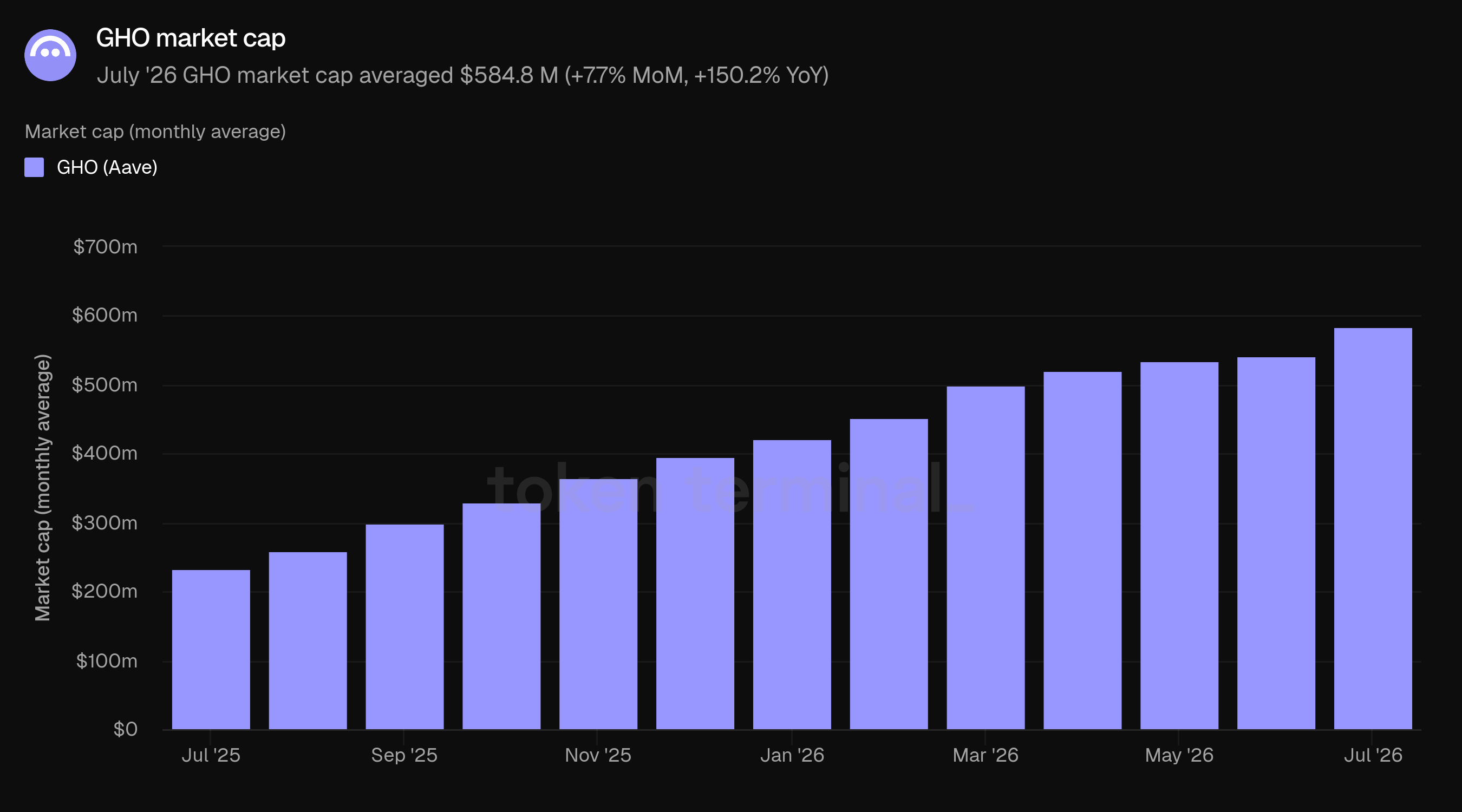
GHO market cap averaged $584.8 M in July, up 7.7% MoM and 150.2% YoY, its thirteenth consecutive monthly increase, a streak running since July 2025. GHO has been the report's most consistent growth series through the drawdown and kept compounding into the recovery. During July, a migration tool from legacy stkGHO staking to the sGHO savings product went live, and governance work to take sGHO cross-chain remained in the pipeline.
11) Outlook
July's story was a turn: after five months of decline, TVL, active loans, market share, and both token market caps rose together, the fee base normalized to interest income that grew with the loan book, and each of the project's growth products (V4, the Monad deployment, GHO) ended the month larger than it started. User counts were the exception, falling to a multi-year low even as capital returned.
The expansion carried straight into August. Deposits on Monad kept climbing in the first days of the month, V4 deposits crossed $350 M on the official basis on August 3, the same day Maple's syrupUSDG went live as collateral on the Global Dollar Hub; a V3-to-V4 position migrator built by DeFiSaver launched on August 4, and Coinbase's cbETH crossed $100 M in deposits on the Base market on August 7. On Horizon, additional tokenized fund collateral went live in early August. The Aave App remained in waitlist at the end of the period, with an iOS release signaled as imminent in late July, and Stable Vaults, formally verified by Certora on July 27, opened the same fixed-rate savings infrastructure to outside businesses. In governance, proposals to extend V4 to further networks and onboard additional collateral remained open alongside a framework for the App's launch economics.
The near-term picture is the inverse of a quarter ago: newer markets compounding, aggregate scale recovering, and the open questions now distribution ones, whether the App and Stable Vaults can convert the project's infrastructure into consumer and business reach, and whether the user base broadens again as they land.
12) Definitions
Products:
Aave V3: the version carrying the bulk of Aave's deposits and loans, launched in March 2022, enabling multichain deployment and features such as e-mode for improved capital efficiency.
Aave V4: launched on Ethereum in late March 2026. Introduces a hub-and-spoke architecture where shared liquidity pools (hubs) connect to modular borrowing strategies (spokes).
Aave Horizon: a specialized lending market for tokenized real-world assets, launched in August 2025. Stablecoin supply is permissionless; collateral onboarding is managed by tokenization issuers.
Aave App: Aave's upcoming mobile app for retail users to access fixed income savings powered by Aave markets.
AAVE: the project's native governance token. AAVE holders govern the Aave DAO, and the token can be staked in the Safety Module, which backstops the project against shortfall events.
GHO: Aave's native decentralized stablecoin, launched in 2023. Borrowers mint GHO using their Aave collateral.
Metrics:
Total value locked: measures the total USD value of assets supplied to Aave's markets, the sum of idle liquidity and outstanding loans.
Active loans: measures the total USD value of outstanding borrows across all Aave lending markets.
Deposits: measures the total USD value of assets supplied to Aave's markets.
Fees: measures the total USD value of fees paid by users across all of Aave's lending markets, aggregated across all income types (see below).
Revenue: measures the total USD value of fees retained by the Aave DAO, aggregated across all income types (see below).
Asset APY: measures the annualized yield accrued by holding a yield-bearing token, calculated from a standardized onchain yield index over a 7-day trailing window; for Aave, it is applied to aTokens and reflects the supply yield earned across Aave's markets.
Monthly active users: measures the number of unique wallet addresses that have interacted with Aave over a rolling 30-day period.
Market share: measures Aave's share of active loans relative to other lending projects.
AAVE market cap: measures the fully diluted valuation of the AAVE token.
GHO market cap: measures the fully diluted valuation of GHO, Aave's native decentralized stablecoin.
Income types:
Interest: fees paid by borrowers on outstanding loans. A share of interest flows to the DAO treasury as revenue.
Liquidation: fees collected when undercollateralized positions are liquidated.
SVR: revenue recaptured from oracle-related MEV during liquidations via Chainlink SVR.
Flash loan: fees charged on uncollateralized loans that are borrowed and repaid within a single transaction.
Treasury: fees from Aave DAO treasury management activities.
GHO stability module: fees charged on swaps between GHO and other stablecoins through the GHO Stability Module.
13) About this report
This report is published monthly and produced leveraging Token Terminal's end-to-end onchain data infrastructure. All metrics are sourced directly from blockchain data. Charts and datasets referenced in this report can be viewed on the corresponding Aave July 2026 Report dashboard on Token Terminal.