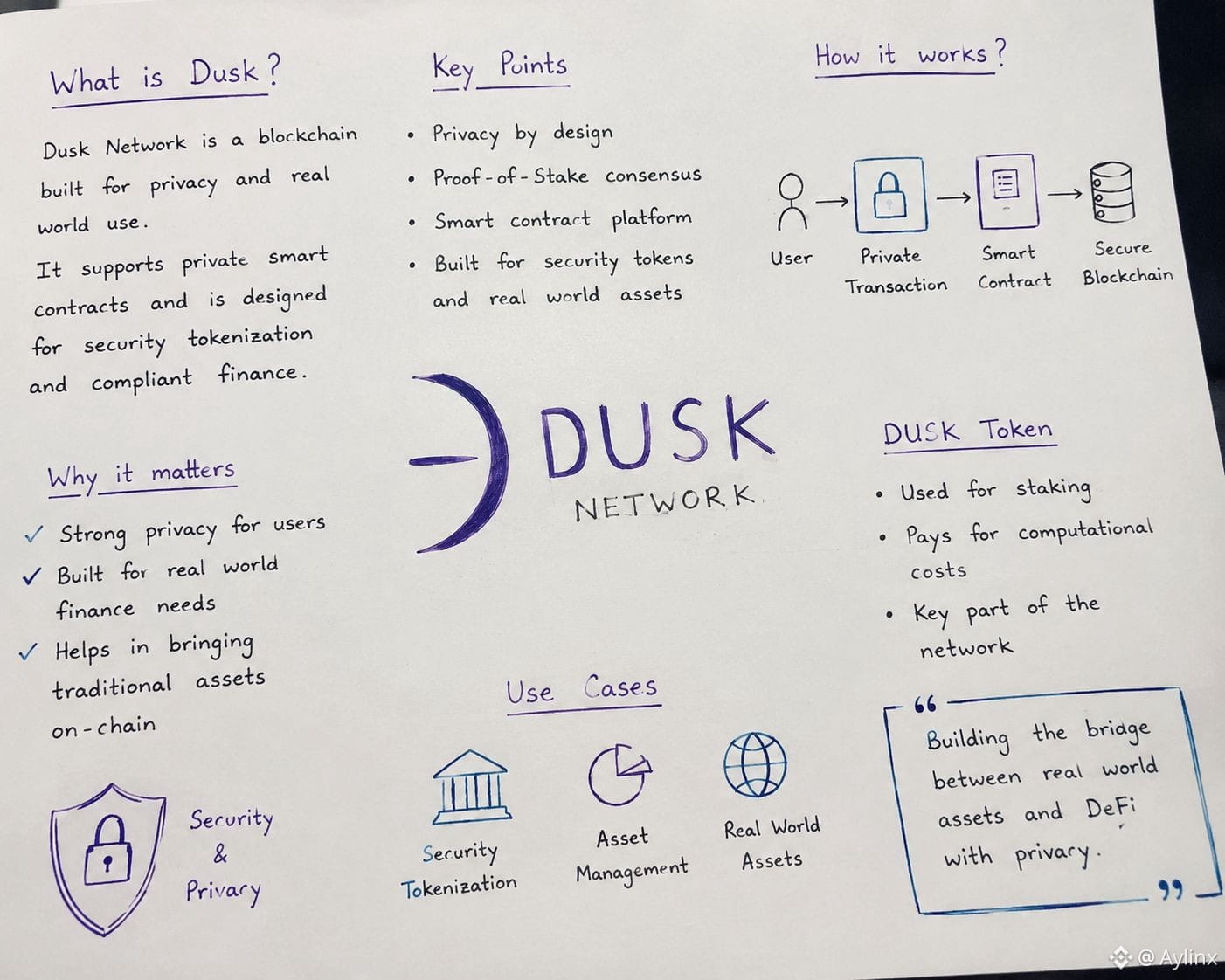
I only started looking into Dusk today, and honestly, I expected the privacy side to be the thing that caught my attention first. Instead, I ended up looking more closely at what DUSK actually does inside the network.
One thing that caught my attention is that DUSK isn’t just another token sitting alongside the network. It’s used for staking and for reimbursing computational costs, so it has a direct role in how the protocol operates. That made me look at the staking design a little differently.
Dusk uses Segregated Byzantine Agreement, a permissionless Proof-of-Stake mechanism, with Proof-of-Blind Bid used for privacy-preserving leader selection. I can see why that matters. If leader selection is less predictable, it potentially gives the network another layer of protection.
Still, I’m only getting into Dusk now, so I don’t want to pretend I’ve already formed a strong opinion. I want to watch how staking participation, validator distribution and network activity develop in practice.
I’m curious whether the design holds up as actual network usage grows. @Dusk $DUSK #dusk
One thing that caught my attention is that DUSK isn’t just another token sitting alongside the network. It’s used for staking and for reimbursing computational costs, so it has a direct role in how the protocol operates. That made me look at the staking design a little differently.
Dusk uses Segregated Byzantine Agreement, a permissionless Proof-of-Stake mechanism, with Proof-of-Blind Bid used for privacy-preserving leader selection. I can see why that matters. If leader selection is less predictable, it potentially gives the network another layer of protection.
Still, I’m only getting into Dusk now, so I don’t want to pretend I’ve already formed a strong opinion. I want to watch how staking participation, validator distribution and network activity develop in practice.
I’m curious whether the design holds up as actual network usage grows. @Dusk $DUSK #dusk