Last week my node on a testnet relay setup in Karachi kept lagging whenever I tried simulating heavy message traffic. I assumed the issue was just my bandwidth being weak, typical local ISP problem I've dealt with before.
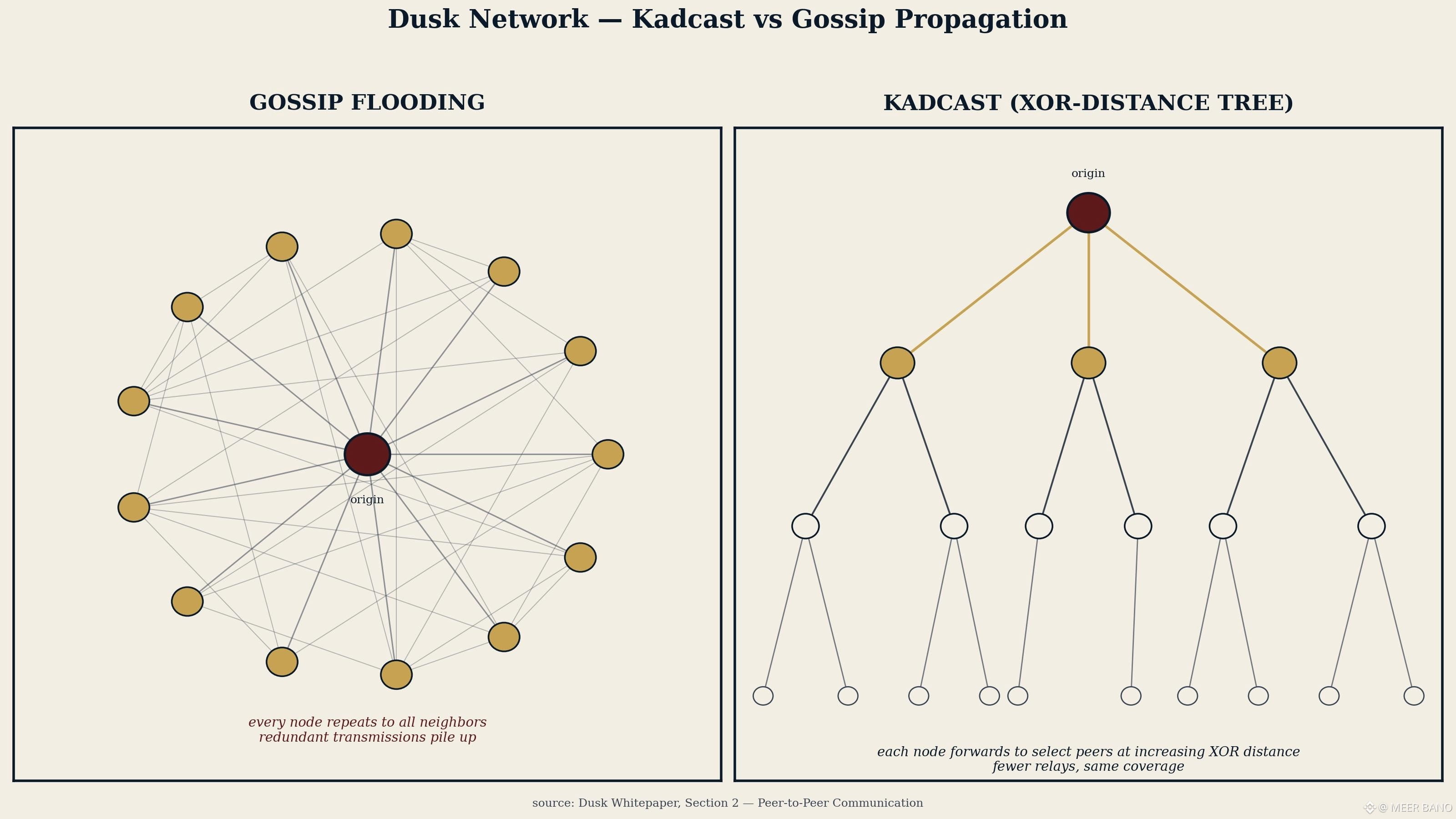
Then I actually read how Dusk handles peer to peer communication and realized my assumption was backwards. The lag wasn't about raw bandwidth, it was about how inefficiently flooding style broadcast works when every node repeats messages to all its neighbors regardless of distance.
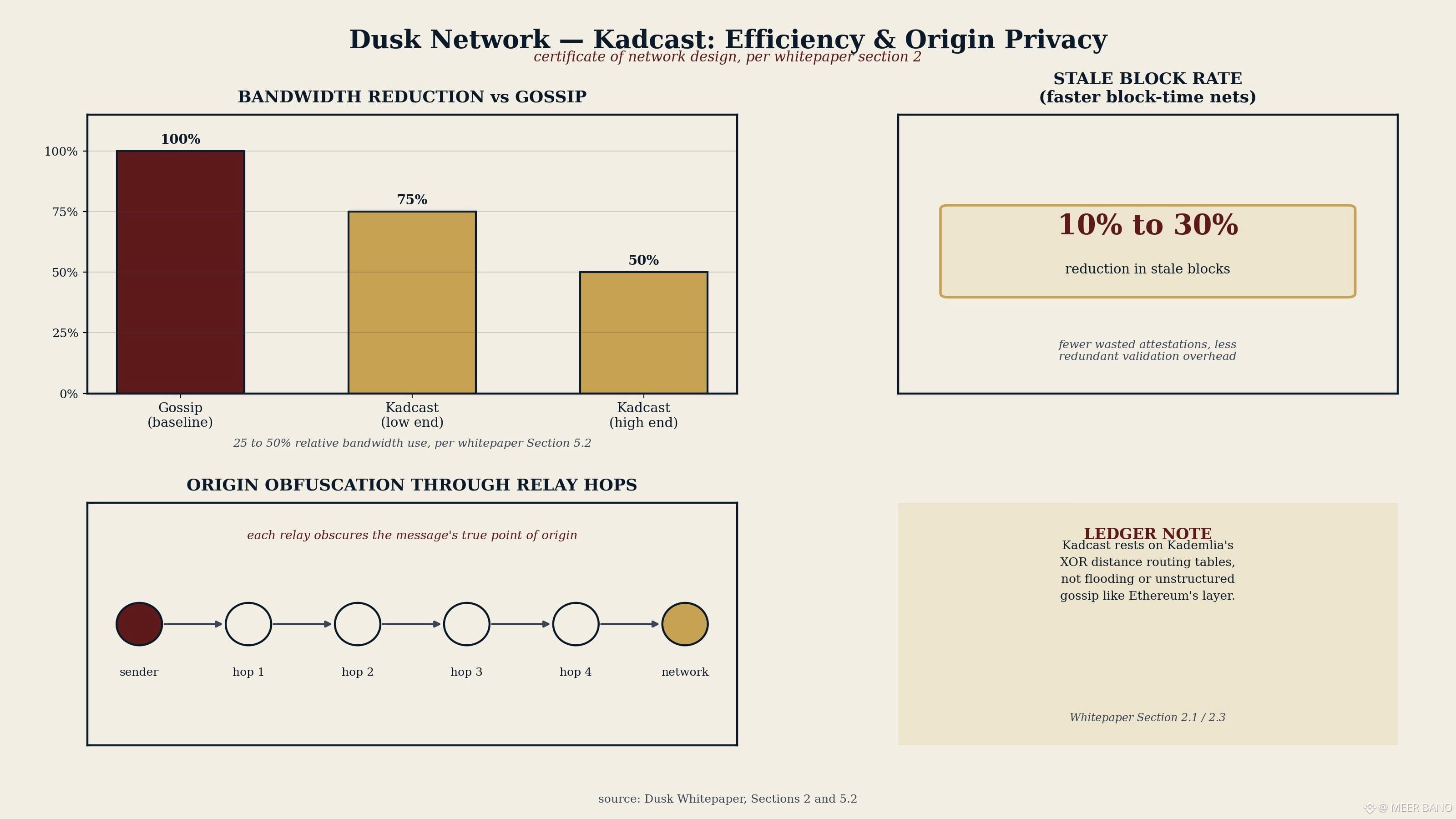
Dusk uses Kadcast instead, built on Kademlia's XOR distance structure. Nodes forward messages only to selected peers at increasing distances, creating a cascading effect rather than blind repetition. This cuts redundant transmissions significantly compared to gossip protocols like the ones Ethereum relies on. It also naturally obscures where a message originated since it passes through multiple hops before reaching the wider network, which lines up with Dusk's privacy focus for financial transactions.
What the whitepaper doesn't spell out clearly is exact real world latency numbers under adverse network conditions, like what happens specifically during regional congestion in places with unstable infrastructure. That's a gap I can't fill with confidence.
The real test for DUSK is whether Kadcast holds its efficiency advantage once node counts scale into the thousands under real network stress, not just controlled testnet conditions.
Has anyone here actually run a Dusk node long enough to notice propagation speed differences firsthand?
#dusk $DUSK @Dusk
Then I actually read how Dusk handles peer to peer communication and realized my assumption was backwards. The lag wasn't about raw bandwidth, it was about how inefficiently flooding style broadcast works when every node repeats messages to all its neighbors regardless of distance.
Dusk uses Kadcast instead, built on Kademlia's XOR distance structure. Nodes forward messages only to selected peers at increasing distances, creating a cascading effect rather than blind repetition. This cuts redundant transmissions significantly compared to gossip protocols like the ones Ethereum relies on. It also naturally obscures where a message originated since it passes through multiple hops before reaching the wider network, which lines up with Dusk's privacy focus for financial transactions.
What the whitepaper doesn't spell out clearly is exact real world latency numbers under adverse network conditions, like what happens specifically during regional congestion in places with unstable infrastructure. That's a gap I can't fill with confidence.
The real test for DUSK is whether Kadcast holds its efficiency advantage once node counts scale into the thousands under real network stress, not just controlled testnet conditions.
Has anyone here actually run a Dusk node long enough to notice propagation speed differences firsthand?
#dusk $DUSK @Dusk