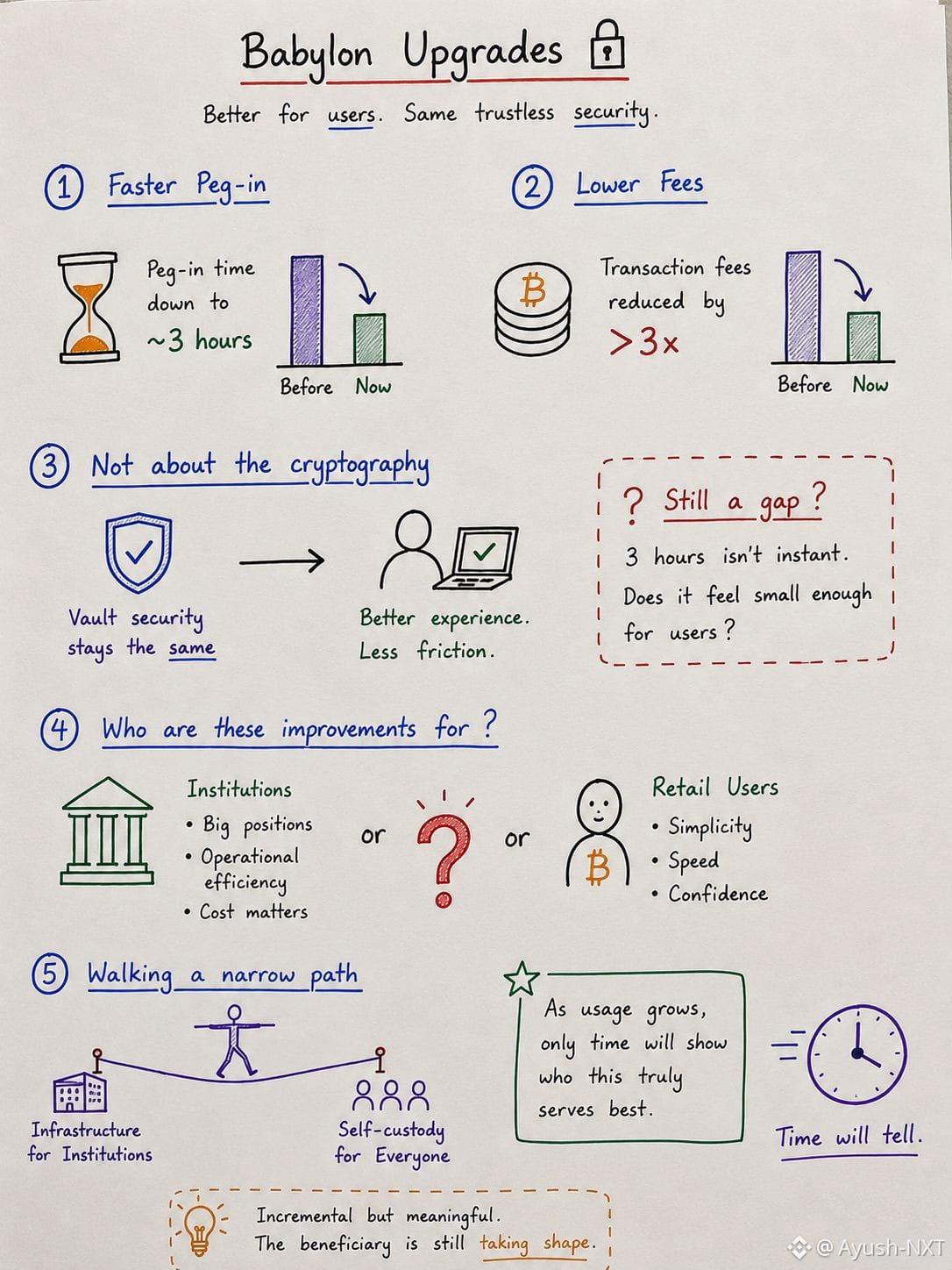
I was looking back at the numbers Babylon shared about peg-in times dropping to around three hours and transaction fees getting cut by more than threefold, and it made me stop and think about how much of adoption actually comes down to details this unglamorous. Nobody talks about deposit friction when they're excited about trustless custody, but I suspect it matters more than most of the narrative admits.
What seems interesting is that these improvements aren't really about the cryptography at all — the underlying vault security model presumably stays the same — they're about making the experience tolerable for someone who isn't deeply technical. Three hours instead of whatever it was before is still not instant, and I sometimes wonder if that gap is small enough for people or if it still feels like friction compared to what they're used to elsewhere in crypto.
The part that makes me pause is the institutional angle sitting behind Babylon's existing scale, billions already staked through the broader protocol. The question that comes to mind is whether faster peg-ins and lower fees are really aimed at everyday retail users, or whether they're quietly optimizing for larger players who care more about operational efficiency across bigger positions. I'm not completely sure those two audiences want the same things from this system.
It makes me think Babylon is threading a narrow path between infrastructure built for institutions and a pitch that still frames self-custody as something ordinary holders should care about. Whether that dual audience holds together as usage grows, or whether one side ends up shaping the protocol's priorities more than the other, feels like something that will only become clear once real deposit volume starts flowing through consistently.
The improvements look incremental but meaningful today, yet who this infrastructure ultimately serves best is still taking shape — anyway, time will tell👍
#baby $BABY @BabylonLabs_io
What seems interesting is that these improvements aren't really about the cryptography at all — the underlying vault security model presumably stays the same — they're about making the experience tolerable for someone who isn't deeply technical. Three hours instead of whatever it was before is still not instant, and I sometimes wonder if that gap is small enough for people or if it still feels like friction compared to what they're used to elsewhere in crypto.
The part that makes me pause is the institutional angle sitting behind Babylon's existing scale, billions already staked through the broader protocol. The question that comes to mind is whether faster peg-ins and lower fees are really aimed at everyday retail users, or whether they're quietly optimizing for larger players who care more about operational efficiency across bigger positions. I'm not completely sure those two audiences want the same things from this system.
It makes me think Babylon is threading a narrow path between infrastructure built for institutions and a pitch that still frames self-custody as something ordinary holders should care about. Whether that dual audience holds together as usage grows, or whether one side ends up shaping the protocol's priorities more than the other, feels like something that will only become clear once real deposit volume starts flowing through consistently.
The improvements look incremental but meaningful today, yet who this infrastructure ultimately serves best is still taking shape — anyway, time will tell👍
#baby $BABY @BabylonLabs_io