#baby $BABY @BabylonLabs_io
Earlier today, I was discussing @BabylonLabs_io with friends, and one point kept bothering me: not every “treasury” is the same thing.
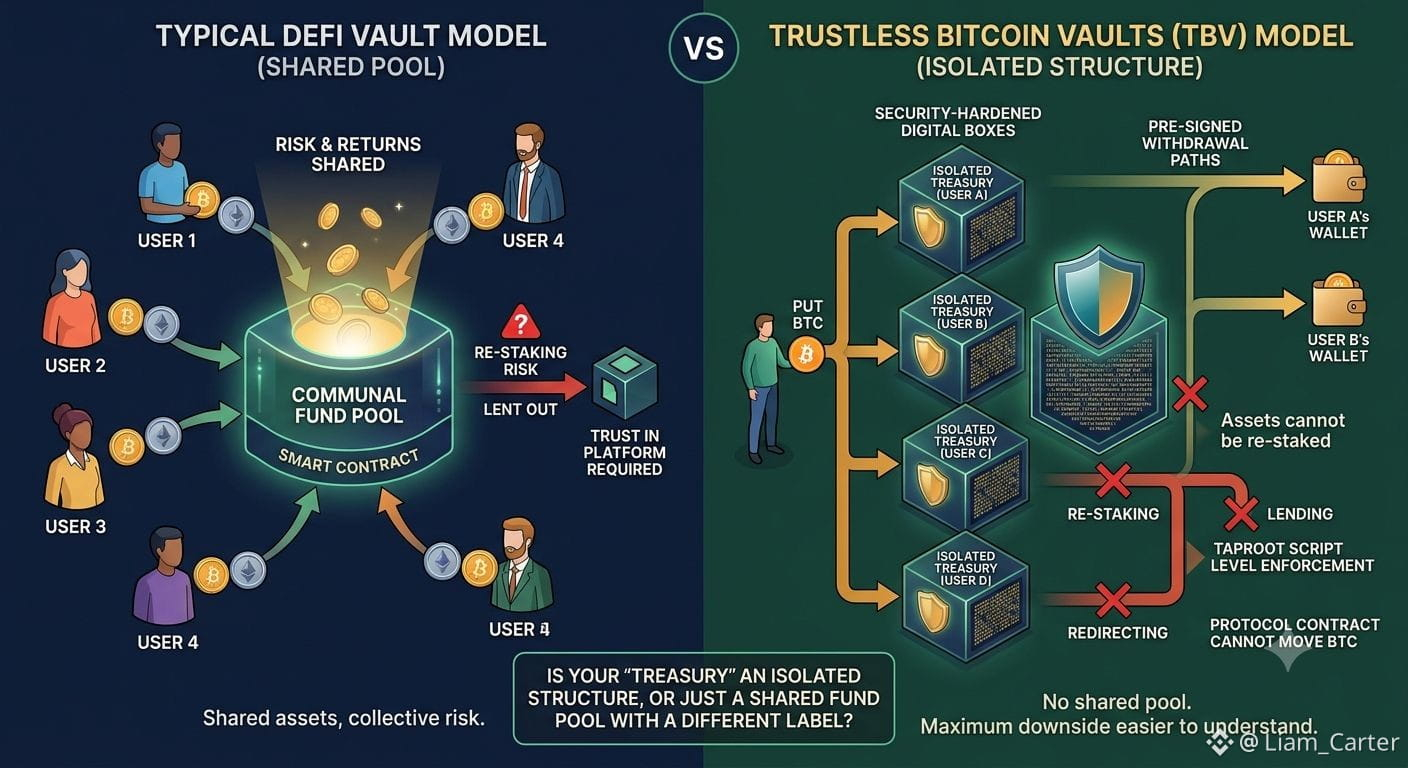
A typical DeFi vault is basically a shared pool. Many users deposit into one contract, and both returns and risks are distributed across the same bucket.
TBV’s treasury model is different. Each treasury is its own isolated UTXO, with a predefined set of pre-signed withdrawal paths. Treasuries do not merge into a shared pool, and they do not mix with one another. The structure is closer to a separate safe-deposit box than a communal fund.
Another key difference: the protocol contract itself cannot move BTC out of the script. It cannot lend it, reuse it, or redirect it elsewhere. That means the assets cannot be re-staked. In many “deposit-and-earn” products, you have to trust the platform not to put your funds to other uses. With TBV, that limitation is enforced at the script level. It is not just a promise; it is built into the design.
For larger amounts, I personally prefer this isolated model over a shared pool. It makes the maximum downside easier to understand. That said, I still have not seen publicly available Taproot script details or audit reports for each individual treasury, so that part remains unclear.
Before depositing into anything called a “treasury,” I think the first question should be simple: is it an isolated structure, or just a shared fund pool with a different label?
Earlier today, I was discussing @BabylonLabs_io with friends, and one point kept bothering me: not every “treasury” is the same thing.
A typical DeFi vault is basically a shared pool. Many users deposit into one contract, and both returns and risks are distributed across the same bucket.
TBV’s treasury model is different. Each treasury is its own isolated UTXO, with a predefined set of pre-signed withdrawal paths. Treasuries do not merge into a shared pool, and they do not mix with one another. The structure is closer to a separate safe-deposit box than a communal fund.
Another key difference: the protocol contract itself cannot move BTC out of the script. It cannot lend it, reuse it, or redirect it elsewhere. That means the assets cannot be re-staked. In many “deposit-and-earn” products, you have to trust the platform not to put your funds to other uses. With TBV, that limitation is enforced at the script level. It is not just a promise; it is built into the design.
For larger amounts, I personally prefer this isolated model over a shared pool. It makes the maximum downside easier to understand. That said, I still have not seen publicly available Taproot script details or audit reports for each individual treasury, so that part remains unclear.
Before depositing into anything called a “treasury,” I think the first question should be simple: is it an isolated structure, or just a shared fund pool with a different label?