I think the most important security question in DeFi is not whether a transaction can execute, but whether the system has enough independent economic weight to make dishonest settlement genuinely expensive.
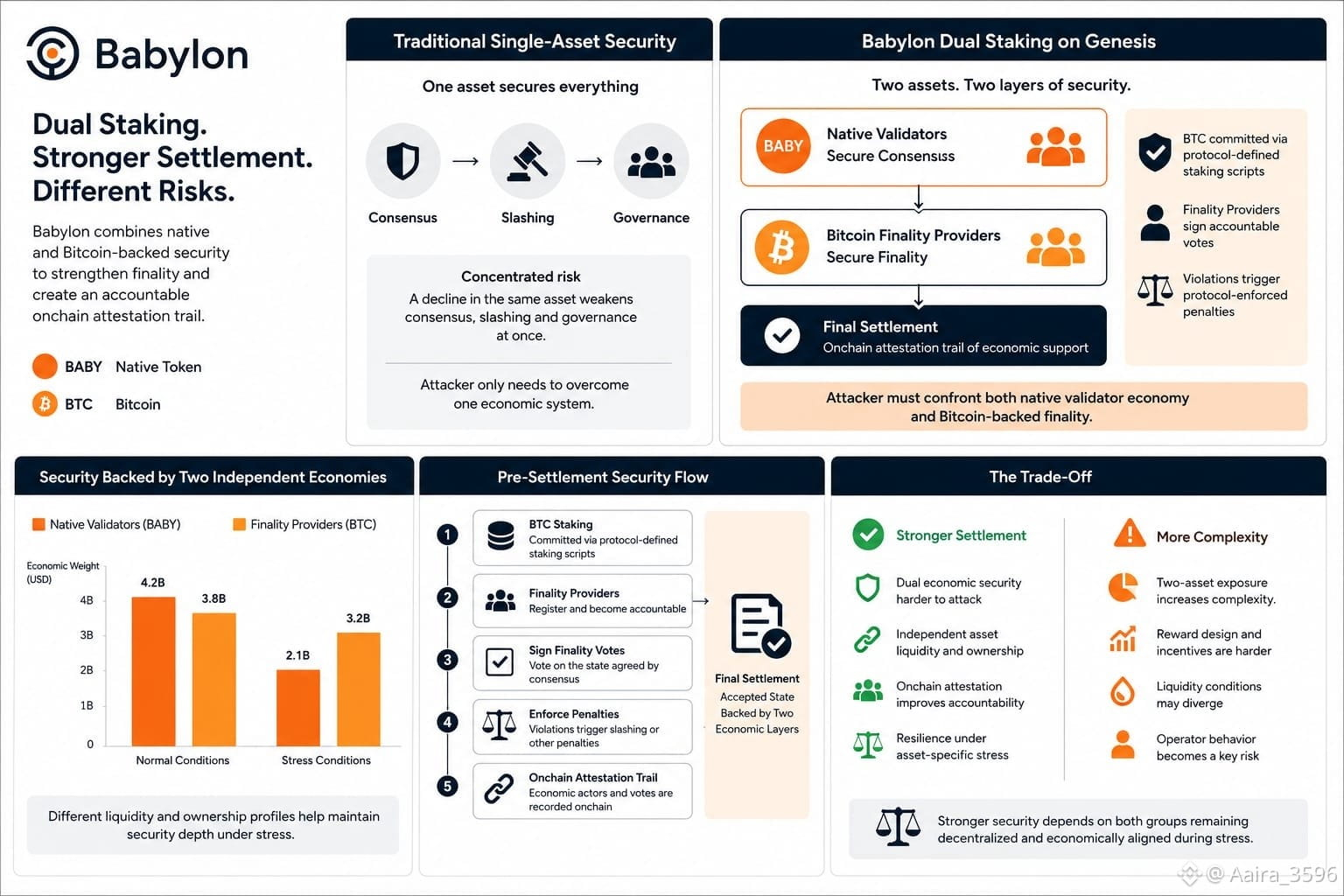
Many onchain applications still depend on a single validator set one native token or an offchain operator to confirm that predefined conditions were met. That creates concentrated risk. When the same asset secures consensus absorbs slashing and determines governance power a sharp decline in that asset can weaken several protections at once.
@BabylonLabs_io approaches this differently through dual staking on Babylon Genesis. Native $BABY validators support chain consensus while Bitcoin backed Finality Providers add finality votes above the underlying consensus layer. The result is not simply more stake. It is security drawn from two assets with different liquidity ownership and risk profiles.
Babylon’s version of pre-settlement control should be understood carefully. It is not a generic policy engine checking every DeFi action before execution. Instead, security conditions are established before participants can influence final settlement: BTC is committed through protocol-defined staking scripts, accountable Finality Providers sign votes and violations can trigger protocol-enforced penalties. Those votes and staking states create an onchain attestation trail showing which economic actors supported the accepted state.
In my view, this improves resilience because an attacker must confront both the native validator economy and Bitcoin-backed finality. But it also adds two-asset exposure. Security can become stronger while incentives reward expectations, liquidity conditions and operator behaviour become more complex.
That trade off matters. Dual staking should be judged not only by total value committed, but by whether both security groups remain sufficiently decentralised and economically aligned during stress.
Does Babylon’s two-asset model create meaningfully stronger settlement or does it simply move security risk into a more complicated structure?#baby
Many onchain applications still depend on a single validator set one native token or an offchain operator to confirm that predefined conditions were met. That creates concentrated risk. When the same asset secures consensus absorbs slashing and determines governance power a sharp decline in that asset can weaken several protections at once.
@BabylonLabs_io approaches this differently through dual staking on Babylon Genesis. Native $BABY validators support chain consensus while Bitcoin backed Finality Providers add finality votes above the underlying consensus layer. The result is not simply more stake. It is security drawn from two assets with different liquidity ownership and risk profiles.
Babylon’s version of pre-settlement control should be understood carefully. It is not a generic policy engine checking every DeFi action before execution. Instead, security conditions are established before participants can influence final settlement: BTC is committed through protocol-defined staking scripts, accountable Finality Providers sign votes and violations can trigger protocol-enforced penalties. Those votes and staking states create an onchain attestation trail showing which economic actors supported the accepted state.
In my view, this improves resilience because an attacker must confront both the native validator economy and Bitcoin-backed finality. But it also adds two-asset exposure. Security can become stronger while incentives reward expectations, liquidity conditions and operator behaviour become more complex.
That trade off matters. Dual staking should be judged not only by total value committed, but by whether both security groups remain sufficiently decentralised and economically aligned during stress.
Does Babylon’s two-asset model create meaningfully stronger settlement or does it simply move security risk into a more complicated structure?#baby