
CryptoScholar
6.2k Publications

CryptoScholar
 Compte Square Vérifié+
Data-driven crypto trader | DeFi strategist | Building edge on Binance
347 Suivis
38.1K+ Abonnés
32.5K+ J’aime
Publications
Tous
Citations
Direct
$UB +12.33% with $1.98M volume. Price is holding a constructive momentum structure.
EP: 0.1325–0.1340
TP: 0.1390 / 0.1450 / 0.1520
SL: 0.1270
Upside remains favored while support stays intact.
EP: 0.1325–0.1340
TP: 0.1390 / 0.1450 / 0.1520
SL: 0.1270
Upside remains favored while support stays intact.
$AEON +13.57% momentum with $1.65M volume signals continued buyer interest.
EP: 0.0660–0.0670
TP: 0.0695 / 0.0730 / 0.0770
SL: 0.0635
Clean continuation setup with controlled downside.
EP: 0.0660–0.0670
TP: 0.0695 / 0.0730 / 0.0770
SL: 0.0635
Clean continuation setup with controlled downside.
$EDEN +15.13% with $13.51M volume keeps the short-term momentum firmly positive.
EP: 0.0685–0.0695
TP: 0.0720 / 0.0750 / 0.0780
SL: 0.0660
Buyers retain control while 0.0660 holds.
EP: 0.0685–0.0695
TP: 0.0720 / 0.0750 / 0.0780
SL: 0.0660
Buyers retain control while 0.0660 holds.
$LIGHT +20.47% momentum with $15.69M volume shows sustained buyer participation.
EP: 0.2180–0.2220
TP: 0.2320 / 0.2420 / 0.2550
SL: 0.2090
Structure remains bullish above the entry zone.
EP: 0.2180–0.2220
TP: 0.2320 / 0.2420 / 0.2550
SL: 0.2090
Structure remains bullish above the entry zone.
$HEMI Strong upside expansion with +26.75% and $64.21M volume. Momentum remains constructive.
EP: 0.01130–0.01145
TP: 0.01190 / 0.01240 / 0.01300
SL: 0.01085
High liquidity supports the continuation setup.
EP: 0.01130–0.01145
TP: 0.01190 / 0.01240 / 0.01300
SL: 0.01085
High liquidity supports the continuation setup.
$DEXE Momentum is accelerating with +36.76% and solid $9.41M volume. Buyers remain firmly in control.
EP: 2.58–2.62
TP: 2.70 / 2.82 / 2.95
SL: 2.48
Trend continuation favored while support holds.
EP: 2.58–2.62
TP: 2.70 / 2.82 / 2.95
SL: 2.48
Trend continuation favored while support holds.
$MAGMA
Strong momentum with +39.70% and $26.53M volume. Breakout strength remains intact.
EP: 0.4980–0.5040
TP: 0.5200 / 0.5450 / 0.5700
SL: 0.4780
Clean momentum setup. Risk stays defined below support.
Strong momentum with +39.70% and $26.53M volume. Breakout strength remains intact.
EP: 0.4980–0.5040
TP: 0.5200 / 0.5450 / 0.5700
SL: 0.4780
Clean momentum setup. Risk stays defined below support.
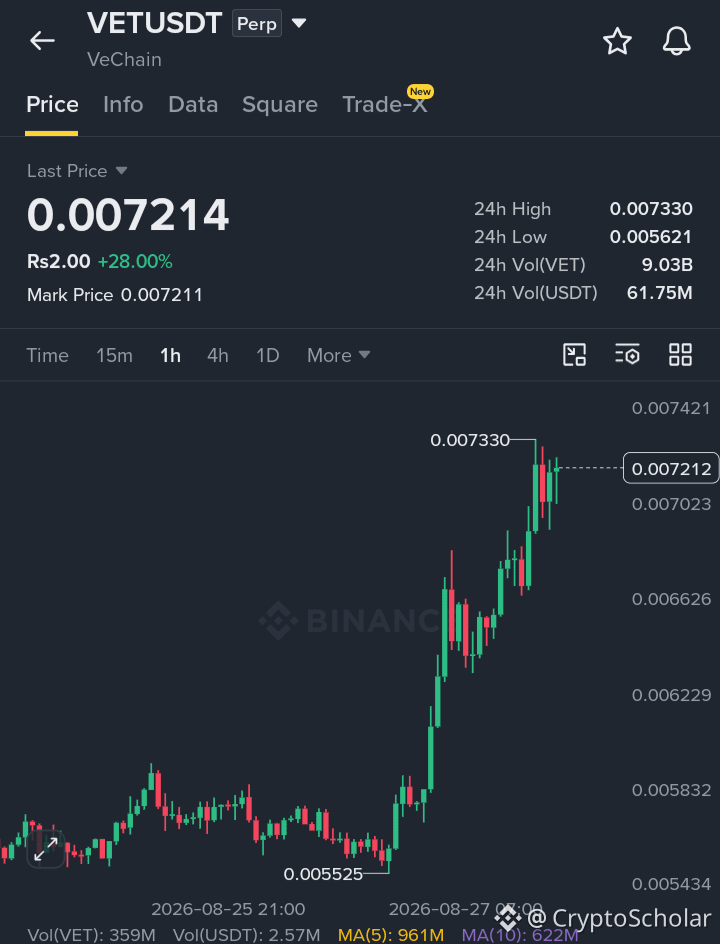
$VET is up more than 27% and buyers are still showing strength. I’m watching for price to hold around the entry zone before looking for another leg higher.
EP: 0.00705–0.00720
TP: 0.00755 / 0.00790 / 0.00835
SL: 0.00682
Simple setup: hold support, keep momentum, target the next resistance levels.
EP: 0.00705–0.00720
TP: 0.00755 / 0.00790 / 0.00835
SL: 0.00682
Simple setup: hold support, keep momentum, target the next resistance levels.
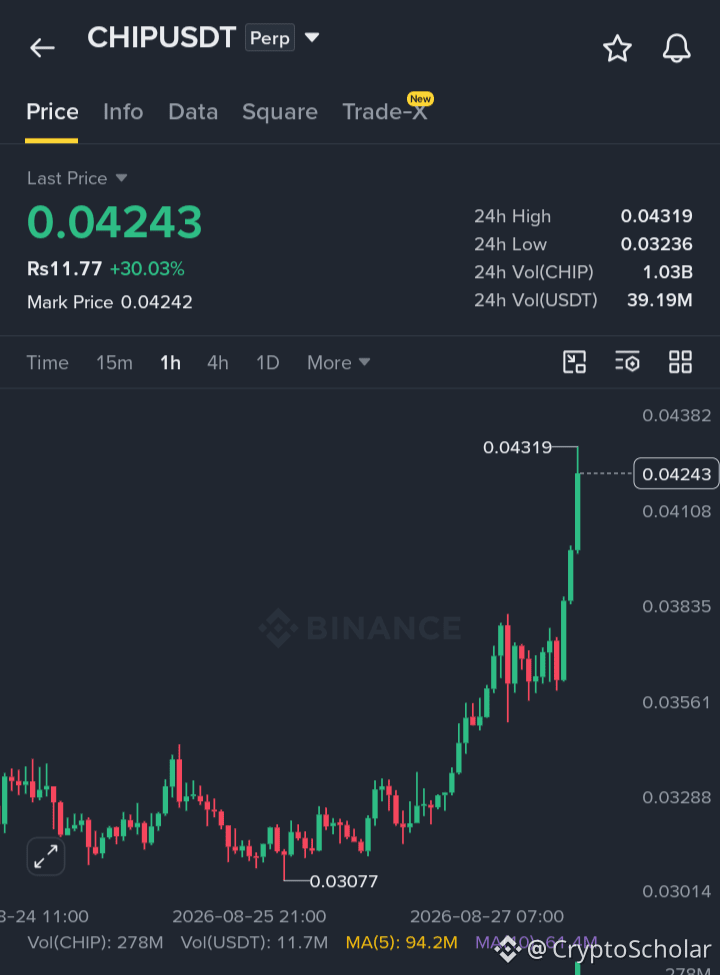
$CHIP is showing solid momentum after a 31% move. I’m not interested in chasing the candle. The better setup is a pullback that holds the current support zone.
EP: 0.04180–0.04280
TP: 0.04500 / 0.04800 / 0.05200
SL: 0.03980
As long as support holds, continuation remains the setup.
EP: 0.04180–0.04280
TP: 0.04500 / 0.04800 / 0.05200
SL: 0.03980
As long as support holds, continuation remains the setup.
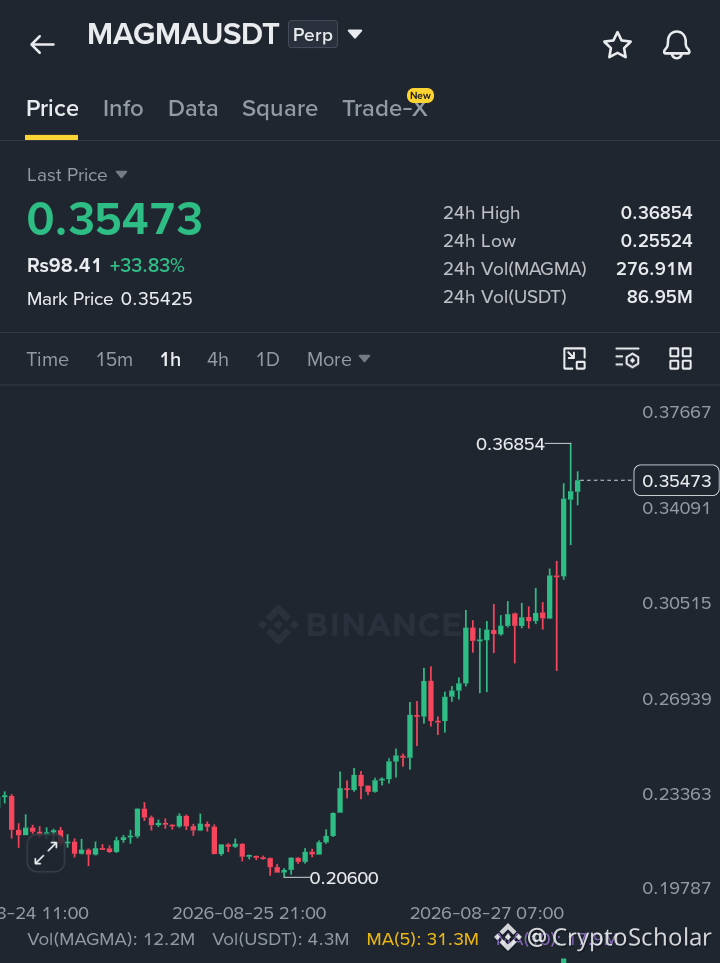
$MAGMA has been moving fast, up more than 34%. The trend still looks strong, and I’m watching the 0.3480–0.3560 area for a controlled entry instead of buying into the spike.
EP: 0.3480–0.3560
TP: 0.3720 / 0.3920 / 0.4150
SL: 0.3330
I’m looking for momentum to hold and buyers to stay in control.
EP: 0.3480–0.3560
TP: 0.3720 / 0.3920 / 0.4150
SL: 0.3330
I’m looking for momentum to hold and buyers to stay in control.
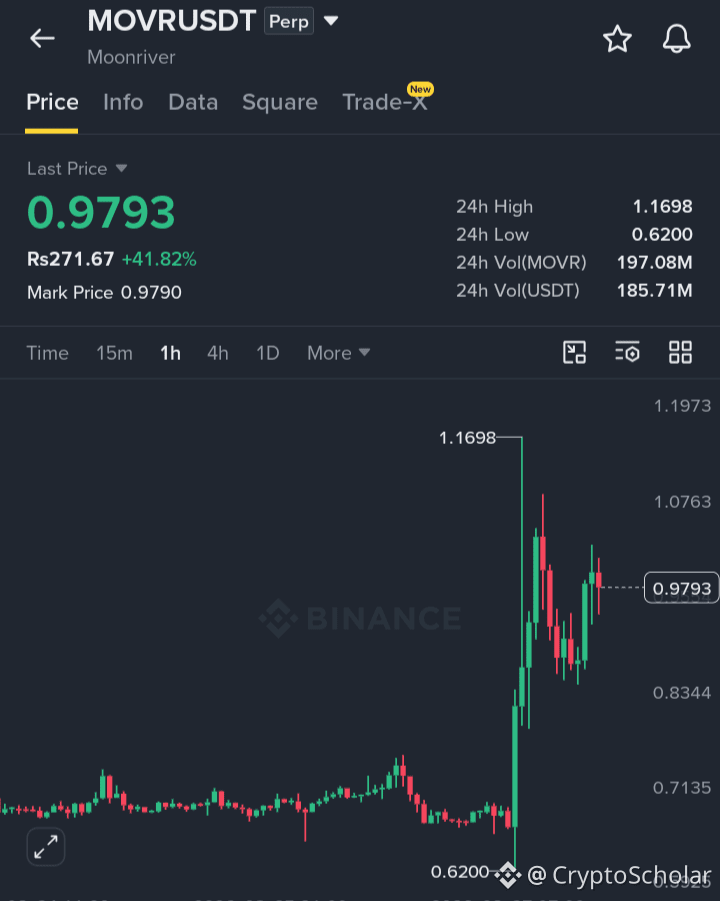
$MOVR is moving with serious momentum after a 42%+ push. Buyers are clearly active, but I’d rather enter near support than chase the move.
EP: 0.9680–0.9800
TP: 1.0200 / 1.0550 / 1.1000
SL: 0.9340
Clean setup, defined risk, and room for continuation.
EP: 0.9680–0.9800
TP: 1.0200 / 1.0550 / 1.1000
SL: 0.9340
Clean setup, defined risk, and room for continuation.
A lBIG 🎁🎁🎁🎁 Giveaway 🎁🎁🎁🎁 to show love to the community.
I’m picking a few winners and sending some rewards your way.
To enter:
• Follow me
• Like + repost
• Drop your favorite comment with yes below
Good luck. Keep building.
I’m picking a few winners and sending some rewards your way.
To enter:
• Follow me
• Like + repost
• Drop your favorite comment with yes below
Good luck. Keep building.
At first I assumed Dusk’s privacy model was mainly about keeping transaction details hidden. But the more I looked, the more I noticed a narrower design choice in Phoenix: the sender can be identified to the receiver. That sounds like a small distinction, but it changes the privacy boundary. The transaction does not become public, yet privacy is not treated as absolute anonymity either. Someone on the receiving side can have information that the rest of the network does not. What caught my attention is the dependency this creates. The system can keep financial activity shielded while still allowing a specific relationship to carry identifying information. That feels closer to how regulated finance already works, where confidentiality often depends on who is entitled to know something rather than nobody knowing it. The technical mechanism is private, but the trust boundary still exists between participants. So maybe the question isn't whether privacy can be preserved. It's who gets to define where that privacy ends?
#dusk $DUSK @Dusk
#dusk $DUSK @Dusk
At first, I thought Dusk’s privacy model was mainly about hiding transaction data.
Then I looked closer.
The harder problem is what happens when privacy meets regulators, issuers, or counterparties that still need proof.
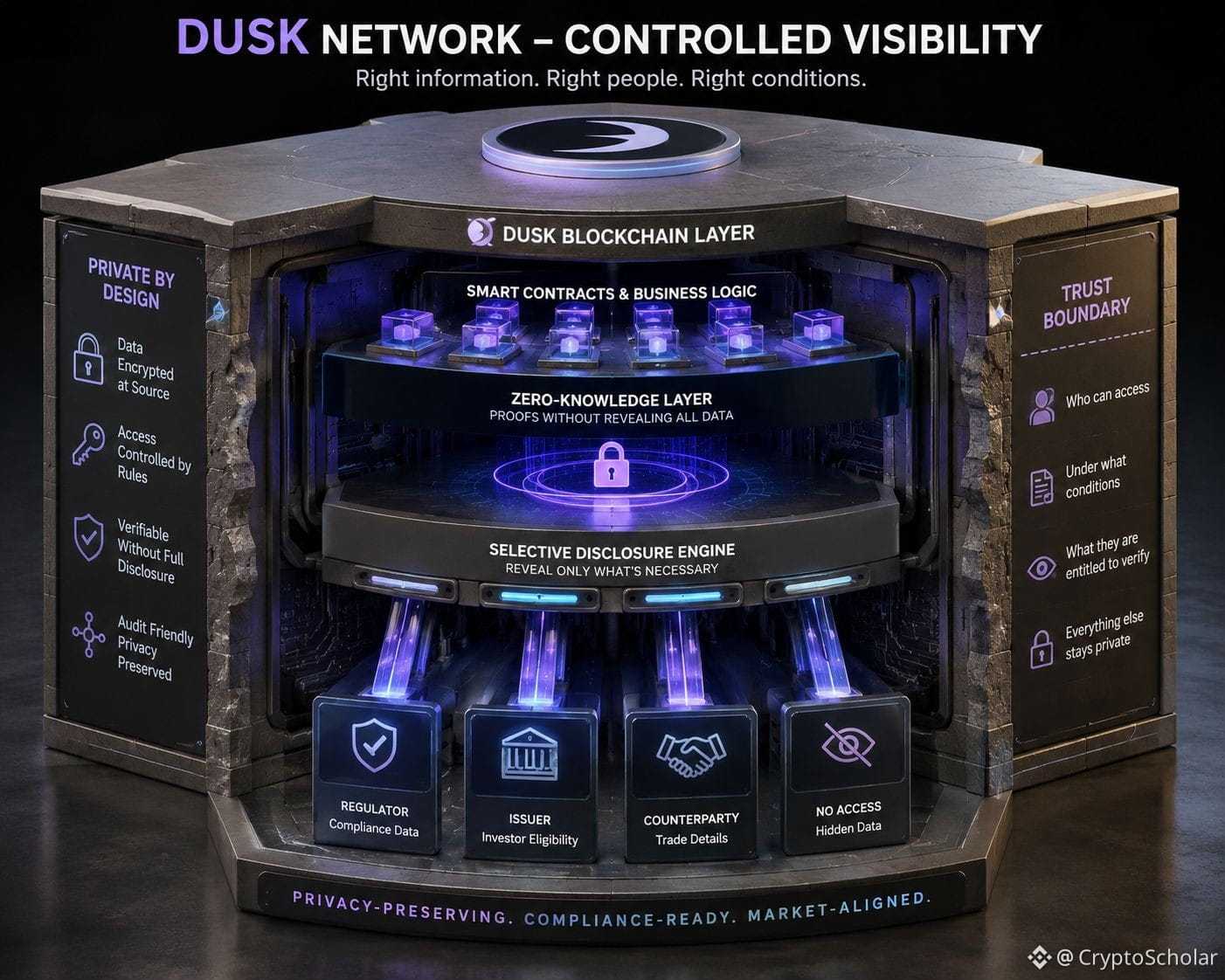
Dusk’s selective disclosure model is built around controlled visibility. Specific information can be revealed to the right party without exposing the entire transaction history.
That changes the way I think about privacy in financial markets.
The challenge is not only protecting data. It is deciding who can access it, under what conditions, and exactly what they are allowed to verify.
Financial markets rarely need absolute secrecy. They need precise visibility.
Dusk seems to be designing around that reality.
So the interesting question for me is not how much Dusk can hide.
It is how precisely Dusk can control who gets to see what.
#dusk $DUSK @Dusk
Then I looked closer.
The harder problem is what happens when privacy meets regulators, issuers, or counterparties that still need proof.
Dusk’s selective disclosure model is built around controlled visibility. Specific information can be revealed to the right party without exposing the entire transaction history.
That changes the way I think about privacy in financial markets.
The challenge is not only protecting data. It is deciding who can access it, under what conditions, and exactly what they are allowed to verify.
Financial markets rarely need absolute secrecy. They need precise visibility.
Dusk seems to be designing around that reality.
So the interesting question for me is not how much Dusk can hide.
It is how precisely Dusk can control who gets to see what.
#dusk $DUSK @Dusk
#dusk $DUSK @Dusk
One detail in Dusk’s consensus design kept bothering me more than I expected:
64 committee credits do not mean 64 equal voices.
Credits are assigned to provisioners, so the weight behind a decision can differ even when the participants look similar on paper.
That changes how I read the committee structure.
The limit keeps the group from becoming too large to coordinate, but influence is still uneven inside that group.
A provisioner can be present without having much practical weight, while another can carry more of the decision-making load through its credit allocation.
I can see why the design works this way.
Consensus needs a way to balance participation with efficiency.
Still, there is a quieter dependency underneath it.
The process that assigns those credits becomes part of the trust model, because it affects who gets heard when the committee reaches a decision.
So the question becomes less about how many validators are involved and more about how fairly influence is distributed?
What does the 64-credit committee actually tell us about validator influence?
One detail in Dusk’s consensus design kept bothering me more than I expected:
64 committee credits do not mean 64 equal voices.
Credits are assigned to provisioners, so the weight behind a decision can differ even when the participants look similar on paper.
That changes how I read the committee structure.
The limit keeps the group from becoming too large to coordinate, but influence is still uneven inside that group.
A provisioner can be present without having much practical weight, while another can carry more of the decision-making load through its credit allocation.
I can see why the design works this way.
Consensus needs a way to balance participation with efficiency.
Still, there is a quieter dependency underneath it.
The process that assigns those credits becomes part of the trust model, because it affects who gets heard when the committee reaches a decision.
So the question becomes less about how many validators are involved and more about how fairly influence is distributed?
What does the 64-credit committee actually tell us about validator influence?
Count ?
100%
Weight ?
0%
Speed ?
0%
Turnover ?
0%
1 Votes • Vote fermé
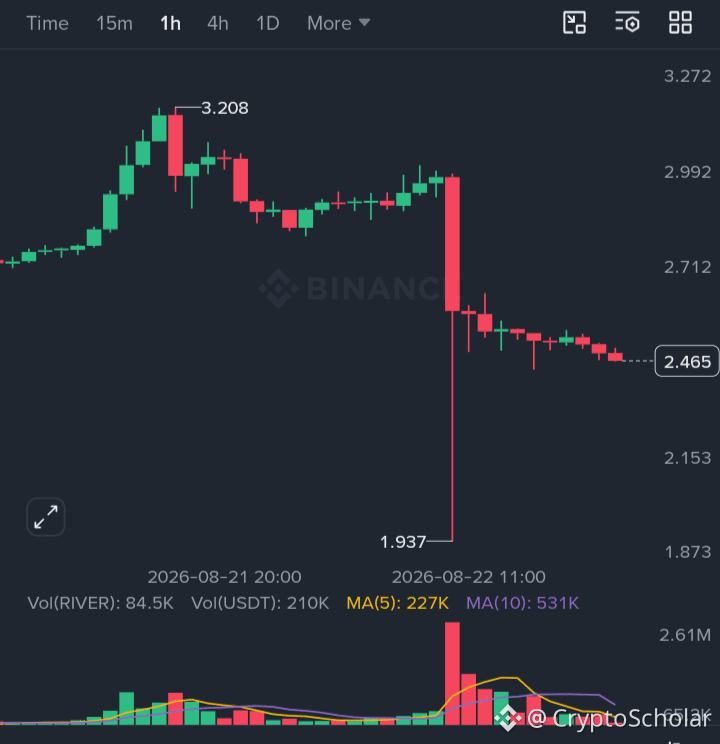
$RIVER
EP: 2.465–2.480
TP: 2.390 / 2.315 / 2.240
SL: 2.560
Selling pressure remains dominant after the 19% decline. Price structure favors further downside while it stays below the nearby resistance zone. Disciplined risk is essential.
EP: 2.465–2.480
TP: 2.390 / 2.315 / 2.240
SL: 2.560
Selling pressure remains dominant after the 19% decline. Price structure favors further downside while it stays below the nearby resistance zone. Disciplined risk is essential.
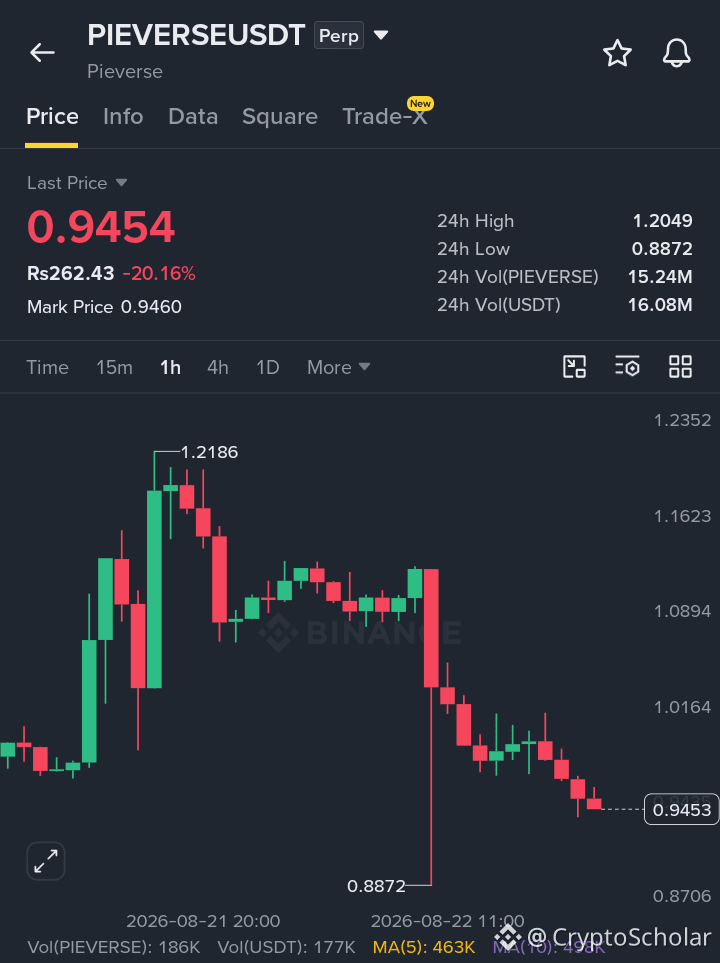
$PIEVERSE EP: 0.9470–0.9500
TP: 0.9150 / 0.8850 / 0.8500
SL: 0.9800
Heavy selling has pushed price toward fresh lows. Momentum remains negative, and a failed recovery near entry would strengthen the continuation setup toward lower supports.
TP: 0.9150 / 0.8850 / 0.8500
SL: 0.9800
Heavy selling has pushed price toward fresh lows. Momentum remains negative, and a failed recovery near entry would strengthen the continuation setup toward lower supports.
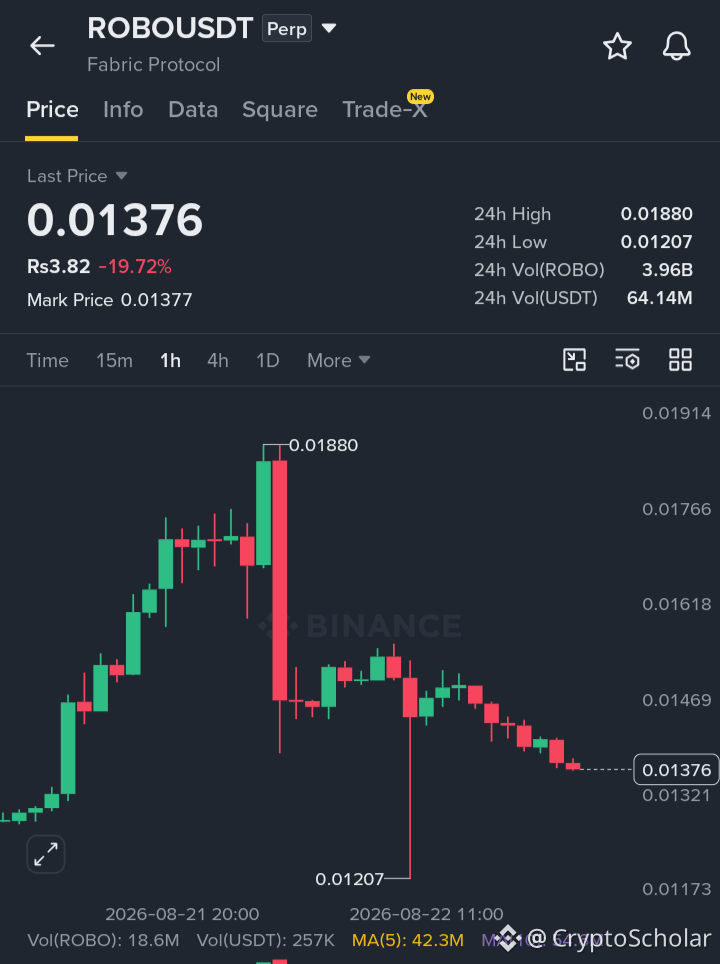
$ROBO
EP: 0.01378–0.01385
TP: 0.01330 / 0.01285 / 0.01240
SL: 0.01425
Bearish momentum is accelerating after the sharp decline. Price remains below key recovery levels, giving the setup a clean continuation bias with controlled invalidation.
EP: 0.01378–0.01385
TP: 0.01330 / 0.01285 / 0.01240
SL: 0.01425
Bearish momentum is accelerating after the sharp decline. Price remains below key recovery levels, giving the setup a clean continuation bias with controlled invalidation.
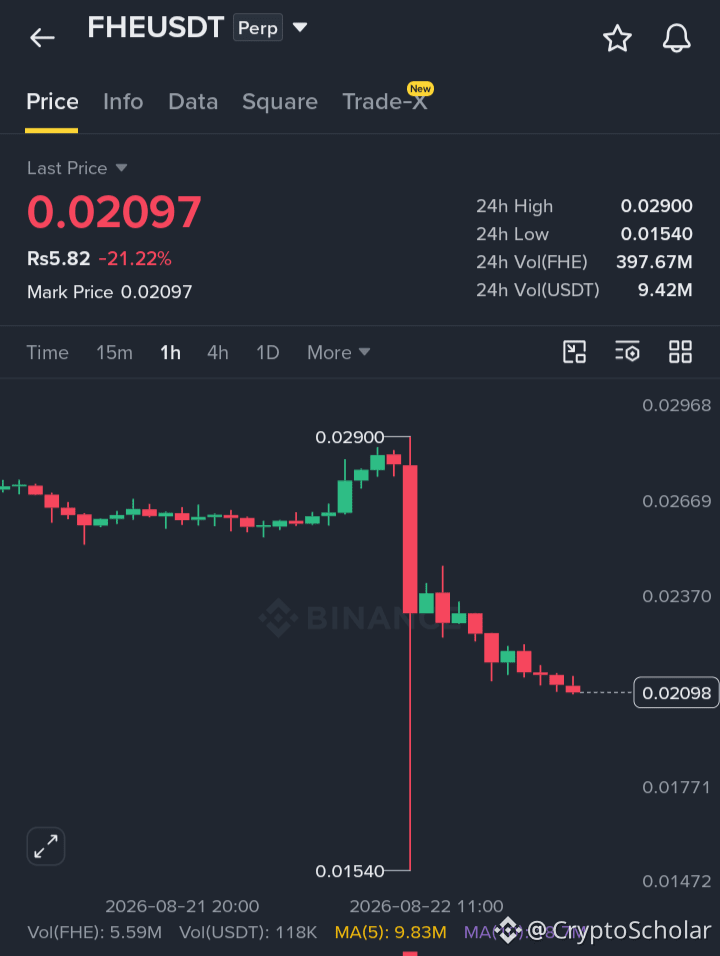
$FHE
EP: 0.02100–0.02110
TP: 0.02035 / 0.01970 / 0.01910
SL: 0.02165
Strong downside momentum keeps sellers in control. Price is trading near fresh lows with no clear reversal structure, favoring another leg lower if support fails.
EP: 0.02100–0.02110
TP: 0.02035 / 0.01970 / 0.01910
SL: 0.02165
Strong downside momentum keeps sellers in control. Price is trading near fresh lows with no clear reversal structure, favoring another leg lower if support fails.
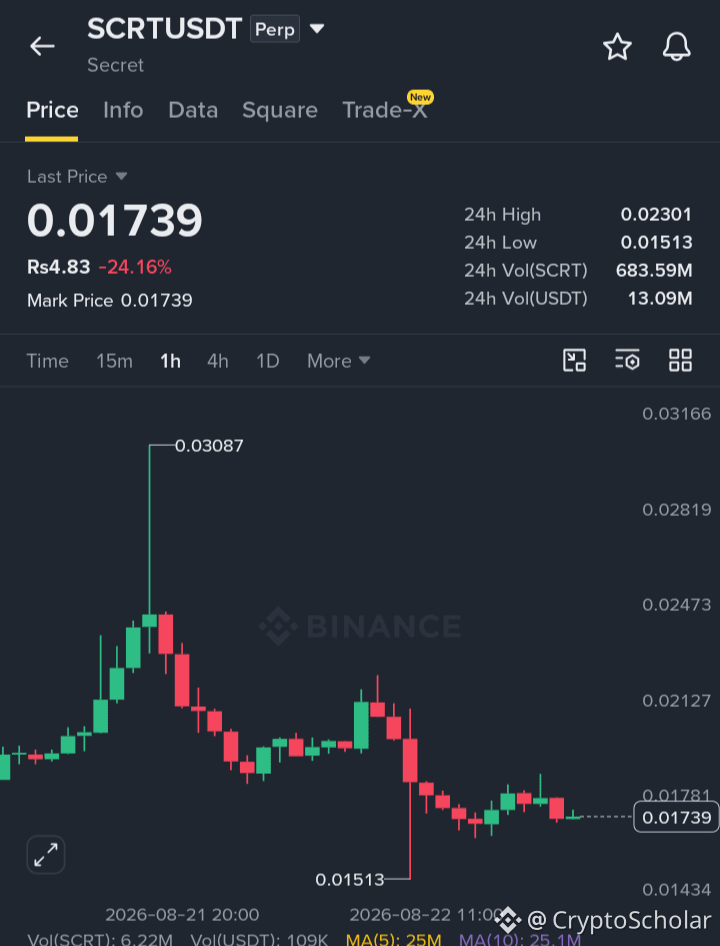
$SCRT SHORT SIGNAL
EP: 0.01735–0.01745
TP: 0.01680 / 0.01625 / 0.01570
SL: 0.01795
Momentum remains firmly bearish after a 24% drop. Weak price structure and sustained selling pressure favor continuation toward lower support zones. Risk remains tightly defined above resistance.
EP: 0.01735–0.01745
TP: 0.01680 / 0.01625 / 0.01570
SL: 0.01795
Momentum remains firmly bearish after a 24% drop. Weak price structure and sustained selling pressure favor continuation toward lower support zones. Risk remains tightly defined above resistance.
Connectez-vous pour découvrir plus de contenu